
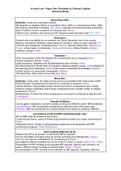
A-Level Law - Paper One: Principles of Criminal Liability
Summary Notes
Actus Reus (AR) -
Definition: Guilty act- prohibited conduct
AR depends on whether offence is a conduct crime- theft or a consequence crime- ABH
AR must be committed voluntarily- Hill v Baxter example of driving becoming involuntary
State of affairs crimes is exception to voluntary rule- Winzar
Failure to act- omission also amount to AR - failure to wear seat belt under RTA 1998
Omissions -
General rule is no liability for an omission- no ‘Good Samaritan’ law in this country
Statutory exceptions: Statutes create liability for omission- failure to wear seat belt RTA
Common law exceptions: Contractual duty- Pitwood, Special relationship- Gibbins and
Proctor, a Duty taken on Voluntarily- Stone and Dobinson, official Position- Dytham,
Creating a Danger- Miller
Causation -
Chain of causation: direct link between D’s act/omission and consequence to V
Factual Causation: But for- Pagett
Legal Causation: Operating and Substantial/more than minimal- Smith
No Intervening Acts: Break chain of causation- Medical palpably wrong- Jordan/Medical D
still operating and substantial- Smith/ Victim actions reasonably foreseeable- Roberts/
Victims actions not reasonably foreseeable- Williams
Thin Skull Rule: Take victims as he finds him- Blaue
Mens Rea -
Definition: Guilty mind- D’s state of mind at time of committing AR- three levels of MR
Direct Intention: Consequence of was the D’s main aim or purpose- Mohan
Indirect Intention: Reasonable person would have known consequence was virtually
certain to happen (objective) and D knew consequence was virtually certain to happen
(subjective)- Woollin
Recklessness: D knew risk of the consequence occurring but continued to take the risk-
Cunningham
Transferred Malice -
Can be guilty if intended to commit a similar crime but to different victim- MR transferred
Latimer/Mitchell: MR successfully transferred as offences were of the same type
Pembilton: MR not transferred as it cannot transfer from person to property- different
Coincidence of AR and MR (contemporaneity rule) -
AR and MR must be present at same time
Continuing act theory: series of linked acts/omissions treated as a single continuing act-
Fagan
Transaction theory: Series of acts/omissions treated as one transaction with MR
continuing throughout- Thabo Meli/Church
Strict Liability Offences (SLO) -
Require only AR to be proved, no element of MR is required
Can be committed voluntarily doing an act but not being truly blameworthy- Callow v
Tillstone- can also be committed by an involuntary act- Winzar
Due diligence offence available but not for all SLO’s which is unjust- Harrow LBC v Shah
Presumption of MR- wording of act indicates MR required, offence truly criminal in its
nature, offence carries a penalty of imprisonment- Sweet v Parsley
No presumption of MR- wording of Act indicates no MR required, regulatory offences
Summary Notes
Actus Reus (AR) -
Definition: Guilty act- prohibited conduct
AR depends on whether offence is a conduct crime- theft or a consequence crime- ABH
AR must be committed voluntarily- Hill v Baxter example of driving becoming involuntary
State of affairs crimes is exception to voluntary rule- Winzar
Failure to act- omission also amount to AR - failure to wear seat belt under RTA 1998
Omissions -
General rule is no liability for an omission- no ‘Good Samaritan’ law in this country
Statutory exceptions: Statutes create liability for omission- failure to wear seat belt RTA
Common law exceptions: Contractual duty- Pitwood, Special relationship- Gibbins and
Proctor, a Duty taken on Voluntarily- Stone and Dobinson, official Position- Dytham,
Creating a Danger- Miller
Causation -
Chain of causation: direct link between D’s act/omission and consequence to V
Factual Causation: But for- Pagett
Legal Causation: Operating and Substantial/more than minimal- Smith
No Intervening Acts: Break chain of causation- Medical palpably wrong- Jordan/Medical D
still operating and substantial- Smith/ Victim actions reasonably foreseeable- Roberts/
Victims actions not reasonably foreseeable- Williams
Thin Skull Rule: Take victims as he finds him- Blaue
Mens Rea -
Definition: Guilty mind- D’s state of mind at time of committing AR- three levels of MR
Direct Intention: Consequence of was the D’s main aim or purpose- Mohan
Indirect Intention: Reasonable person would have known consequence was virtually
certain to happen (objective) and D knew consequence was virtually certain to happen
(subjective)- Woollin
Recklessness: D knew risk of the consequence occurring but continued to take the risk-
Cunningham
Transferred Malice -
Can be guilty if intended to commit a similar crime but to different victim- MR transferred
Latimer/Mitchell: MR successfully transferred as offences were of the same type
Pembilton: MR not transferred as it cannot transfer from person to property- different
Coincidence of AR and MR (contemporaneity rule) -
AR and MR must be present at same time
Continuing act theory: series of linked acts/omissions treated as a single continuing act-
Fagan
Transaction theory: Series of acts/omissions treated as one transaction with MR
continuing throughout- Thabo Meli/Church
Strict Liability Offences (SLO) -
Require only AR to be proved, no element of MR is required
Can be committed voluntarily doing an act but not being truly blameworthy- Callow v
Tillstone- can also be committed by an involuntary act- Winzar
Due diligence offence available but not for all SLO’s which is unjust- Harrow LBC v Shah
Presumption of MR- wording of act indicates MR required, offence truly criminal in its
nature, offence carries a penalty of imprisonment- Sweet v Parsley
No presumption of MR- wording of Act indicates no MR required, regulatory offences


