100% satisfaction guarantee Immediately available after payment Both online and in PDF No strings attached 4.2 TrustPilot
logo-home
Exam (elaborations)

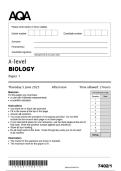
A-level ECONOMICS Paper 1 Markets and Market Failure

Rating
-
Sold
-
Pages
13
Grade
A+
Uploaded on
29-05-2022
Written in
2021/2022

A-level ECONOMICS Paper 1 Markets and Market Failure Monday 20 May 2019 Morning Time allowed: 2 hours Materials For this paper you must have: • an AQA 12-page answer book • a calculator. Instructions • Use black ink or black ball-point pen. Pencil should only be used for drawing. • Write the information required on the front cover of your answer book. The Paper Reference is 7136/1. • In Section A answer EITHER Context 1 OR Context 2. • In Section B, answer ONE essay. Information • The marks for questions are shown in brackets. • The maximum mark forthis paper is 80. • There are 40 marks for Section A and 40 marks for Section B. • You will be marked on your ability to: – use good English – organise information clearly – use specialist vocabulary where appropriate. Advice • You are advised to spend 1 hour on Section A and 1 hour on Section B. IB/M/Jun19/E11 7136/1 S - The Marketplace to Buy and Sell your Study Material 2 IB/M/Jun19/7136/1 Th reCs study sceeHwearos .c Section A Answer EITHER Context 1 OR Context 2. EITHER Context 1 Total for this context: 40 marks The market for sand Study Extracts A, B and C, and then answer all parts of Context 1 which follow. Extract A Figure 1: Indices of US producer prices for sand, Jan 2010–Jan 2018 (Jan 2010=100) Figure 2: Global demand for sand (millions of tons), 2010–2025 i shared via our om Source: Federal Reserve Economic Data, 2018 Source: The Freedonia Group/National Post, 2018 Extract B: Is the world running out of sand? Sand is in high demand. Sand accounts for up to 85% of all mining and the global depletion of sand is rapidly exceeding its natural renewal rate. Sand is mostly used in the construction industry to make concrete and asphalt. Chinese demand has risen significantly, reflecting the country's rapid pace of construction: it built 32.3 million houses and 4.5 million kilometres of road between 2011 and 2014. Sand also has industrial uses: it is used to make glass, 5 electronics, and to help extract oil in the fracking industry. While market demand for industrial sand has tracked overall economic growth in the USA, the demand for fracking sand has been as volatile as oil prices. Vast quantities of sand are dumped into the sea to reclaim land: Singapore, for example, has expanded its land area by over 20% since the 1960s. Much of this sand originates from 10 Indonesia, where sand miners have completely erased over 20 islands since 2005. The S - The Marketplace to Buy and Sell your Study Material 3 IB/M/Jun19/7136/1 Maldives and Kiribati have used sand to shore up their islands againstrising sea levels. The United Nations forecasts that, by 2030, there will be over 40 ‘megacities’, home to more than S - The Marketplace to Buy and Sell your Study Material 4 IB/M/Jun19/7136/1 This study resource was 10 million inhabitants (up from 31 in 2016), which means more housing and infrastructure will need to be built. Also, sea levels will continue to rise and so sand will only become more 15 sought after. But why is there a shortage when sand seems so abundant? Desert sand is too smooth, and so cannot be used for most commercial purposes. Australian sand was shipped to a faraway desert to build Dubai’s Burj Khalifa tower, made possible by cheaper transportation. Most countries have rules in place about where, and how much, sand can be mined. However, surging demand has sparked a lucrative illegal trade in many rapidly developing countries which 20 is damaging the environment, causing pollution and harming local biodiversity. Extract C: The need for international action Source: News reports, February 2018 There are currently no international conventions to regulate sand extraction, trade and use. Critics argue that the international community needs to treat sand like a resource on a par with clean air, biodiversity and other natural endowments that nations seek to manage for the future. In the developed world, concerns have led to restrictions on where sand can be mined. In the USA, for example, mining it offshore or near large residential areas is restricted. Regulations 5 are also in place in many developing countries. Indonesia, Malaysia and Cambodia have all placed restrictions on exports, although the rules are not always enforced. There is a particular problem of ineffective enforcement in India, with organised criminal networks ignoring rules and conducting unregulated sand mining. Substitutes for sand do exist. Mud can be used for land reclamation, straw and wood for 10 building houses, and crushed rock for making concrete. In some rich countries a shift towards these alternative production processes is already under way as sand prices rise. In the UK, sand demand is 25% less than in 2007, and 28% of building materials used in the UK in 2014 had been recycled. Rising prices will eventually also force builders in developing countries to explore alternatives to sand. But without better law enforcement, high sand prices also make 15 illegal mining more profitable. Source: News reports, February 2018 Using the data in Extract A (Figure 1), calculate the percentage change in the price of construction sand between January 2014 and January 2018. Give your answer correct to one decimal place. [2 marks] Explain how the data in Extract A (Figures 1 and 2) show that expansion in the global sand market is leading to prices of construction sand rising in real terms. [4 marks] Extract B (line 18) states that the global trade in sand has been ‘made possible by cheaper transportation’. With the help of a diagram, explain how cheaper transportation and a construction boom in East Asia have led to growth in the market for sand. [9 marks] 0 3 0 2 0 1 S - The Marketplace to Buy and Sell your Study Material 5 IB/M/Jun19/7136/1 Extract C (lines 14–15) states that ‘Rising prices will eventually also force builders in developing countries to explore alternatives to sand.’ Use the extracts and your knowledge of economics to assess the view that the increasing scarcity of sand is a problem best solved by market forces, rather than through government intervention. [25 marks] This study source was downloaded by from CourseH :55:29GMT-05:00 Turn over ► 0 4 S - The Marketplace to Buy and Sell your Study Material 6 IB/M/Jun19/7136/1 Source: Office of Rail and Road, svishas2017 tudredy uurr sceeHwearos . a wider choice of services’, proclaimed vocated the privatisation of British Rail. Do NOT answer Context 2 if you have answered Context 1. OR Context 2 Total for this context: 40 marks The British railway system Study Extracts D, E and F and then answer all parts of Context 2 which follow. Extract D Figure 3: UK (excluding NorthernIreland) rail industry income, 2010–2016 Figure 4: Indices of UK rail ticket prices and passenger kilometres, 2004–2017 (2004=100) Thi Feb a reso com Passenger income as % of total 44% 48% Extract E: Privatisation of British Rail ‘More competition, greater efficiency and the 1992 Government white paper that ad Two decades on, passenger journeys have more than doubled from 735 million in 1994–5, to 1.7bn in 2016–17. But how much of this is due to the benefits of privatisation, rather than factors such as increasing urban congestion and a rising population? The UK’s trains and tracks are more 5 intensively used than in any other European market except the Netherlands. Investment is up, at around four times (in real terms) the £1.6bn a year it averaged in the late 1980s. The data on service quality are mixed. The UK performs well in terms of punctuality and reliability, but many journeys are uncomfortable. At peak hours 23% of London commuters have to stand. Instead of pushing British Rail into the private sector as a natural monopoly, the Government 10 split it up and sold it in no less than 100 pieces between 1995 and 1997. Privatisation was supposed to unleash efficiencies that would justify the returns private operators demand for their services. However, a recent study shows that the cost of running the UK’s railways is 40% higher than in the rest of Europe. “The train you catch is owned by a bank, leased to a private company, which has a franchise from the Department for Transport to run it on track owned by 15 This study source was downloaded by from CourseH :55:29GMT-05:00 £ millions 2010–11 2015–16 Passenge r income Governme nt funding Network Rail income 2 565 2 C 300 Other income 793 833 Total S - The Marketplace to Buy and Sell your Study Material 7 IB/M/Jun19/7136/1 This study resource was Network Rail, all regulated by another office, and paid for by taxpayers or passengers,” says Prof John Stittle. Since 1996, government subsidies have almost doubled in realterms. Ticket prices are now 25% higher in real terms than in 1995 and 30% higher than in France, Sweden and Switzerland. Extract F: A return to Government ownership? Source: News reports, February 2018 In May 2018, the Government allowed Virgin and Stagecoach to end their East Coast mainline franchise three years early, after claims they had lost more than £100 million. This has led to accusations that private companies can just walk away whenever profits dry up. When their predecessor, National Express, gave up the East Coast line franchise in 2009, it was renationalised. During the following five years under state control, it increased ticket sales, 5 returned about £1bn to the taxpayer and improved customer satisfaction. Encouraged by this success, the Labour Party has proposed rail renationalisation of the entire UK network. Recent polls suggest almost 75% of the UK population agree, although opponents contend that most of the British public really don't care about who runs the trains; what they care about is reliability, comfort and price. 10 Part of the appeal of rail renationalisation comes from the low up-front costs: by taking over operations as franchises expire, the Government would avoid having to spend billions in buying out private companies. The Labour Party’s plan involves reversing the splitting up of the service so that customers receive a simplified ticketing system with improved efficiency, although this may impact on dynamic efficiency and innovation. 15 Opponents of nationalisation argue that the train operating companies are efficient and not making excessive profits. “Profits are about 3.4% across the industry”, says Mark Smith, a former government regulator. “So if you eliminated all profits overnight you would get a one-off 3.4% cut in fares, which isn’t going to set the world on fire.” Source: News reports, May 2018 Using the data in Extract D (Figure 3), calculate the amount of government funding per £ of passenger income in the UK rail industry for the year 2015–16. Give your answer correct to the nearest penny. [2 marks] Explain how the data in Extract D (Figure 4) show that in the UK, between 2004 and 2017, changes in the demand for rail travel contributed to changes in the price of rail travel. [4 marks] Extract E (lines 10–11) describes the British railway sector as a ‘natural monopoly’, which was split up into ‘no less than 100 pieces’ when it was privatised. With the help of a diagram, explain why breaking up a natural monopoly in rail may affect long-run average costs. [9 marks] Extract F (lines 9–10) suggests that ‘the British public really don't care about who runs the trains; what they care about is reliability, comfort and 0 8 0 7 0 6 0 5 S - The Marketplace to Buy and Sell your Study Material 8 IB/M/Jun19/7136/1 price.’ Use the extracts and your knowledge of economics to evaluate the case for renationalising railways in the UK. [25 marks] This study source was downloaded by from CourseH :55:29GMT-05:00 Turn over ► shared via CourseH S - The Marketplace to Buy and Sell your Study Material 9 This study source was downloaded by fromCourseH :55:29GMT-05:00 IB/M/Jun19/7136/1 CourseHsource was Explain how rules of thumb and irrationality can affect consumers’ demand for goods and services. Section B Answer one essay from this section. Each essay carries 40 marks. EITHER Essay 1 For a long time, supermarkets and other commercial firms have understood the benefits of behavioural economic concepts such as choice architecture and framing. The public sector has been slow off the mark, but at last governments are now taking advantage of the opportunities provided by nudging. Thishsatureddy via [15 marks] Using examples to illustrate your answer, assess the usefulness of behavioural economic theory compared to traditional economic policies in helping governments to correct market failures [25 marks] OR Essay 2 Several loss-making retailers including Homebase, House of Fraser and Poundworld have had to decide whether to shut down operations or carry on while making losses. In contrast, the music- streaming firm Spotify was valued at $27 billion in 2018, despite never having made a profit in any year since it was founded. Spotify has been more focused on expanding market share. Explain the factors a profit-maximising firm will take into account when deciding whether to shut down or to carry on operating, both in the short run and in the long run. [15 marks] Discuss the validity of the traditional economic assumption that the main objective of firms is to maximise profits. [25 marks] 1 2 1 1 1 0 0 9 S - The Marketplace to Buy and Sell your Study Material 1 This study source was downloaded by fromCourseH :55:29GMT-05:00 IB/M/Jun19/7136/1 shared OR Essay 3 ‘Each time the Government imposes a minimum price or wage, the result is almost always excess supply. What matters is the extent to which this is a problem.’ Explain how the impact of a minimum price for a good or service is affected by its price elasticity of demand and its price elasticity of supply. [15 marks] Discuss the view that a national minimum wage is beneficial for an economy. [25 marks] END OF QUESTIONS Thi study via reCsoursceH 1 4 1 3 S - The Marketplace to Buy and Sell your Study Material 1 IB/M/Jun19/7136/1 There are no questions printed on this page Thishsatureddy via reCsoursceH Copyright information For confidentialit y purposes, from the November 2015 examination series, acknowledg em ents of third -party copyright material are published in a separate booklet rather than including them on the examination paper or support materials. This booklet is pub lished after each examination series and is available for free download from .uk after the live examination series. Permission to reproduce all copyright material has been applied for. In some cases, efforts to contact copyright -holders may have been unsuccessful and AQA will be happy to rectify any omissions of acknowledg em ent s. If you have any queries please contact the Copyright Team, AQA, Stag Hill House, Guildford, GU2 7XJ. Copyrig ht © 2019 AQA and its licensors. All rights reserved. 05:55:29 GM T - 05:0 0 This study source was downloaded by from CourseH on * 1 9 6 S - The Marketplace to Buy and Sell your Study Material 1 IB/M/Jun19/7136/1 A7136/1*

Show more Read less


Whoops! We can’t load your doc right now. Try again or contact support.

Document information

Uploaded on
May 29, 2022
Number of pages
13
Written in
2021/2022
Type
Exam (elaborations)
Contains
Questions & answers

Subjects

Content preview

A-level
ECONOMICS
Paper 1 Markets and Market Failure

Monday 20 May 2019 Morning Time allowed: 2 hours
Materials
For this paper you must have:
• an AQA 12-page answer book
• a calculator.

Instructions
• Use black ink or black ball-point pen. Pencil should only be used for drawing.
• Write the information required on the front cover of your
answer book. The Paper Reference is 7136/1.
• In Section A answer EITHER Context 1 OR Context 2.
• In Section B, answer ONE essay.

Information
• The marks for questions are shown in brackets.
• The maximum mark for this paper is 80.
• There are 40 marks for Section A and 40 marks for Section B.
• You will be marked on your ability to:
– use good English
– organise information clearly
– use specialist vocabulary where appropriate.


Advice
• You are advised to spend 1 hour on Section A and 1 hour on Section B.


https://www.coursehero.com/file/82181410/P1-2019-pdf/ Distribution of this document is illegal

, IB/M/Jun19/E11 7136/1


https://www.coursehero.com/file/82181410/P1-2019-pdf/ Distribution of this document is illegal

£8.85
Get access to the full document:

100% satisfaction guarantee
Immediately available after payment
Both online and in PDF
No strings attached

Get to know the seller
Seller avatar
ScottStevens
5.0
(1)

Get to know the seller

Seller avatar
ScottStevens Teachme2-tutor
View profile
Follow You need to be logged in order to follow users or courses
Sold
5
Member since
3 year
Number of followers
5
Documents
51
Last sold
1 year ago

5.0

1 reviews

5
1
4
0
3
0
2
0
1
0

Recently viewed by you

Why students choose Stuvia

Created by fellow students, verified by reviews

Quality you can trust: written by students who passed their exams and reviewed by others who've used these revision notes.

Didn't get what you expected? Choose another document

No problem! You can straightaway pick a different document that better suits what you're after.

Pay as you like, start learning straight away

No subscription, no commitments. Pay the way you're used to via credit card and download your PDF document instantly.

Student with book image

“Bought, downloaded, and smashed it. It really can be that simple.”

Alisha Student

Frequently asked questions