WEEK 1
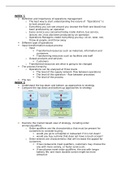
Definition and importance of operations management
o The best way to start understanding the nature of “Operations” is
to look around you
o Everything you can see around you (except the flesh and blood) has
been produced by an operation
o Every service you consumed today (radio station, bus service,
lecture, etc.) has also been produced by an operation
o Operations Managers create everything you buy, sit on, wear, eat,
throw at people, and throw away
Different type of operations
Input-transformation-output process
o Input
Transformed resources such as materials, information and
customers
Transforming resources such as facilities and staff
o Output products and services
Customers
o Transformed resources are what is going to be changed
The process hierarchy
o Operations can be analysed at three levels
The level of the supply network -flow between operations
The level of the operation – flow between processes
The level of the process
The 4vs
WEEK 2
Understand the top-down and bottom up approaches to strategy
Compare the top-down and bottom-up approaches to strategy
Examine the market based view of strategy, including order
winners/qualifiers
o Order qualifiers are the characteristics that must be present for
customers to consider buying.
would you go to a hospital or restaurant if it is not clean?
would you buy a phone that does not have a touch-screen?
o Order winners are characteristics that will increase the appeal for
customers.
if two restaurants meet qualifiers, customers may choose the
one with more variety, or faster service etc.
if two phones meet order qualifiers, the one with longer
battery life, and more durable screen might be more
attractive
, o If order qualifiers are not present, customers will not even consider,
but more of these will not encourage them to buy
(e.g. 1 is better than 0, but adding more may not help)
o The more of an order winner there is, the more attractive
(e.g. 24hrs battery is better than 12hrs, 48hrs is even better
than 24!)
o Other factors may be less important
o BEWARE – over time, order winners can become qualifiers or less
important factors as standards change!
Examine the resources based view and consider how operations resources
can drive strategy
o The operations-resource perspective sees a company as a bundle of
resources (e.g. people, technology, brands).
o This relates to the transformation model – managing the
transforming resources to create value for customers
o Competitiveness comes from developing resources that are:
Valuable
Rare
In-imitable
Non-substitutable
o Operations management can be strategic
Ops Mgmt is about controlling day-to-day operations,
Ops Strategy is about planning, resources and long term
decisions.
(Excellent) operations can be a source of competitiveness
and drive the business strategy.
o Operations Strategy can be developed in two ways
top-down (managers develop vision and pass down to lower
levels to define implementation) or
bottom-up (operations personnel use experience to identify
opportunities that inform managers) approaches.
The skills of people in the operations and the processes can
accumulate experience and learning that helps the business.
o Operations Strategy can be based on market or resource
perspectives
We can first understand what customers want (e.g. order
qualifiers and order winners) and ensure the appropriate
resources.
Or we can first look at what resources are available (e.g.
unused capacity) and come up with ways we can address
unmet market needs.
o Alignment is key – resources must fit with markets, but no-one can
do everything
key performance objectives include cost, quality, speed,
dependability, flexibility
WEEK 3
Three triple bottom line
o What is crucial to do is to first introduce what we mean by the triple
bottom line.
o J Elkington introduced the concept that organisation could not just
measure themselves on economic profit they generate for their
owners, but also the impact their operations have on Society,
(people) and the ecological impact (planet).
, o Therefore, I the context of this course we need to consider how the
design of an operation and the on-going delivery of that operation
can impact TBL performance.
o Planet – The environmental account, measured by environmental
impact of the operation
Recyclability of materials, energy consumption, waste
material generation
Reducing transport-related energy
Noise pollution, fume and emission pollution
Obsolescence and wastage
Environmental impact of process failures
Recovery to minimize impact of failures
o People – The social account, measured by the impact of the
operation on the quality of people’s lives
Customer safety from products and services
Employment impact of an operation’s location
Employment implications of outsourcing
Repetitive or alienating work
Staff safety and workplace stress
Non-exploitation of developing country suppliers
o Profit – The economic account, measured by profitability, return on
assets, etc of the operation.
Cost of producing products and services
Revenue from the effects of quality, speed, dependability,
and flexibility
Effectiveness of investment in operations resources
Risk and resilience of supply
Building capabilities for the future
Why is operations performance importance important?
o So focusing on being excellent operationally has a number of real
implications to the economic bottom line.
o Process efficiency=lower costs
o Reduced errors, better resilience=lower ‘operational’ risk
o Higher capacity utilisation=lower capital requirements
o Enhanced service=secure revenue
o Opportunities for process=capabilities for future innovation
The five performance objective
o Quality=error free processes & error free products and services
o Speed=fast throughput & quick delivery
o Dependability=reliable operation & dependable delivery
o Flexibility= ability to change & frequent new products, maximum
choice
o Cost = minimum cost, maximum value & minimum price, highest
value
Polar diagrams
o Polar diagrams are used to indicate the relative importance of each
performance objective to an operation or process
o They can also be used to indicate the difference between different
products and services produced by an operation or process
Trade-offs between performance objectives
o “We must have high quality”
o “We must be as fast as possible in responding”
o “We must be totally dependable”
Definition and importance of operations management
o The best way to start understanding the nature of “Operations” is
to look around you
o Everything you can see around you (except the flesh and blood) has
been produced by an operation
o Every service you consumed today (radio station, bus service,
lecture, etc.) has also been produced by an operation
o Operations Managers create everything you buy, sit on, wear, eat,
throw at people, and throw away
Different type of operations
Input-transformation-output process
o Input
Transformed resources such as materials, information and
customers
Transforming resources such as facilities and staff
o Output products and services
Customers
o Transformed resources are what is going to be changed
The process hierarchy
o Operations can be analysed at three levels
The level of the supply network -flow between operations
The level of the operation – flow between processes
The level of the process
The 4vs
WEEK 2
Understand the top-down and bottom up approaches to strategy
Compare the top-down and bottom-up approaches to strategy
Examine the market based view of strategy, including order
winners/qualifiers
o Order qualifiers are the characteristics that must be present for
customers to consider buying.
would you go to a hospital or restaurant if it is not clean?
would you buy a phone that does not have a touch-screen?
o Order winners are characteristics that will increase the appeal for
customers.
if two restaurants meet qualifiers, customers may choose the
one with more variety, or faster service etc.
if two phones meet order qualifiers, the one with longer
battery life, and more durable screen might be more
attractive
, o If order qualifiers are not present, customers will not even consider,
but more of these will not encourage them to buy
(e.g. 1 is better than 0, but adding more may not help)
o The more of an order winner there is, the more attractive
(e.g. 24hrs battery is better than 12hrs, 48hrs is even better
than 24!)
o Other factors may be less important
o BEWARE – over time, order winners can become qualifiers or less
important factors as standards change!
Examine the resources based view and consider how operations resources
can drive strategy
o The operations-resource perspective sees a company as a bundle of
resources (e.g. people, technology, brands).
o This relates to the transformation model – managing the
transforming resources to create value for customers
o Competitiveness comes from developing resources that are:
Valuable
Rare
In-imitable
Non-substitutable
o Operations management can be strategic
Ops Mgmt is about controlling day-to-day operations,
Ops Strategy is about planning, resources and long term
decisions.
(Excellent) operations can be a source of competitiveness
and drive the business strategy.
o Operations Strategy can be developed in two ways
top-down (managers develop vision and pass down to lower
levels to define implementation) or
bottom-up (operations personnel use experience to identify
opportunities that inform managers) approaches.
The skills of people in the operations and the processes can
accumulate experience and learning that helps the business.
o Operations Strategy can be based on market or resource
perspectives
We can first understand what customers want (e.g. order
qualifiers and order winners) and ensure the appropriate
resources.
Or we can first look at what resources are available (e.g.
unused capacity) and come up with ways we can address
unmet market needs.
o Alignment is key – resources must fit with markets, but no-one can
do everything
key performance objectives include cost, quality, speed,
dependability, flexibility
WEEK 3
Three triple bottom line
o What is crucial to do is to first introduce what we mean by the triple
bottom line.
o J Elkington introduced the concept that organisation could not just
measure themselves on economic profit they generate for their
owners, but also the impact their operations have on Society,
(people) and the ecological impact (planet).
, o Therefore, I the context of this course we need to consider how the
design of an operation and the on-going delivery of that operation
can impact TBL performance.
o Planet – The environmental account, measured by environmental
impact of the operation
Recyclability of materials, energy consumption, waste
material generation
Reducing transport-related energy
Noise pollution, fume and emission pollution
Obsolescence and wastage
Environmental impact of process failures
Recovery to minimize impact of failures
o People – The social account, measured by the impact of the
operation on the quality of people’s lives
Customer safety from products and services
Employment impact of an operation’s location
Employment implications of outsourcing
Repetitive or alienating work
Staff safety and workplace stress
Non-exploitation of developing country suppliers
o Profit – The economic account, measured by profitability, return on
assets, etc of the operation.
Cost of producing products and services
Revenue from the effects of quality, speed, dependability,
and flexibility
Effectiveness of investment in operations resources
Risk and resilience of supply
Building capabilities for the future
Why is operations performance importance important?
o So focusing on being excellent operationally has a number of real
implications to the economic bottom line.
o Process efficiency=lower costs
o Reduced errors, better resilience=lower ‘operational’ risk
o Higher capacity utilisation=lower capital requirements
o Enhanced service=secure revenue
o Opportunities for process=capabilities for future innovation
The five performance objective
o Quality=error free processes & error free products and services
o Speed=fast throughput & quick delivery
o Dependability=reliable operation & dependable delivery
o Flexibility= ability to change & frequent new products, maximum
choice
o Cost = minimum cost, maximum value & minimum price, highest
value
Polar diagrams
o Polar diagrams are used to indicate the relative importance of each
performance objective to an operation or process
o They can also be used to indicate the difference between different
products and services produced by an operation or process
Trade-offs between performance objectives
o “We must have high quality”
o “We must be as fast as possible in responding”
o “We must be totally dependable”