

Photosynthesis : Overview
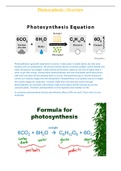
Photosynthesis is generally respiration in reverse. It takes place in mostly plants, but also some
bacteria such as cyanobacteria. The process involves plants converting sunlight, carbon dioxide and
water into glucose and oxygen. Unlike animals and humans, plants do not have to digest food in
order to get their energy. Instead plants photosynthesise and react chemically which leaves them
with their own type of food, allowing them to survive. Photosynthesis also is vital for humans to
survive as it releases oxygen into the atmosphere. Photosynthesis is our primary source of oxygen.
We require oxygen for respiration. As plants make their own food and survive through
photosynthesis, we eat plants and products made by the plants and the animals we eat also
consume plants. Therefore, photosynthesis is very important and essential for life.
In conclusion photosynthesis directly and indirectly affects all life on earth. That is why it is very
important.
, Chloroplasts
Photosynthesis is carried out by chloroplasts, which are double-membraned organelles. They're
present in the cells of plants. They move about within the cell, allowing them to align themselves in
the most advantageous position for light absorption. When exposed to reduced light levels, the
chloroplasts align in a sheet light pattern to maximize light exposure. They will arrange themselves
to limit light exposure inside the cell if there is too much light. Photooxidative damage is the result of
too much light exposure.
The form of chloroplasts varies depending on the organism in which they are present. The cup-
shaped chloroplast found in chlamydomonas, the ribbon or spiral-shaped chloroplast found in
spirogyra, and the star-shaped chloroplast found in zygnema are just a few examples of the many
chloroplast forms encountered. They may also be oval or lens-shaped, which is the most common
form in higher plants.
Chloroplasts have two membranes: an outer and an inner membrane, as well as an intermembrane
gap between them. Small molecules can pass through the outer membrane, but the inner
membrane is less permeable, and most molecules need embedded transport proteins to traverse it.
, Chloroplasts
The stroma is an aqueous fluid that exists inside the inner membrane. Ribosomes and chloroplast
DNA may be found in the stroma. The Calvin cycle, the second phase in photosynthesis that creates
glucose, takes place in this stroma. The thylakoid system is suspended in the stroma. Thylakoids are
membranous sacks that make up this system. They're found in grana, which are stacks of them
(singular granum). Lamellae join the grana together. The lumen is the space within the thylakoid.
Chlorophyll pigments are located in the thylakoids' membranes and are responsible for the
chloroplast's green colour. A photosynthetic electron transport chain and ATP synthase are also
found in the thylakoid membrane, which is where the light-dependent activities of photosynthesis
take place.
The chloroplast's primary role is to aid in photosynthesis. The light-dependent reaction, which
happens in the thylakoid membranes, and the light-independent reaction, which occurs in the
stroma of the chloroplast, are the two processes of photosynthesis
Photosynthesis is generally respiration in reverse. It takes place in mostly plants, but also some
bacteria such as cyanobacteria. The process involves plants converting sunlight, carbon dioxide and
water into glucose and oxygen. Unlike animals and humans, plants do not have to digest food in
order to get their energy. Instead plants photosynthesise and react chemically which leaves them
with their own type of food, allowing them to survive. Photosynthesis also is vital for humans to
survive as it releases oxygen into the atmosphere. Photosynthesis is our primary source of oxygen.
We require oxygen for respiration. As plants make their own food and survive through
photosynthesis, we eat plants and products made by the plants and the animals we eat also
consume plants. Therefore, photosynthesis is very important and essential for life.
In conclusion photosynthesis directly and indirectly affects all life on earth. That is why it is very
important.
, Chloroplasts
Photosynthesis is carried out by chloroplasts, which are double-membraned organelles. They're
present in the cells of plants. They move about within the cell, allowing them to align themselves in
the most advantageous position for light absorption. When exposed to reduced light levels, the
chloroplasts align in a sheet light pattern to maximize light exposure. They will arrange themselves
to limit light exposure inside the cell if there is too much light. Photooxidative damage is the result of
too much light exposure.
The form of chloroplasts varies depending on the organism in which they are present. The cup-
shaped chloroplast found in chlamydomonas, the ribbon or spiral-shaped chloroplast found in
spirogyra, and the star-shaped chloroplast found in zygnema are just a few examples of the many
chloroplast forms encountered. They may also be oval or lens-shaped, which is the most common
form in higher plants.
Chloroplasts have two membranes: an outer and an inner membrane, as well as an intermembrane
gap between them. Small molecules can pass through the outer membrane, but the inner
membrane is less permeable, and most molecules need embedded transport proteins to traverse it.
, Chloroplasts
The stroma is an aqueous fluid that exists inside the inner membrane. Ribosomes and chloroplast
DNA may be found in the stroma. The Calvin cycle, the second phase in photosynthesis that creates
glucose, takes place in this stroma. The thylakoid system is suspended in the stroma. Thylakoids are
membranous sacks that make up this system. They're found in grana, which are stacks of them
(singular granum). Lamellae join the grana together. The lumen is the space within the thylakoid.
Chlorophyll pigments are located in the thylakoids' membranes and are responsible for the
chloroplast's green colour. A photosynthetic electron transport chain and ATP synthase are also
found in the thylakoid membrane, which is where the light-dependent activities of photosynthesis
take place.
The chloroplast's primary role is to aid in photosynthesis. The light-dependent reaction, which
happens in the thylakoid membranes, and the light-independent reaction, which occurs in the
stroma of the chloroplast, are the two processes of photosynthesis




