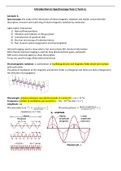
Introduction to Spectroscopy Year 1 Term 1:
Lecture 1:
Spectroscopy: the study of the interaction of electromagnetic radiation and matter concerned with
absorption, emission and scattering of electromagnetic radiation by molecules
Light matter interactions:
1) Nature/Photosynthesis
2) Vibration and rotations in the gas phase
3) Luminescence of quantum dots
4) Electron microscopy of individual atoms
5) Non-invasive optical oxygenation test (haemoglobin)
Infrared Imaging used to show what is hot and contains NO chemical information
Mid infrared chemical imaging is used for long distances/toxic gases, pollutants
MRI used a chemical agent to show the problem
X-rays are used for large distanced/astronomical
Electromagnetic radiation: a combination of oscillating electric and magnetic fields which are in phase
with each other
The plane of oscillation of the magnetic and electric fields is orthogonal and these are both orthogonal to
the direction of propagation
Wavelength: distance between two identical peaks in a wave [λ] = nm = 10-9m
Frequency: number of oscillations per second [ν] = THz = 1012Hz (1Hz = 1 s-1)
Amplitude = A
1 1 𝑠𝑝𝑒𝑒𝑑 𝑜𝑓 𝑙𝑖𝑔ℎ𝑡(𝑚/𝑠) 𝑐
𝑊𝑎𝑣𝑒𝑛𝑢𝑚𝑏𝑒𝑟(𝑐𝑚−1 ) = 𝑤𝑎𝑣𝑒𝑙𝑒𝑛𝑔𝑡ℎ = 𝜆 𝑊𝑎𝑣𝑒𝑙𝑒𝑛𝑔𝑡ℎ(𝑚) = 𝑓𝑟𝑒𝑞𝑢𝑒𝑛𝑐𝑦(𝑠−1 ) = 𝜈
,Classical Physic Assumptions:
1) Particle travels in a trajectory with a precise position and momentum at any moment
2) Any type of motion can b excited into a state of arbitrary energy (energy is not continuous)
3) Waves and particles are distinct concepts
These assumptions ONLY work for large objects →New theory of Quantum Mechanics
Proof of wave properties:
If light were particles, two bullets would be observed on the detector screen, but the idea of inference of
light proves its wave-like nature
,Black Body Radiation:
A black body can absorb and emit all frequencies = perfect absorber
How does the intensity of EM radiation emitted by a black body depend on the frequency of radiation and
the temperature?
The classical theory fails at short wavelength (high energy)
Energy quanta:
𝐸 = ℎ × 𝜈 where h = 6.626x10⁻³⁴ Js
A quantum is the smallest possible and therefore invisible unit of a given quantity or quantifiable
phenomenon
Solution to Black Body radiation:
, Photoelectric effect: evidence for photons:
1) Electrons are emitted immediately with no time lag
2) Increasing light intensity increases the number of photoelectrons but NOT the maximum KE
3) Red light (long wavelength) causes NO ejection of electrons, no matter the intensity
4) Weak violet light (short wavelength) will eject a few electrons, but their maximum KE are greater
than those for intense light of longer wavelength
5) Blue wavelength ejects the most electrons at the maximum KE
Metals emit electrons when they are exposed to high energy radiation (i.e. ultraviolet)
Wave-Particle Duality:
ℎ ℎ
𝜆= =
𝑚𝑢 𝑝
Where m = particle mass in kg and u = particle speed in m/s
Light is not the only particle which displays wave particle behaviour, but electrons/protons also do
Slow moving electrons were fired at a crystalline nickel target and found that the same diffraction patterns
appeared as for diffracted X-rays
Lecture 2:
Units:
Energy is in Joules → J = kgm2s-2
𝐸(𝐽) 107
Energy in wavenumbers → 𝐸 (𝑐𝑚−1 ) = or 𝐸(𝑐𝑚) = 𝜆(𝑛𝑚)
ℎ𝑐
ℎ𝑐
Wavelength in nm → 𝐸 (𝐽) = ℎ𝜈 (𝐻𝑧) = (𝑛𝑚)
𝜆
eV → 1 eV = 1.6x10⁻⁹J
Types of molecular energy:
1) Translational, <10cm-1
2) Rotational, 1-100cm-1
3) Vibrational, 100-4000cm-1
4) Electronic, 104-105cm-1
Lecture 1:
Spectroscopy: the study of the interaction of electromagnetic radiation and matter concerned with
absorption, emission and scattering of electromagnetic radiation by molecules
Light matter interactions:
1) Nature/Photosynthesis
2) Vibration and rotations in the gas phase
3) Luminescence of quantum dots
4) Electron microscopy of individual atoms
5) Non-invasive optical oxygenation test (haemoglobin)
Infrared Imaging used to show what is hot and contains NO chemical information
Mid infrared chemical imaging is used for long distances/toxic gases, pollutants
MRI used a chemical agent to show the problem
X-rays are used for large distanced/astronomical
Electromagnetic radiation: a combination of oscillating electric and magnetic fields which are in phase
with each other
The plane of oscillation of the magnetic and electric fields is orthogonal and these are both orthogonal to
the direction of propagation
Wavelength: distance between two identical peaks in a wave [λ] = nm = 10-9m
Frequency: number of oscillations per second [ν] = THz = 1012Hz (1Hz = 1 s-1)
Amplitude = A
1 1 𝑠𝑝𝑒𝑒𝑑 𝑜𝑓 𝑙𝑖𝑔ℎ𝑡(𝑚/𝑠) 𝑐
𝑊𝑎𝑣𝑒𝑛𝑢𝑚𝑏𝑒𝑟(𝑐𝑚−1 ) = 𝑤𝑎𝑣𝑒𝑙𝑒𝑛𝑔𝑡ℎ = 𝜆 𝑊𝑎𝑣𝑒𝑙𝑒𝑛𝑔𝑡ℎ(𝑚) = 𝑓𝑟𝑒𝑞𝑢𝑒𝑛𝑐𝑦(𝑠−1 ) = 𝜈
,Classical Physic Assumptions:
1) Particle travels in a trajectory with a precise position and momentum at any moment
2) Any type of motion can b excited into a state of arbitrary energy (energy is not continuous)
3) Waves and particles are distinct concepts
These assumptions ONLY work for large objects →New theory of Quantum Mechanics
Proof of wave properties:
If light were particles, two bullets would be observed on the detector screen, but the idea of inference of
light proves its wave-like nature
,Black Body Radiation:
A black body can absorb and emit all frequencies = perfect absorber
How does the intensity of EM radiation emitted by a black body depend on the frequency of radiation and
the temperature?
The classical theory fails at short wavelength (high energy)
Energy quanta:
𝐸 = ℎ × 𝜈 where h = 6.626x10⁻³⁴ Js
A quantum is the smallest possible and therefore invisible unit of a given quantity or quantifiable
phenomenon
Solution to Black Body radiation:
, Photoelectric effect: evidence for photons:
1) Electrons are emitted immediately with no time lag
2) Increasing light intensity increases the number of photoelectrons but NOT the maximum KE
3) Red light (long wavelength) causes NO ejection of electrons, no matter the intensity
4) Weak violet light (short wavelength) will eject a few electrons, but their maximum KE are greater
than those for intense light of longer wavelength
5) Blue wavelength ejects the most electrons at the maximum KE
Metals emit electrons when they are exposed to high energy radiation (i.e. ultraviolet)
Wave-Particle Duality:
ℎ ℎ
𝜆= =
𝑚𝑢 𝑝
Where m = particle mass in kg and u = particle speed in m/s
Light is not the only particle which displays wave particle behaviour, but electrons/protons also do
Slow moving electrons were fired at a crystalline nickel target and found that the same diffraction patterns
appeared as for diffracted X-rays
Lecture 2:
Units:
Energy is in Joules → J = kgm2s-2
𝐸(𝐽) 107
Energy in wavenumbers → 𝐸 (𝑐𝑚−1 ) = or 𝐸(𝑐𝑚) = 𝜆(𝑛𝑚)
ℎ𝑐
ℎ𝑐
Wavelength in nm → 𝐸 (𝐽) = ℎ𝜈 (𝐻𝑧) = (𝑛𝑚)
𝜆
eV → 1 eV = 1.6x10⁻⁹J
Types of molecular energy:
1) Translational, <10cm-1
2) Rotational, 1-100cm-1
3) Vibrational, 100-4000cm-1
4) Electronic, 104-105cm-1