BIOLOGICAL PSYCHOLOGY REVISION:
Aggression is defined as behaviour that is intended to cause injury, both
psychological or physical.
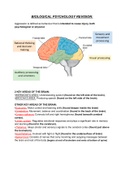
2 KEY AREAS OF THE BRAIN:
•WERNICKE'S AREA: Understanding speech (found on the left side of the brain).
•BROCHA’S AREA: Producing speech (found on the left side of the brain).
OTHER KEY AREAS OF THE BRAIN:
•Subcortex: Motor control and learning skills (found deeper inside the brain)
•Cerebellum: Movement, balance and coordination (found in the back of the brain).
•Corpus callosum: Connects left and right hemispheres (found beneath cerebral
cortex).
•Limbic system: Regulates emotional responses and plays a significant role in memory
and learning (found in the cerebrum).
•Thalamus: relays (motor and sensory) signals to the cerebral cortex (found just above
the brainstem).
•Hypothalamus: Involved with fight or flight (found in the undersurface of brain)
•Spinal Cord: Consists of nerves that carry incoming and outgoing messages between
the brain and rest of the body (begins at end of brainstem and ends at bottom of spine)
, •Prefrontal cortex: rational thinking, regulates behaviour (found in the most frontal
area of brain)
•Amygdala: How a person would respond to threats and challenges.
•Cerebral cortex: Attention, perception, awareness, thought, memory, language, and
consciousness.
EFFECT OF COCAINE ON NEUROTRANSMITTERS:
Cocaine is a stimulant drug which acts on the mesocorticolimbic pathway. The area of
the brain that cocaine significantly impacts is the nucleus accumbens (primary reward
centre of the brain). Cocaine acts by mimicking the dopamine neurotransmitter to block
(antagonise) the receptors which lead to the neurone recycling the dopamine. By doing
this, it makes all the dopamine stay in one place at the synapse, and because there's so
much of it, it causes the person to feel high/euphoric. Overtime, the dopamine receptors
would become down regulated because of the damage that the cocaine does to the
receptors, so fewer receptors would be active. This decreases the number of dopamine
produced in the body, (which would explain withdrawal effects).
^ STUDY TO SUPPORT THIS:
Weinshenker and Schroeder (2007): we find that cocaine acts in a similar way to
dopamine as when we destroy the mesocorticolimbic pathway in mouse brains, they
can no longer create the dopamine reward pathways any longer; they’re damaged.
These researchers found that when they have those areas damaged, they can no
longer consume cocaine as well. This shows that cocaine has the same
structure/affects the same brain structure that dopamine does too.
COUNTER ARGUMENT:
However, research on animals is a bit problematic. This is because the human brain is
far more complex than animal brains/ mouse brains. So isolating a single
neurotransmitter does not reflect a human as dopamine is shown to also have an effect
on noradrenaline and serotonin. This means that animal studies may lack validity as the
findings of these animal studies cannot really be generalised to humans.
EFFECT OF HEROIN ON NEUROTRANSMITTERS:
Heroin is an opioid drug (slows CNS activity), which acts on the neurons with opioid
receptors in the: cerebral cortex - attention, perception, awareness, thought, memory,
language, and consciousness. limbic system - Regulates emotional responses.
Significant role in memory and learning. and hypothalamus - controls motivational
behaviour and body’s fight or flight. (The opioid receptors help the brain to manage
pain).Heroin uses opioid receptors to help trick the brain into releasing endorphins -
which are natural painkillers produced by the body to relieve stress and pain. Heroin is
an agonist. It binds to opioid receptors and tells the brain to create more endorphins.
Aggression is defined as behaviour that is intended to cause injury, both
psychological or physical.
2 KEY AREAS OF THE BRAIN:
•WERNICKE'S AREA: Understanding speech (found on the left side of the brain).
•BROCHA’S AREA: Producing speech (found on the left side of the brain).
OTHER KEY AREAS OF THE BRAIN:
•Subcortex: Motor control and learning skills (found deeper inside the brain)
•Cerebellum: Movement, balance and coordination (found in the back of the brain).
•Corpus callosum: Connects left and right hemispheres (found beneath cerebral
cortex).
•Limbic system: Regulates emotional responses and plays a significant role in memory
and learning (found in the cerebrum).
•Thalamus: relays (motor and sensory) signals to the cerebral cortex (found just above
the brainstem).
•Hypothalamus: Involved with fight or flight (found in the undersurface of brain)
•Spinal Cord: Consists of nerves that carry incoming and outgoing messages between
the brain and rest of the body (begins at end of brainstem and ends at bottom of spine)
, •Prefrontal cortex: rational thinking, regulates behaviour (found in the most frontal
area of brain)
•Amygdala: How a person would respond to threats and challenges.
•Cerebral cortex: Attention, perception, awareness, thought, memory, language, and
consciousness.
EFFECT OF COCAINE ON NEUROTRANSMITTERS:
Cocaine is a stimulant drug which acts on the mesocorticolimbic pathway. The area of
the brain that cocaine significantly impacts is the nucleus accumbens (primary reward
centre of the brain). Cocaine acts by mimicking the dopamine neurotransmitter to block
(antagonise) the receptors which lead to the neurone recycling the dopamine. By doing
this, it makes all the dopamine stay in one place at the synapse, and because there's so
much of it, it causes the person to feel high/euphoric. Overtime, the dopamine receptors
would become down regulated because of the damage that the cocaine does to the
receptors, so fewer receptors would be active. This decreases the number of dopamine
produced in the body, (which would explain withdrawal effects).
^ STUDY TO SUPPORT THIS:
Weinshenker and Schroeder (2007): we find that cocaine acts in a similar way to
dopamine as when we destroy the mesocorticolimbic pathway in mouse brains, they
can no longer create the dopamine reward pathways any longer; they’re damaged.
These researchers found that when they have those areas damaged, they can no
longer consume cocaine as well. This shows that cocaine has the same
structure/affects the same brain structure that dopamine does too.
COUNTER ARGUMENT:
However, research on animals is a bit problematic. This is because the human brain is
far more complex than animal brains/ mouse brains. So isolating a single
neurotransmitter does not reflect a human as dopamine is shown to also have an effect
on noradrenaline and serotonin. This means that animal studies may lack validity as the
findings of these animal studies cannot really be generalised to humans.
EFFECT OF HEROIN ON NEUROTRANSMITTERS:
Heroin is an opioid drug (slows CNS activity), which acts on the neurons with opioid
receptors in the: cerebral cortex - attention, perception, awareness, thought, memory,
language, and consciousness. limbic system - Regulates emotional responses.
Significant role in memory and learning. and hypothalamus - controls motivational
behaviour and body’s fight or flight. (The opioid receptors help the brain to manage
pain).Heroin uses opioid receptors to help trick the brain into releasing endorphins -
which are natural painkillers produced by the body to relieve stress and pain. Heroin is
an agonist. It binds to opioid receptors and tells the brain to create more endorphins.