1
Energetics
A student determined a value for the enthalpy change when a sample
of propanone was burned. The heat produced was used to warm
some water in a copper calorimeter.
The student found that the temperature of 150 g of water increased by
8.0 °C when 4.50 × 10⁻³ mol of pure propanone was burned in air.
Use the student’s results to calculate a value, in kJ mol −1, for the
enthalpy change when one mole of propanone is burned.
(The specific heat capacity of water is 4.18 J K−1 g−1)
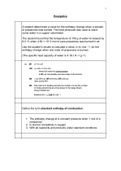
Define the term standard enthalpy of combustion.
1. The enthalpy change at a constant pressure when 1 mol of a
compound
2. Is burned completely in oxygen
3. With all reactants and products under standard conditions
, 2
Suggest two reasons why the value obtained by the student in part (c)
is different from the value calculated in part (e)
1. Heat loss
, 3
2. The specific heat capacity of the apparatus was not considered
3. incomplete combustion
4. The water may end up in the gaseous state rather than a liquid
5. Reactants and products may not be in standard states.
1. redox
2. Calcium is extracted by electrolysis
3. calcium is expensive to extract
4. Calcium extraction uses electricity
5. Calcium extraction uses large amount of energy
6. Calcium is a reactive metal
, 4
1. HCl is corrosive
2. H2 is flammable
3. The HCl is easily separated as it is a gas so it will escape
1. Increase in volume
2. Smaller increase in T above room temperature
Energetics
A student determined a value for the enthalpy change when a sample
of propanone was burned. The heat produced was used to warm
some water in a copper calorimeter.
The student found that the temperature of 150 g of water increased by
8.0 °C when 4.50 × 10⁻³ mol of pure propanone was burned in air.
Use the student’s results to calculate a value, in kJ mol −1, for the
enthalpy change when one mole of propanone is burned.
(The specific heat capacity of water is 4.18 J K−1 g−1)
Define the term standard enthalpy of combustion.
1. The enthalpy change at a constant pressure when 1 mol of a
compound
2. Is burned completely in oxygen
3. With all reactants and products under standard conditions
, 2
Suggest two reasons why the value obtained by the student in part (c)
is different from the value calculated in part (e)
1. Heat loss
, 3
2. The specific heat capacity of the apparatus was not considered
3. incomplete combustion
4. The water may end up in the gaseous state rather than a liquid
5. Reactants and products may not be in standard states.
1. redox
2. Calcium is extracted by electrolysis
3. calcium is expensive to extract
4. Calcium extraction uses electricity
5. Calcium extraction uses large amount of energy
6. Calcium is a reactive metal
, 4
1. HCl is corrosive
2. H2 is flammable
3. The HCl is easily separated as it is a gas so it will escape
1. Increase in volume
2. Smaller increase in T above room temperature