Written by students who passed Immediately available after payment Read online or as PDF Wrong document? Swap it for free 4.6 TrustPilot
logo-home
Document preview thumbnail
Preview 3 out of 18 pages
Summary

A-level Edexcel History Protest and Reaction, 1963-72 Summary Notes for REDUCED CONTENT 2022

Document preview thumbnail
Preview 3 out of 18 pages

Summarised, condensed, easy to understand revision notes for Protest and Reaction, 1963-72 Contains only the content covered in the 2022 summer exams (reduced content) Includes: Civil rights, protest and personal freedom, Johnson's Great Society

Content preview

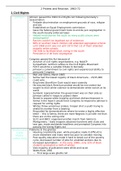
2 Protest and Reaction, 1963-72
1 Civil Rights
Johnson Johnson passed the 1964 Civil Rights Act following Kennedy’s
assassination
- Forbade discrimination on employment grounds of race, religion
and sex
- Established an Equal Employment commission
- Gave the federal government tools to end de jure segregation in
the south (locally enforced laws)
- Helped revolutionise the south as many public places were
desegregated
- Racism couldn’t be legalised out of existence
- 68% of southern black children still attended segregated schools
until 1968 and it was not until 1973 that 1/2 of them attended
majority white schools
- Did little to facilitate black voting in the south
- Persistence of de facto segregation

Congress passed the Act because of
- Activism of civil rights organisations, e.g. NAACP
- Sympathetic northern whites to the Civil Rights Movement
- Felt it would be a suitable tribute to Kennedy
- Johnson’s commitment to civil rights and experienced ability to
persuade Congress
Voting - MLK and Selma, March 1965
Rights Act, - Selma had the lowest registry of black Americans – 23/15,000
1965 could vote
- King knew Sheriff Jim Clark would react violently
- He ensured black American protest would be non-violent but
sought to elicit white violence to demonstrate white racism at its
worst
- Symbolic representation the government was on their side as
Johnson called in troops to protect them
- Aimed to expose white brutality and black disfranchisement in
Selma in the hope it would force Congress to respond to Johnson’s
request for voting rights
- Whites threw venomous snakes, trooper shot a youth trying to
shield his mother from a beating
- King jailed for demonstrations where he wrote a highly effective
letter – ‘this is Selma, there are more Negroes in jail with me than
there are on the voting rolls’
- SLCC and SNCC organised another march from Selma to
Montgomery – state troopers attacked marchers with clubs and
tear gas, made worldwide headlines and prompted Congress into
passing the Voting Rights Act
Ghettoizatio Problems in the ghettos
n and - Housing consistently poor, white prejudice made it difficult to
Martin move elsewhere and many were too poor to consider moving
Luther King - Poor-quality education made it hard to break out of the poverty
cycle, decreased number of jobs for unskilled workers due to
increased automation – in the early 1960s, only 32% of black
students graduated vs 56% of whites
- Vast majority of policemen were white and racist
- Watts Riots 1956
o First large-scale ghetto riot

, 2 Protest and Reaction, 1963-72
o Set fire to several blocks of stores in Watts
o Had an impact on MLK – ‘a class revolt of the underprivileged
against the privileged… the main issue is economic’
o MLK began defining freedom in terms of economic equality,
calling for better distribution of the wealth and planned his
Chicago campaign

The Chicago campaign, 1966
- Staged for 2 reasons
- Firstly, although Civil Rights Act 1964 ended de jure segregation in
the south, de facto (voluntary) segregation and social and
economic inequality persisted in the ghettos
- Secondly, ghetto residents believed moderate civil rights leaders
didn’t understand their problems and did little to solve them
- As a result, many turned to radicalism and violence which King
feared would alienate whites and prevent further federal support,
so hoped his Chicago campaign would encourage black ghetto
residents to reject violence and support the moderate wing of the
Civil Rights Movement
- 700,000 out of 3 million Chicago residents were black Americans
who suffered unemployment, housing and education problems in
the ghettos

- MLK’s family became temporary residents from July to September
1966 and found their relationships deteriorated dramatically in the
stifling heat
- The campaign aimed to draw attention to the appalling living
conditions in the ghetto and the difficulties facing black families
who tried to move out
- King led reporters around rat-infested apartments that lacked air
conditioning
- Led marchers into white districts where blacks couldn’t buy homes
and they were met with abuse and violence
- 2 months of publicity, marches and protests led to Mayor Daley
agreeing with King that the housing situation would improve
- However, Daley regened on the agreement once King left Chicago

Significance of the Chicago campaign
- Many northern whites sympathised with Chicago whites who knew
if blacks moved into white working-class areas, property values
would fall and schools would decline
- Helping the ghettos would cost taxpayers money and white
Americans were unwilling to pay for improvements
- Alienated whites
- Despite $4 million federal grant for Chicago housing and a legacy
of community action, many black Chicagoans lapsed into apathy,
losing hope in King and turning to the Black Power movement
- King increasing disillusionment that further progress was unlikely
- King persisted and sought to broaden the movement by uniting all
impoverished groups in his Poor People’s Campaign, wanting
ethnic minorities to come together and camp out in Washington in
a civil disobedience campaign to draw national attention to their
poverty. However, he admitted ‘it just isn’t working, people aren’t
responding’

, 2 Protest and Reaction, 1963-72
Evaluation of Martin Luther King
- Played a vital role in the demise of de jure segregation in the south
through his protests, inspiration and organisation
- Impressive rhetorical skills and ability to inspire meant he was
recognised as the leading spokesperson for black Americans
- Belief in the effectiveness of mass protest and manipulation of
white violence switched emphasis of black activism from the
NAACP’s litigation strategy to mass action
- 1963 Washington speech and Birmingham campaign played a big
role in encouraging Kennedy to support the 1964 Civil Rights Act
- Selma campaign was key in the passing of the 1965 Voting Rights
Act
- Failed to achieve anything significant in Chicago
- Watts Riots of 1965 showed the Voting Rights Act was insufficient
as riots continued to break out over poverty and didn’t resolve
divisions in society
Malcom X - Drew national attention to the ghetto problems in the north
- Encouraged black militancy demonstrated in the rise of the Black
Power movement and multiple ghetto riots from 1964 to 1968
- Joined the Nation of Islam in jail – a black American religion that
became popular in ghettos, teaching people that white people
were evil, and so Malcom agreed it made sense to live separate to
them
- Favoured separatism (separation of racial, cultural r gender related
groups)
- Had similar aims to King as they both wanted to improve black
lives through sermons, speeches and writings
- Believed black people should control their own social, economic
and political lives and problems
- Believed non-violence disarmed the oppressed and mocked
Christian teachings King believed in, as he thought they were
‘criminal’ in encouraging white violence
- Claimed the fear he generated amongst whites helped the passage
of the Civil Rights Act
- Greatest successes were in his drawing of attention to the
Northern ghetto problems
- Contributed to growing black pride
- Inspired a new generation of black Americans through his influence
on the development of the Black Power movement
- Criticised by the New York Times for being racist
- NAACP leader said he achieved nothing
Nation of - Established in 1930
Islam - Believed Allah created people black, the evil scientist Yakub
created other racists and whites would rule the world for
thousands of years until Allah returned and ended their supremacy
- Set up temples in black ghettos in cities such as Detroit and
Chicago
- Taught Malcom the white man was the devil giving him a sense of
racial pride and identity
- Malcom became a NOI minister and by 1950s, was its most
effective preacher and recruiter

Aims
- The separation of blacks and white – intergration was not the goal
- Black economic independence in all forms

Connected book
 image
Publisher: Unknown ISBN: 9781471837692 Edition: Unknown

Document information

Study Level
Summarized whole book?
No
Which chapters are summarized?
Chapter 2 protest and reaction, 1963-72
Uploaded on
April 17, 2022
Number of pages
18
Written in
2021/2022
Type
Summary
£4.49

Wrong document? Swap it for free Within 14 days of purchase and before downloading, you can choose a different document. You can simply spend the amount again.
Written by students who passed
Immediately available after payment
Read online or as PDF

Seller avatar
Reputation scores are based on the amount of documents a seller has sold for a fee and the reviews they have received for those documents. There are three levels: Bronze, Silver and Gold. The better the reputation, the more your can rely on the quality of the sellers work.
lilylogan101
4.7
(73)
Sold
183
Followers
91
Items
0
Last sold
3 months ago


Reviews from verified buyers


Why students choose Stuvia

Created by fellow students, verified by reviews

Quality you can trust: written by students who passed their exams and reviewed by others who've used these revision notes.

Didn't get what you expected? Choose another document

No problem! You can straightaway pick a different document that better suits what you're after.

Pay as you like, start learning straight away

No subscription, no commitments. Pay the way you're used to via credit card and download your PDF document instantly.

Student with book image

“Bought, downloaded, and smashed it. It really can be that simple.”

Alisha Student

Working on your references?

Create accurate citations in APA, MLA and Harvard with our free citation generator.

Working on your references?

Frequently asked questions