

Inherited change
Studying inheritance
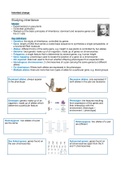
Mendel
• Experimented on pea plants
• Controlled pollination
• Worked out the basic principles of inheritance: dominant and recessive genes and
the 3:1 ratio
Key definitions:
• Genetics: the study of inheritance, controlled by genes
• Gene: length of DNA that carries a coded base sequence to synthesise a single polypeptide, or
a functional RNA molecule
• Alleles: different forms of the same gene, e.g. height in pea plants is controlled by two alleles
• Genome: total genetic make up of an organism, made up of genes on chromosomes
• Polygenes: a single feature that is determined by several genes, e.g. human height
• Gene mapping: a technique used to locate the position of a gene on a chromosome
• Chi squared: stats test used to find out whether offspring phenotypes fit an expected ratio
• Homologous chromosomes: 2 chromosomes of a pair carrying the same genes but different
alleles
• Co-dominance: Where both alleles are expressed in the phenotype
• Multiple alleles: there are more than two types of allele for a particular gene, e.g. blood groups
Dominant alleles: always appear Recessive alleles: only expressed if
in the phenotype both alleles in the pair are recessive
Genotype: genetic make up of an Phenotype: the features resulting
organism, made up of alleles which from expression of the genes and
determine a particular feature their interaction with the
environment. [Genotype +
environment = phenotype]
Homozygous: two alleles of a pair Heterozygous: two alleles of a pair
are the same are different
Sex linked genes: genes found on Autosomal genes: genes found on
the sex chromosomes all chromosomes apart from the X
and Y chromosomes
, Monohybrid inheritance.
Monohybrid inheritance is a single pair of contrasted characteristics (e.g. tall and short/dwarf
plants) that are controlled by a single gene
The position of a gene on a particular chromosome is known as the gene locus. In a diploid
organism, chromosomes occur in homologous pairs and so there will be two alleles present for a
specific gene (one inherited from each parent).
This means that there will be 3 possible combinations of alleles for the characteristic:
Monohybrid crosses
Steps to follow:
1. Parental phenotypes and genotypes
2. Gametes - represent with a letter and a circle around it
3. Punnett square diagram
4. Offspring genotypes and phenotypes
Pure breeding organisms will produce the same phenotype with successive self crosses as they
are homozygous
If a cross is carried out between 2 pure breeding parents the offspring = the F1 generation.
Crossing 2 individuals from the F1 generation leads to an F2 generation
Crossing two heterozygotes:
The ratio of dominant to recessive phenotypes is 3:1 and this is Mendel’s first law.
Studying inheritance
Mendel
• Experimented on pea plants
• Controlled pollination
• Worked out the basic principles of inheritance: dominant and recessive genes and
the 3:1 ratio
Key definitions:
• Genetics: the study of inheritance, controlled by genes
• Gene: length of DNA that carries a coded base sequence to synthesise a single polypeptide, or
a functional RNA molecule
• Alleles: different forms of the same gene, e.g. height in pea plants is controlled by two alleles
• Genome: total genetic make up of an organism, made up of genes on chromosomes
• Polygenes: a single feature that is determined by several genes, e.g. human height
• Gene mapping: a technique used to locate the position of a gene on a chromosome
• Chi squared: stats test used to find out whether offspring phenotypes fit an expected ratio
• Homologous chromosomes: 2 chromosomes of a pair carrying the same genes but different
alleles
• Co-dominance: Where both alleles are expressed in the phenotype
• Multiple alleles: there are more than two types of allele for a particular gene, e.g. blood groups
Dominant alleles: always appear Recessive alleles: only expressed if
in the phenotype both alleles in the pair are recessive
Genotype: genetic make up of an Phenotype: the features resulting
organism, made up of alleles which from expression of the genes and
determine a particular feature their interaction with the
environment. [Genotype +
environment = phenotype]
Homozygous: two alleles of a pair Heterozygous: two alleles of a pair
are the same are different
Sex linked genes: genes found on Autosomal genes: genes found on
the sex chromosomes all chromosomes apart from the X
and Y chromosomes
, Monohybrid inheritance.
Monohybrid inheritance is a single pair of contrasted characteristics (e.g. tall and short/dwarf
plants) that are controlled by a single gene
The position of a gene on a particular chromosome is known as the gene locus. In a diploid
organism, chromosomes occur in homologous pairs and so there will be two alleles present for a
specific gene (one inherited from each parent).
This means that there will be 3 possible combinations of alleles for the characteristic:
Monohybrid crosses
Steps to follow:
1. Parental phenotypes and genotypes
2. Gametes - represent with a letter and a circle around it
3. Punnett square diagram
4. Offspring genotypes and phenotypes
Pure breeding organisms will produce the same phenotype with successive self crosses as they
are homozygous
If a cross is carried out between 2 pure breeding parents the offspring = the F1 generation.
Crossing 2 individuals from the F1 generation leads to an F2 generation
Crossing two heterozygotes:
The ratio of dominant to recessive phenotypes is 3:1 and this is Mendel’s first law.


