

Nucleic acids
DNA structure
Basic structure
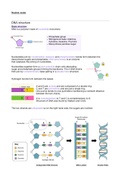
DNA is a polymer made of nucleotide monomers:
• Phosphate group
• Nitrogenous base: Adenine,
Cytosine, Guanine, Thymine
• Deoxyribose pentose sugar
Nucleotides join by condensation reactions and phosphodiester bonds form between the
deoxyribose sugars and phosphates. DNA polymerase is an enzyme
that catalyses the joining of nucleotides.
Nucleotides together form a polynucleotide chain with alternating
sugar and phosphate groups forming the backbone. The 2 DNA chains
then join by complementary base pairing in a double helix structure.
Hydrogen bonds form between the bases:
A and G are purines and are composed of a double ring.
C and T are pyrimidines and are just a single ring.
One purine bonds to one pyrimidine maintaining a constant distance
between the two chains.
A is complementary to T and C is complementary to G
Structure of DNA was found by Watson and Crick.
The two strands are antiparallel so on the right hand side, the sugars are inverted.
, RNA vs DNA
Stability of DNA
• Very stable structure that passes generation to generation without many changes
• Hydrogen bonds link the base pairs which make it stable.
• There are 3 H bonds between C and G
• There are 2 H bonds between A and T
Structure of DNA
Structure Function
Large molecule Stores lots of information
Coiled in a helix Large volume in a small space - compact
Double stranded both strands act as templates for DNA replication (semi-
conservative)
Backbone of sugar and phosphate Stability and protection of base code from outside chemical and
physical forces
Complementary base paring DNA replication is accurate and produces two exact copies
Many hydrogen bonds Molecule is stable.
Hydrogen bonds are weak Easily broken for protein synthesis or DNA replication
individually
Base sequence Information stored and bases code for amino acids
DNA replication
This occurs before cell division to ensure the daughter cells have the genetic information to
produce all the enzymes and proteins they need. Called semi conservative replication
1. The DNA is uncoiled
2. The enzyme DNA helicase breaks the hydrogen bonds
between the bases, causing the strands of the DNA to
separate.
3. Free nucleotides are attracted to their complementary
bases and they bind to them. The two original strands of
DNA act as templates.
4. The nucleotides are joined together by DNA polymerase
which makes phosphodiester bonds. The DNA polymerase
also proof reads the sequence
5. The nucleotides are all joined to form a complete
polynucleotide chain. H bonds reform. Two identical strands of DNA are formed. Each strand
contains half of the original DNA.
DNA structure
Basic structure
DNA is a polymer made of nucleotide monomers:
• Phosphate group
• Nitrogenous base: Adenine,
Cytosine, Guanine, Thymine
• Deoxyribose pentose sugar
Nucleotides join by condensation reactions and phosphodiester bonds form between the
deoxyribose sugars and phosphates. DNA polymerase is an enzyme
that catalyses the joining of nucleotides.
Nucleotides together form a polynucleotide chain with alternating
sugar and phosphate groups forming the backbone. The 2 DNA chains
then join by complementary base pairing in a double helix structure.
Hydrogen bonds form between the bases:
A and G are purines and are composed of a double ring.
C and T are pyrimidines and are just a single ring.
One purine bonds to one pyrimidine maintaining a constant distance
between the two chains.
A is complementary to T and C is complementary to G
Structure of DNA was found by Watson and Crick.
The two strands are antiparallel so on the right hand side, the sugars are inverted.
, RNA vs DNA
Stability of DNA
• Very stable structure that passes generation to generation without many changes
• Hydrogen bonds link the base pairs which make it stable.
• There are 3 H bonds between C and G
• There are 2 H bonds between A and T
Structure of DNA
Structure Function
Large molecule Stores lots of information
Coiled in a helix Large volume in a small space - compact
Double stranded both strands act as templates for DNA replication (semi-
conservative)
Backbone of sugar and phosphate Stability and protection of base code from outside chemical and
physical forces
Complementary base paring DNA replication is accurate and produces two exact copies
Many hydrogen bonds Molecule is stable.
Hydrogen bonds are weak Easily broken for protein synthesis or DNA replication
individually
Base sequence Information stored and bases code for amino acids
DNA replication
This occurs before cell division to ensure the daughter cells have the genetic information to
produce all the enzymes and proteins they need. Called semi conservative replication
1. The DNA is uncoiled
2. The enzyme DNA helicase breaks the hydrogen bonds
between the bases, causing the strands of the DNA to
separate.
3. Free nucleotides are attracted to their complementary
bases and they bind to them. The two original strands of
DNA act as templates.
4. The nucleotides are joined together by DNA polymerase
which makes phosphodiester bonds. The DNA polymerase
also proof reads the sequence
5. The nucleotides are all joined to form a complete
polynucleotide chain. H bonds reform. Two identical strands of DNA are formed. Each strand
contains half of the original DNA.


