Photosynthesis
Overview
• Photosynthesis occurs in chloroplasts in leaves. The energy for this reaction comes from light
energy from the sun and plants convert this into chemical energy (this is known as transduction).
• Plants are known as photoautotrophs as they use light energy to make their own food.
• The main product is triose phosphate which is used in other reactions such as respiration
• Simple inorganic compounds are converted into more complex organic compounds
Leaf adaptations:
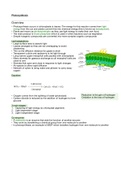
• Large surface area to absorb light
• Leaves arranged so they are not overlapping to avoid
shadowing
• Thin so the diffusion distance for gases is short
• Transparent cuticle and epidermis to let light through
• Long narrow upper mesophyll cells packed with chloroplasts
• Many stomata for gaseous exchange so all mesophyll cells are
close to one
• Stomata that open and close in response to light changes
• Air spaces to allow rapid diffusion
• Network of xylem to bring water and phloem to carry away
sugars
Equation:
• Oxygen comes from the splitting of water (photolysis) Reduction is the gain of hydrogen
• Carbon dioxide is reduced by the addition of hydrogen to form Oxidation is the loss of hydrogen
glucose
3 main stages:
1. Capturing of light energy by chloroplast pigments
2. Light dependent stage
3. Light independent stage
Co-enzymes
• A coenzyme is an enzyme that aids the function of another enzyme
• They work by transferring a chemical group from one molecule to another
• In photosynthesis, an example is NADP which transfers hydrogen from one molecule to another
, Capturing of light
Structure and role of chloroplasts
Thylakoid membranes light dependent reactions take place. Contains chlorophyll,
accessory pigments, electron transport systems and enzymes
arranged in photosystems
Grana stacks of thylakoid and enclose the hydrogen reservoir for
chemiosmosis
Intergranal lamellae Some thylakoids have tubular extensions that join up with thylakoids
in the next grana
Stroma fluid where light independent stage takes place. Contains enzymes
for this reaction
Starch granule insoluble storage for carbohydrate products
Chloroplast envelope phospholipid bilayer that is permeable to glucose, Fe2+ and Mg2+,
oxygen and CO2
Ribosomes and DNA used to produce enzymes for photosynthesis
• Endosymbiotic theory of evolution
• There is internal compartmentalisation as LDS and LIS happen in different places
Chlorophyll structure:
• Porphyrin ring
• Flat square structure
• Similar to haemoglobin and myoglobin
• Long tail region joined to ring which is embedded into the thylakoid
membrane
• Different chlorophyll molecules have different side chains on the head of their
structure which alters their light absorbance
• Chlorophyll a is found in all photosynthetic plants
• Hydrocarbon tail is hydrophobic and the head is hydrophilic
Wavelengths of light
• Plants only use the visible light region of sunlight and this is a mixture of different wavelengths
• Objects appear different colours due to the wavelength of light they reflect
• Many plants have chlorophyll and it reflects green light and absorbs blue and red light
• Different pigments broaden range of wavelengths absorbed - have a different structure to
chlorophyll. Known as accessory pigments
Overview
• Photosynthesis occurs in chloroplasts in leaves. The energy for this reaction comes from light
energy from the sun and plants convert this into chemical energy (this is known as transduction).
• Plants are known as photoautotrophs as they use light energy to make their own food.
• The main product is triose phosphate which is used in other reactions such as respiration
• Simple inorganic compounds are converted into more complex organic compounds
Leaf adaptations:
• Large surface area to absorb light
• Leaves arranged so they are not overlapping to avoid
shadowing
• Thin so the diffusion distance for gases is short
• Transparent cuticle and epidermis to let light through
• Long narrow upper mesophyll cells packed with chloroplasts
• Many stomata for gaseous exchange so all mesophyll cells are
close to one
• Stomata that open and close in response to light changes
• Air spaces to allow rapid diffusion
• Network of xylem to bring water and phloem to carry away
sugars
Equation:
• Oxygen comes from the splitting of water (photolysis) Reduction is the gain of hydrogen
• Carbon dioxide is reduced by the addition of hydrogen to form Oxidation is the loss of hydrogen
glucose
3 main stages:
1. Capturing of light energy by chloroplast pigments
2. Light dependent stage
3. Light independent stage
Co-enzymes
• A coenzyme is an enzyme that aids the function of another enzyme
• They work by transferring a chemical group from one molecule to another
• In photosynthesis, an example is NADP which transfers hydrogen from one molecule to another
, Capturing of light
Structure and role of chloroplasts
Thylakoid membranes light dependent reactions take place. Contains chlorophyll,
accessory pigments, electron transport systems and enzymes
arranged in photosystems
Grana stacks of thylakoid and enclose the hydrogen reservoir for
chemiosmosis
Intergranal lamellae Some thylakoids have tubular extensions that join up with thylakoids
in the next grana
Stroma fluid where light independent stage takes place. Contains enzymes
for this reaction
Starch granule insoluble storage for carbohydrate products
Chloroplast envelope phospholipid bilayer that is permeable to glucose, Fe2+ and Mg2+,
oxygen and CO2
Ribosomes and DNA used to produce enzymes for photosynthesis
• Endosymbiotic theory of evolution
• There is internal compartmentalisation as LDS and LIS happen in different places
Chlorophyll structure:
• Porphyrin ring
• Flat square structure
• Similar to haemoglobin and myoglobin
• Long tail region joined to ring which is embedded into the thylakoid
membrane
• Different chlorophyll molecules have different side chains on the head of their
structure which alters their light absorbance
• Chlorophyll a is found in all photosynthetic plants
• Hydrocarbon tail is hydrophobic and the head is hydrophilic
Wavelengths of light
• Plants only use the visible light region of sunlight and this is a mixture of different wavelengths
• Objects appear different colours due to the wavelength of light they reflect
• Many plants have chlorophyll and it reflects green light and absorbs blue and red light
• Different pigments broaden range of wavelengths absorbed - have a different structure to
chlorophyll. Known as accessory pigments