

Mass transport
Circulatory system
Mass transport is the movement in bulk of molecules in one direction from high to low pressure.
Why large organisms have a transport system
• Diffusion is insufficient for the supply of many materials over large distances
• Surface area to volume ratio is small in large animals and so specialist exchange systems are
needed to supply the large volume of cells
• High metabolic rate - more cells and more aerobic respiration
Circulatory system
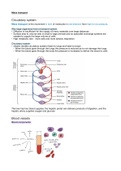
• closed, double circulatory system (heart to lungs and heart to body)
• When the blood goes through the lungs the pressure is reduced as to not damage the lungs
• When the blood goes through the body the pressure is increased to deliver the blood to cells
The liver has two blood supplies: the hepatic portal vein delivers products of digestion, and the
hepatic artery supplies oxygen and glucose
Blood vessels
Blood components:
,Different types of blood vessels:
Why pressure decreases from the
heart:
• Friction from contact with the walls
of the blood vessels
• Fluid lost in tissue fluid formation
Arteries:
Transport blood under high pressure from the heart to the tissues
• Thick muscle layer: they can constrict and dilate to control volume of blood
• Thick elastic layer: elastic is stretched at high pressure and then recoils at low
blood pressure. This keeps blood pressure high to reach all body cells
• Thick wall: resists the vessel bursting
• No valves: blood under high pressure so doesn’t flow backwards
Arterioles:
Directs blood to different areas of the body
• Thick muscle layer: they can contract and relax to control volume of blood
going to different regions
Capillaries:
Exchange metabolic materials between the blood and body cells. The flow is
much slower allowing time for exchange
• Very thin: diffusion distance is small so rapid diffusion
• Numerous and highly branched: large surface area for exchange - many
capillaries form a capillary bed
• Narrow diameter: permeate tissues so there is a short diffusion pathway
• Narrow lumen: red blood cells are squeezed flat against the side which brings
then closer to the cells, reducing diffusion distance
• Spaces between endothelial cells: white blood cells can escape to destroy
pathogens
Veins:
Transport blood slowly at low pressure to heart
• Thin muscle layer: carry blood away from tissues so no constriction/dilation
needed to control blood flow
• Thin elastic layer: low pressure will not cause a recoil action/it will not burst
• Thin wall: no risk of bursting, allows then to be flattened easily
• Valves: ensure blood doesn’t flow backwards. When muscles contract, veins
are compressed and the pressure rises - the veins ensure the blood flows in
the correct direction.
, Tissue fluid
Tissue fluid is the liquid that bathes all body cells.
• This links the circulatory system and the lymphatic system
• The lymphatic system collects excess tissue fluid and returns it to the blood
• Tissue fluid forced out under pressure and this is a type of ultrafiltration
• It is how cells receive oxygen and glucose and how carbon dioxide is removed
1. At the arterial end, the blood is at high hydrostatic pressure so fluid is forced out of the
permeable capillary walls. Proteins are too big to leave the capillary so they stay in the blood
2. This fluid forms tissue fluid. Materials are exchanged between cells e.g. water, ions, glucose,
oxygen
3. At the venule end, the blood is at lower hydrostatic pressure since it has lost a lot of fluid and
there is more friction with the capillary walls. This means that tissue fluid is forced back into
the capillaries due to the difference in pressure
4. Water returns to the blood by osmosis since the blood has a lower water potential than the
tissue fluid - it has a lower water potential because of fluid loss and retention of proteins
5. Solutes may also enter the blood by diffusion e.g. carbon dioxide
6. There is excess tissue fluid which drains into lymph vessels and forms lymph, which is carried
back into the bloodstream
The lymphatic system is moved by:
• Hydrostatic pressure of tissue fluid
• Contraction of body muscles
Medical conditions:
• High blood pressure leads to more fluid forced out of capillaries so swelling and excess tissue
fluid
• Inactivity leads to swelling because there are no contraction of the muscles which means the
lymphatic system isn’t moved
• Kwashiorkor is a diet lacking in protein and leads to higher water potential in blood so less
osmosis into the blood so swelling and excess tissue fluid.
Circulatory system
Mass transport is the movement in bulk of molecules in one direction from high to low pressure.
Why large organisms have a transport system
• Diffusion is insufficient for the supply of many materials over large distances
• Surface area to volume ratio is small in large animals and so specialist exchange systems are
needed to supply the large volume of cells
• High metabolic rate - more cells and more aerobic respiration
Circulatory system
• closed, double circulatory system (heart to lungs and heart to body)
• When the blood goes through the lungs the pressure is reduced as to not damage the lungs
• When the blood goes through the body the pressure is increased to deliver the blood to cells
The liver has two blood supplies: the hepatic portal vein delivers products of digestion, and the
hepatic artery supplies oxygen and glucose
Blood vessels
Blood components:
,Different types of blood vessels:
Why pressure decreases from the
heart:
• Friction from contact with the walls
of the blood vessels
• Fluid lost in tissue fluid formation
Arteries:
Transport blood under high pressure from the heart to the tissues
• Thick muscle layer: they can constrict and dilate to control volume of blood
• Thick elastic layer: elastic is stretched at high pressure and then recoils at low
blood pressure. This keeps blood pressure high to reach all body cells
• Thick wall: resists the vessel bursting
• No valves: blood under high pressure so doesn’t flow backwards
Arterioles:
Directs blood to different areas of the body
• Thick muscle layer: they can contract and relax to control volume of blood
going to different regions
Capillaries:
Exchange metabolic materials between the blood and body cells. The flow is
much slower allowing time for exchange
• Very thin: diffusion distance is small so rapid diffusion
• Numerous and highly branched: large surface area for exchange - many
capillaries form a capillary bed
• Narrow diameter: permeate tissues so there is a short diffusion pathway
• Narrow lumen: red blood cells are squeezed flat against the side which brings
then closer to the cells, reducing diffusion distance
• Spaces between endothelial cells: white blood cells can escape to destroy
pathogens
Veins:
Transport blood slowly at low pressure to heart
• Thin muscle layer: carry blood away from tissues so no constriction/dilation
needed to control blood flow
• Thin elastic layer: low pressure will not cause a recoil action/it will not burst
• Thin wall: no risk of bursting, allows then to be flattened easily
• Valves: ensure blood doesn’t flow backwards. When muscles contract, veins
are compressed and the pressure rises - the veins ensure the blood flows in
the correct direction.
, Tissue fluid
Tissue fluid is the liquid that bathes all body cells.
• This links the circulatory system and the lymphatic system
• The lymphatic system collects excess tissue fluid and returns it to the blood
• Tissue fluid forced out under pressure and this is a type of ultrafiltration
• It is how cells receive oxygen and glucose and how carbon dioxide is removed
1. At the arterial end, the blood is at high hydrostatic pressure so fluid is forced out of the
permeable capillary walls. Proteins are too big to leave the capillary so they stay in the blood
2. This fluid forms tissue fluid. Materials are exchanged between cells e.g. water, ions, glucose,
oxygen
3. At the venule end, the blood is at lower hydrostatic pressure since it has lost a lot of fluid and
there is more friction with the capillary walls. This means that tissue fluid is forced back into
the capillaries due to the difference in pressure
4. Water returns to the blood by osmosis since the blood has a lower water potential than the
tissue fluid - it has a lower water potential because of fluid loss and retention of proteins
5. Solutes may also enter the blood by diffusion e.g. carbon dioxide
6. There is excess tissue fluid which drains into lymph vessels and forms lymph, which is carried
back into the bloodstream
The lymphatic system is moved by:
• Hydrostatic pressure of tissue fluid
• Contraction of body muscles
Medical conditions:
• High blood pressure leads to more fluid forced out of capillaries so swelling and excess tissue
fluid
• Inactivity leads to swelling because there are no contraction of the muscles which means the
lymphatic system isn’t moved
• Kwashiorkor is a diet lacking in protein and leads to higher water potential in blood so less
osmosis into the blood so swelling and excess tissue fluid.


