

Transport across cell membranes
Cell membrane structure
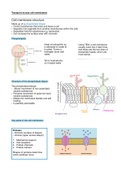
Made up of a phospholipid bilayer
• Control substances that enter and leave a cell
• Separate one organelle from another (membranes within the cell)
• Separates harmful substances e.g. lysosomes
• Can increase the surface area with microvilli
Phospholipids:
Head is hydrophilic so Using TEM, a cell membrane
is attracted to water (it usually looks like 2 dark lines,
is polar). Forms a and these are the two lines of
hydrogen bond with phosphate heads, which are
water. more dense.
Tail is hydrophobic
so it repels water
Structure of the phospholipid bilayer:
The phospholipid bilayer:
• Allows movement of non-polar/lipid
soluble substances
• Prevents movement of polar/non lipid
soluble substances
• Makes the membrane flexible and self
healing.
• Is partially permeable
Key parts of the cell membrane:
Proteins
• Extrinsic (surface of bilayer)
• Intrinsic (span across bilayer)
1. Mechanical support
2. Cell receptors
3. Protein channels
4. Protein carriers
Shapes of proteins determine
which particles move
, Cholesterol
1. Reduces lateral movement of molecules in membrane by
binding to fatty acid tails and bringing phospholipids closer
together
2. Makes the membrane less fluid
3. Prevents leakage of water and dissolved ions as its
hydrophobic
4. Maintains shape of animal cells
Glycolipids
1. Helps maintain stability
2. Helps cells attach to one another to form a tissue
3. Acts as a cell surface receptor as carbohydrate portion extends out
of the cell
Glycoproteins
1. Allows cells to recognise each other
2. Helps cells attach to one another to form a tissue
3. Acts as a cell surface receptors specifically for neurotransmitters
and hormones
Fluid mosaic model:
Fluid because the phospholipids can move relative to each other
Mosaic because the proteins in the membrane vary in shape, size and patterns
Evidence for this model:
1: use of radio labelled extrinsic proteins
• Inject radio labelled proteins into the cell membrane
• Over time the diffuse so they are evenly spread
• Therefore it is fluid
2: extraction of phospholipids
• Extracted the phospholipids and spread them over water so the layer was one molecule thick
• Measured surface area
• Area of the lipid monolayer was twice the surface area of the layer in a normal cell
• Therefore there is a bilayer
3: Freeze-fracture technique
• Cell put into liquid nitrogen and then fractured along the cell membrane
• Some of the protein could be extracted easily and some not so easily
• Therefore some proteins are intrinsic and some are extrinsic
Functions of membranes within cells:
• Control entry and exit of materials
• Separate organelles and their reactions from cytoplasm
• Provide internal transport system e.g. ER
• Isolate enzymes that might damage the cell e.g. lysosomes
• Provide surfaces for reactions e.g. RER
Cell membrane structure
Made up of a phospholipid bilayer
• Control substances that enter and leave a cell
• Separate one organelle from another (membranes within the cell)
• Separates harmful substances e.g. lysosomes
• Can increase the surface area with microvilli
Phospholipids:
Head is hydrophilic so Using TEM, a cell membrane
is attracted to water (it usually looks like 2 dark lines,
is polar). Forms a and these are the two lines of
hydrogen bond with phosphate heads, which are
water. more dense.
Tail is hydrophobic
so it repels water
Structure of the phospholipid bilayer:
The phospholipid bilayer:
• Allows movement of non-polar/lipid
soluble substances
• Prevents movement of polar/non lipid
soluble substances
• Makes the membrane flexible and self
healing.
• Is partially permeable
Key parts of the cell membrane:
Proteins
• Extrinsic (surface of bilayer)
• Intrinsic (span across bilayer)
1. Mechanical support
2. Cell receptors
3. Protein channels
4. Protein carriers
Shapes of proteins determine
which particles move
, Cholesterol
1. Reduces lateral movement of molecules in membrane by
binding to fatty acid tails and bringing phospholipids closer
together
2. Makes the membrane less fluid
3. Prevents leakage of water and dissolved ions as its
hydrophobic
4. Maintains shape of animal cells
Glycolipids
1. Helps maintain stability
2. Helps cells attach to one another to form a tissue
3. Acts as a cell surface receptor as carbohydrate portion extends out
of the cell
Glycoproteins
1. Allows cells to recognise each other
2. Helps cells attach to one another to form a tissue
3. Acts as a cell surface receptors specifically for neurotransmitters
and hormones
Fluid mosaic model:
Fluid because the phospholipids can move relative to each other
Mosaic because the proteins in the membrane vary in shape, size and patterns
Evidence for this model:
1: use of radio labelled extrinsic proteins
• Inject radio labelled proteins into the cell membrane
• Over time the diffuse so they are evenly spread
• Therefore it is fluid
2: extraction of phospholipids
• Extracted the phospholipids and spread them over water so the layer was one molecule thick
• Measured surface area
• Area of the lipid monolayer was twice the surface area of the layer in a normal cell
• Therefore there is a bilayer
3: Freeze-fracture technique
• Cell put into liquid nitrogen and then fractured along the cell membrane
• Some of the protein could be extracted easily and some not so easily
• Therefore some proteins are intrinsic and some are extrinsic
Functions of membranes within cells:
• Control entry and exit of materials
• Separate organelles and their reactions from cytoplasm
• Provide internal transport system e.g. ER
• Isolate enzymes that might damage the cell e.g. lysosomes
• Provide surfaces for reactions e.g. RER


