

Biological molecules
Monomers and polymers
Polymers are large molecules made up of many similar or identical smaller units called
monomers.
Monomers are smaller units from which larger molecules are made
Monomer Polymer Lipids are not
polymers as they
Alpha glucose Glycogen/starch have glycerol and 3
fatty acids which are
Beta glucose Cellulose not similar or
identical
Amino acid Protein
Nucleotide DNA
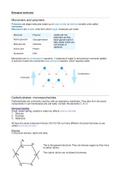
Monomers join in condensation reactions. 1 molecule of water is removed per monomer added.
A polymer is split into monomers in a hydrolysis reaction, which requires water.
Carbohydrates: monosaccharides
Carbohydrates are commonly used by cells as respiratory substrates. They also form structural
components in cell membranes and cell walls. Contain the elements C, H, O.
Monosaccharides
Small, sweet tasting, soluble in water (so affects water potential)
1. Glucose
2. Fructose
3. Galactose
All have the same molecular formula, C6 H12 O6, but have different structural formulae so are
called structural isomers.
Glucose
2 structural isomers, alpha and beta.
This is the general structure. They are hexose sugars as they have
6 carbon atoms.
The carbon atoms are numbered clockwise.
, Alpha Beta
storage monomer, e.g. starch and glycogen Strength e.g. cellulose
The different structures means they have different physical properties.
Disaccharides
• Soluble in water, sweet tasting.
• 2 monosaccharides joined by a condensation reaction, forming a glycosidic bond:
This bond is a C-O-C bond. It is also a 1,4 bond as it joins
carbons 1 and 4 together.
Formula = C12 H22 O11 (not C12 H24 O12, because one molecule of water is lost in the
condensation reaction.)
1. Maltose [glucose and glucose], intermediate in the digestion of starch
2. Lactose [glucose and galactose], sugar in milk and energy source for young mammals
3. Sucrose [glucose and fructose], used by plants to transport carbohydrates in the phloem
Polysaccharides
All are polymers, made from many similar or identical monomers.
1. Starch
2. Glycogen
3. Cellulose
Starch
• Made of alpha glucose monomers
• Storage in plants
• Insoluble in water (like all polysaccharides)
• 2 types of chains of monomers: amylose and amylopectin
Amylopectin:
1,4 and 1,6 glycosidic
bonds.
Branched structure
Amylose:
1,4 glycosidic bonds.
Long unbranched
chains that coil
Monomers and polymers
Polymers are large molecules made up of many similar or identical smaller units called
monomers.
Monomers are smaller units from which larger molecules are made
Monomer Polymer Lipids are not
polymers as they
Alpha glucose Glycogen/starch have glycerol and 3
fatty acids which are
Beta glucose Cellulose not similar or
identical
Amino acid Protein
Nucleotide DNA
Monomers join in condensation reactions. 1 molecule of water is removed per monomer added.
A polymer is split into monomers in a hydrolysis reaction, which requires water.
Carbohydrates: monosaccharides
Carbohydrates are commonly used by cells as respiratory substrates. They also form structural
components in cell membranes and cell walls. Contain the elements C, H, O.
Monosaccharides
Small, sweet tasting, soluble in water (so affects water potential)
1. Glucose
2. Fructose
3. Galactose
All have the same molecular formula, C6 H12 O6, but have different structural formulae so are
called structural isomers.
Glucose
2 structural isomers, alpha and beta.
This is the general structure. They are hexose sugars as they have
6 carbon atoms.
The carbon atoms are numbered clockwise.
, Alpha Beta
storage monomer, e.g. starch and glycogen Strength e.g. cellulose
The different structures means they have different physical properties.
Disaccharides
• Soluble in water, sweet tasting.
• 2 monosaccharides joined by a condensation reaction, forming a glycosidic bond:
This bond is a C-O-C bond. It is also a 1,4 bond as it joins
carbons 1 and 4 together.
Formula = C12 H22 O11 (not C12 H24 O12, because one molecule of water is lost in the
condensation reaction.)
1. Maltose [glucose and glucose], intermediate in the digestion of starch
2. Lactose [glucose and galactose], sugar in milk and energy source for young mammals
3. Sucrose [glucose and fructose], used by plants to transport carbohydrates in the phloem
Polysaccharides
All are polymers, made from many similar or identical monomers.
1. Starch
2. Glycogen
3. Cellulose
Starch
• Made of alpha glucose monomers
• Storage in plants
• Insoluble in water (like all polysaccharides)
• 2 types of chains of monomers: amylose and amylopectin
Amylopectin:
1,4 and 1,6 glycosidic
bonds.
Branched structure
Amylose:
1,4 glycosidic bonds.
Long unbranched
chains that coil


