

Unit 1- Biology
Specialised cells and the lungs
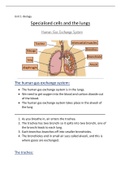
Trachea Intercostal muscles
Bronchus
Ribcage
Bronchiole
lung
Alveoli
diaphragm
The human gas exchange system:
• The human gas exchange system is in the lungs.
• We need to get oxygen into the blood and carbon dioxide out
of the blood.
• The human gas exchange system takes place in the alveoli of
the lung
________________________________________________________
1. As you breathe in, air enters the trachea.
2. The trachea has two bronchi so it splits into two bronchi, one of
the bronchi leads to each lung.
3. Each bronchus branches off into smaller bronchioles.
4. The bronchioles end in small air sacs called alveoli, and this is
where gases are exchanged.
The trachea:
, • The trachea is a flexible airway that is supported by rings of
cartilage. The rings of cartilage prevent the trachea from
collapsing when the air supply inside falls.
• The walls of the trachea are made up of muscles that are lined
with ciliated epithelium and goblet cells.
• The goblet cells produce mucus which traps dirt and bacteria.
• The cilia move the mucus up to the throat where it is
swallowed.
• The cilia produce rapid wave like motions
• The cilia moves the mucus and trapped foreign bodies (such as
pathogens) up and out of the respiratory system.
Bronchi and bronchioles:
• Bronchi are two divisions of the trachea; the larger bronchi
are supported by cartilage. Smaller bronchi (bronchioles) are
not supported by cartilage.
• Bronchioles are the branching subdivisions of the bronchi.
• The walls of the bronchi are made up of muscle that is lined
with epithelial cells. The muscles enable them to control the
flow of air in and out of the alveoli.
Alveoli and its structure:
• The alveoli are sites of gaseous exchange.
• The structure of the alveoli consists of one layer of squamous
epithelial cells which therefore gives a short diffusion pathway
for gas exchange.
• There are elastin in the walls of the alveoli which allows for
stretch and recoil (the alveoli can therefore stretch and recoil
due to elasticity).
Specialised cells and the lungs
Trachea Intercostal muscles
Bronchus
Ribcage
Bronchiole
lung
Alveoli
diaphragm
The human gas exchange system:
• The human gas exchange system is in the lungs.
• We need to get oxygen into the blood and carbon dioxide out
of the blood.
• The human gas exchange system takes place in the alveoli of
the lung
________________________________________________________
1. As you breathe in, air enters the trachea.
2. The trachea has two bronchi so it splits into two bronchi, one of
the bronchi leads to each lung.
3. Each bronchus branches off into smaller bronchioles.
4. The bronchioles end in small air sacs called alveoli, and this is
where gases are exchanged.
The trachea:
, • The trachea is a flexible airway that is supported by rings of
cartilage. The rings of cartilage prevent the trachea from
collapsing when the air supply inside falls.
• The walls of the trachea are made up of muscles that are lined
with ciliated epithelium and goblet cells.
• The goblet cells produce mucus which traps dirt and bacteria.
• The cilia move the mucus up to the throat where it is
swallowed.
• The cilia produce rapid wave like motions
• The cilia moves the mucus and trapped foreign bodies (such as
pathogens) up and out of the respiratory system.
Bronchi and bronchioles:
• Bronchi are two divisions of the trachea; the larger bronchi
are supported by cartilage. Smaller bronchi (bronchioles) are
not supported by cartilage.
• Bronchioles are the branching subdivisions of the bronchi.
• The walls of the bronchi are made up of muscle that is lined
with epithelial cells. The muscles enable them to control the
flow of air in and out of the alveoli.
Alveoli and its structure:
• The alveoli are sites of gaseous exchange.
• The structure of the alveoli consists of one layer of squamous
epithelial cells which therefore gives a short diffusion pathway
for gas exchange.
• There are elastin in the walls of the alveoli which allows for
stretch and recoil (the alveoli can therefore stretch and recoil
due to elasticity).


