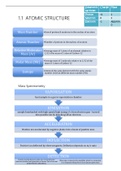
Subatomic Charge Mass
particles
Proton +1 1
1.1 ATOMIC STRUCTURE Neutron 0 1
Electron -1 Approx.
0
Mass Number •Sum of protons & neutrons in the nucleus of an atom
Atomic Number •Number of protons in the nucleus of an atom
Relative Molecular •Average mass of 1 atom of an element relative to
Mass (Ar) 1/12 of he mass of 1 atom of Carbon-12
•Average mass of 1 molecule relative to 1/12 of the
Molar Mass (Mr) mass of 1 atom of Carbon-12
•Atoms of the same element with the same atomic
Isotope number (Ar) but different mass number (Mr)
Mass Spectrometry
VAPORISATION
heat sample to a gas in vaporisation chamber
IONISATION
sample bombarded with high speed/high energy e's from electron gun - turned
into positive ion by knocking off an electron.
ACCELERATION
Positive ion accelerated by negative plates into a beam of positive ions.
DEFLECTION
Positive ion deflected by electromagnets. Deflection depends on m/z ratio
DETECTION
Positive ion hits detecor, picks up e's from detector Mass spec connected to amplifier which is connected
(electron transfer) and generates a current. Size of current
proportional to abundance. to a computer that plots a chart (mass spectrum)
, 7
working out
structure of organic 6
Relative Abundance
molecules 5
4
identifying 3
used for measuring
elements &
Ar 2
isotopes
1
measuring
relative 0
abundance a b m/z ratio
c d e
Molecular ion - largest
m/z ratio
Ionisation • energy required to remove 1 mole of
Energy (ΔHi) electrons from 1 mole of gaseous atoms.
Shell closest to
e.g Boron (2,3)Title nucleus (2
7 electrons) higher
6 ΔHi
5
4 Different shell further
Δ Hi
3 from nucleus, lower
2 ΔHi
1
0
a b c d e General trend down the group
No of e's removed
first ionisation energy
kjmol-1
DOWN THE GROUP
Ionisation energy decreases because
there are more shells/more shielding.
Therefore outer e’s are further from
nucleus so less energy required to atomic number
remover outermost e.
•ΔHi increases across a period
•Same no. of shells, same shielding but
ΔHi Across a period (period 3) nuclear charge increasing so e's held
6
1 more tightly
5 •Al has an electron in 3p orbital
which is higher energy than the 3s
4 orbital (furhter from nucleus) so
2 less energy required to remove it.
ΔHi
3
2 • In P each 3p orbital contains 1 electron
whereas in S, one of the 3p orbitals
contains 2 electrons.
1
3 • Repulsion between these paired electrons
makes it easier to remove one of them
0
Na Mg AL Si P S Cl Ar
, 1.2 AMOUNT OF SUBSTANCE
Molecular
• Actual
number
of
each
type
of
atom
Formula
in
a
compound
Empirical
• Simplest
whole
number
ratio
of
Formula
atoms
in
a
compound
Avogadro's
• 6x10²³
no.
of
atoms
of
12C
in
12g
of
constant
the
12C
isotope.
• Amount
of
substance
that
contains
the
Mole
same
no.
of
particles
as
there
are
atoms
of
12C
in
12g
of
the
12C
isotope.
𝑚𝑎𝑠𝑠
𝑚𝑜𝑙𝑒𝑠 =
𝑀𝑟
Empirical formula
Atoms X Y 𝑀𝑟
𝑀𝐹 =
% mass 𝑀𝑎𝑠𝑠 𝑜𝑓 𝐸𝐹
Moles
Simplest Ratio
then multiply EF by ^ to get
MF.
moles
Solid
moles
=
mass/Mr
volume
x
molarity
MOLE
Vol = m
3
Liquid
Gas
moles
=
vol.
x
PV=nRT
conc.
Temp = K
3
-3
Dm
Mol dm Pressure = N = moles
Pa
particles
Proton +1 1
1.1 ATOMIC STRUCTURE Neutron 0 1
Electron -1 Approx.
0
Mass Number •Sum of protons & neutrons in the nucleus of an atom
Atomic Number •Number of protons in the nucleus of an atom
Relative Molecular •Average mass of 1 atom of an element relative to
Mass (Ar) 1/12 of he mass of 1 atom of Carbon-12
•Average mass of 1 molecule relative to 1/12 of the
Molar Mass (Mr) mass of 1 atom of Carbon-12
•Atoms of the same element with the same atomic
Isotope number (Ar) but different mass number (Mr)
Mass Spectrometry
VAPORISATION
heat sample to a gas in vaporisation chamber
IONISATION
sample bombarded with high speed/high energy e's from electron gun - turned
into positive ion by knocking off an electron.
ACCELERATION
Positive ion accelerated by negative plates into a beam of positive ions.
DEFLECTION
Positive ion deflected by electromagnets. Deflection depends on m/z ratio
DETECTION
Positive ion hits detecor, picks up e's from detector Mass spec connected to amplifier which is connected
(electron transfer) and generates a current. Size of current
proportional to abundance. to a computer that plots a chart (mass spectrum)
, 7
working out
structure of organic 6
Relative Abundance
molecules 5
4
identifying 3
used for measuring
elements &
Ar 2
isotopes
1
measuring
relative 0
abundance a b m/z ratio
c d e
Molecular ion - largest
m/z ratio
Ionisation • energy required to remove 1 mole of
Energy (ΔHi) electrons from 1 mole of gaseous atoms.
Shell closest to
e.g Boron (2,3)Title nucleus (2
7 electrons) higher
6 ΔHi
5
4 Different shell further
Δ Hi
3 from nucleus, lower
2 ΔHi
1
0
a b c d e General trend down the group
No of e's removed
first ionisation energy
kjmol-1
DOWN THE GROUP
Ionisation energy decreases because
there are more shells/more shielding.
Therefore outer e’s are further from
nucleus so less energy required to atomic number
remover outermost e.
•ΔHi increases across a period
•Same no. of shells, same shielding but
ΔHi Across a period (period 3) nuclear charge increasing so e's held
6
1 more tightly
5 •Al has an electron in 3p orbital
which is higher energy than the 3s
4 orbital (furhter from nucleus) so
2 less energy required to remove it.
ΔHi
3
2 • In P each 3p orbital contains 1 electron
whereas in S, one of the 3p orbitals
contains 2 electrons.
1
3 • Repulsion between these paired electrons
makes it easier to remove one of them
0
Na Mg AL Si P S Cl Ar
, 1.2 AMOUNT OF SUBSTANCE
Molecular
• Actual
number
of
each
type
of
atom
Formula
in
a
compound
Empirical
• Simplest
whole
number
ratio
of
Formula
atoms
in
a
compound
Avogadro's
• 6x10²³
no.
of
atoms
of
12C
in
12g
of
constant
the
12C
isotope.
• Amount
of
substance
that
contains
the
Mole
same
no.
of
particles
as
there
are
atoms
of
12C
in
12g
of
the
12C
isotope.
𝑚𝑎𝑠𝑠
𝑚𝑜𝑙𝑒𝑠 =
𝑀𝑟
Empirical formula
Atoms X Y 𝑀𝑟
𝑀𝐹 =
% mass 𝑀𝑎𝑠𝑠 𝑜𝑓 𝐸𝐹
Moles
Simplest Ratio
then multiply EF by ^ to get
MF.
moles
Solid
moles
=
mass/Mr
volume
x
molarity
MOLE
Vol = m
3
Liquid
Gas
moles
=
vol.
x
PV=nRT
conc.
Temp = K
3
-3
Dm
Mol dm Pressure = N = moles
Pa