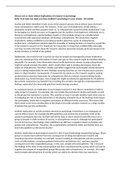
Discuss one or more ethical implications of research in psychology.
Refer to at least one topic you have studied in psychology in your answer. [16 marks]
Stanley and Seiber identified 4 main areas of the research process where ethical issues that have
social consequences might occur. For instance, in the case of schizophrenia, simply asking a
potentially socially sensitive question (such as, “is schizophrenia caused by family dysfunction”) may
be damaging to a family structure as it suggests that the families of schizophrenic individuals are to
blame for schizophrenia, causing feelings of guilt, or that anybody living in an unstable family
environment with expressed emotions will develop schizophrenia. This would have negative
implications, adding credibility to prevailing prejudice about the causes of schizophrenia.
Furthermore, schizophrenic patients might be incapable of making decisions on how they would like
to be treated in research so it is important for researchers to keep their confidentiality and make
sure they are fully informed about the research. Also the researcher should ask for permission from
family members on behalf of the patient.
Additionally, any research that is carried out may be funded and managed by private institutions
who may misinterpret the information for their own gain or the research might be misinterpreted by
the public. For example, false information about family dysfunction always causing schizophrenia
might be spread amongst the public, which could further add to existing stereotypes about the
origins of schizophrenia. Therefore, Stanley and Seiber suggest that psychologists should always be
active in taking responsibility for their findings; ensuring that they are not misused and to prevent
abuse or discrimination. Consequently, if researchers do not do so, the research could be used by
professionals to develop treatments for schizophrenia that are centred around resolving family
dysfunction (e.g. family therapy), even though this might not always be appropriate for all patients.
Also private companies may benefit from providing this narrative through the misinterpretation of
findings, especially if the financially gain from family therapy practices.
As mentioned above, an implication of psychological research is that there is potential for indirect
wider impact of research. For example, this can include the participant’s family and friends, as well
as the group they represent in society. This could be an issue in socially sensitive topic areas such as
investigating the role of family dysfunction in developing schizophrenia as the findings could impact
the participants' family due to negative stereotypes of different family structures. This means that
there needs to be more consideration of the impact of socially sensitive research on a large number
of people than just the participants.
Another implication of socially sensitive research in psychology is that there is an inadequacy of
current ethical issues. For example the BPS guidelines may protect the immediate needs of the
research participants but may not deal with all the ways in which research may inflict harm on a
group of people or wider sections of society. In schizophrenia research, although the participants
may be anonymous, the findings when published can still have a negative impact on families and
people with schizophrenia. Therefore, the considerations outlined by Sieber and Stanley have not
been fully applied to professional practice.
Another implication of psychological research is that it may disadvantage marginalised groups. Many
groups in society have suffered from the consequences of being excluded from research and
misinterpreted when included. For example, research looking at schizophrenia and the symptoms
(such as hallucinations, social/occupational dysfunction and delusion etc.) can have negative
consequences for the marginalised groups, in this case, people with schizophrenia. This is because
the findings of the data can be misinterpreted and then misunderstood by society which can lead to
negative stereotypes of marginalised groups like people with schizophrenia, for example, this might
lead to people alienating them in society which can add to the distress they may experience.
Refer to at least one topic you have studied in psychology in your answer. [16 marks]
Stanley and Seiber identified 4 main areas of the research process where ethical issues that have
social consequences might occur. For instance, in the case of schizophrenia, simply asking a
potentially socially sensitive question (such as, “is schizophrenia caused by family dysfunction”) may
be damaging to a family structure as it suggests that the families of schizophrenic individuals are to
blame for schizophrenia, causing feelings of guilt, or that anybody living in an unstable family
environment with expressed emotions will develop schizophrenia. This would have negative
implications, adding credibility to prevailing prejudice about the causes of schizophrenia.
Furthermore, schizophrenic patients might be incapable of making decisions on how they would like
to be treated in research so it is important for researchers to keep their confidentiality and make
sure they are fully informed about the research. Also the researcher should ask for permission from
family members on behalf of the patient.
Additionally, any research that is carried out may be funded and managed by private institutions
who may misinterpret the information for their own gain or the research might be misinterpreted by
the public. For example, false information about family dysfunction always causing schizophrenia
might be spread amongst the public, which could further add to existing stereotypes about the
origins of schizophrenia. Therefore, Stanley and Seiber suggest that psychologists should always be
active in taking responsibility for their findings; ensuring that they are not misused and to prevent
abuse or discrimination. Consequently, if researchers do not do so, the research could be used by
professionals to develop treatments for schizophrenia that are centred around resolving family
dysfunction (e.g. family therapy), even though this might not always be appropriate for all patients.
Also private companies may benefit from providing this narrative through the misinterpretation of
findings, especially if the financially gain from family therapy practices.
As mentioned above, an implication of psychological research is that there is potential for indirect
wider impact of research. For example, this can include the participant’s family and friends, as well
as the group they represent in society. This could be an issue in socially sensitive topic areas such as
investigating the role of family dysfunction in developing schizophrenia as the findings could impact
the participants' family due to negative stereotypes of different family structures. This means that
there needs to be more consideration of the impact of socially sensitive research on a large number
of people than just the participants.
Another implication of socially sensitive research in psychology is that there is an inadequacy of
current ethical issues. For example the BPS guidelines may protect the immediate needs of the
research participants but may not deal with all the ways in which research may inflict harm on a
group of people or wider sections of society. In schizophrenia research, although the participants
may be anonymous, the findings when published can still have a negative impact on families and
people with schizophrenia. Therefore, the considerations outlined by Sieber and Stanley have not
been fully applied to professional practice.
Another implication of psychological research is that it may disadvantage marginalised groups. Many
groups in society have suffered from the consequences of being excluded from research and
misinterpreted when included. For example, research looking at schizophrenia and the symptoms
(such as hallucinations, social/occupational dysfunction and delusion etc.) can have negative
consequences for the marginalised groups, in this case, people with schizophrenia. This is because
the findings of the data can be misinterpreted and then misunderstood by society which can lead to
negative stereotypes of marginalised groups like people with schizophrenia, for example, this might
lead to people alienating them in society which can add to the distress they may experience.