Psychology: Attachment
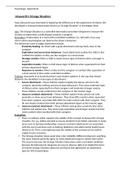
Ainsworth’s Strange Situation:
Mary Ainsworth was interested in exploring the differences in the attachment of infants. She
developed a structured observation known as ‘Strange Situation’ to investigate them.
Aim: The Strange Situation is a controlled observation procedure designed to measure the
security of attachment a child displays towards a caregiver.
Procedure: It takes place in a room with controlled conditions (i.e. lab) with a two-way
mirror where psychologists can observe the infant’s behaviour.
The behaviours used to judge attachment include:
- Proximity Seeking: An infant with a good attachment will stay fairly close to the
caregiver.
- Exploration and secure-base behaviour: Good attachment enables the child to feel
confident to explore as they use the caregiver as a secure base.
- Stranger Anxiety: When a child is closely shows signs of distress when a stranger is
around.
- Separation Anxiety: When a child shows signs of distress when separated from their
primary attachment figure.
- Response to reunion: When a baby and the caregiver is reunited after separation of
a short period of time under controlled condition.
Findings: Ainsworth et al found that there were distinct patterns in the way that infants
behaved. She identified 3 main types of attachment:
Secure attachment—These children explore happily but always returns to the
caregiver (proximity seeking and secure base behaviour). They show moderate signs
of distress when separated from their caregiver and moderate stranger anxiety.
These children accept comfort from the caregiver in the reunion stage.
Insecure-avoidant attachment—These children explore freely and do not seek
proximity or show secure base behaviour. They show little reaction when separated
from their caregiver and make little effort to make contact with their caregiver. They
do not require comfort from their primary attachment figure at the reunion stage.
Insecure-resistant attachment—These children seek greater proximity than other
children and explore less. They show huge separation and stranger anxiety but they
resist comfort when reunited with their caregiver.
Evaluation:
There is evidence which supports the validity of the concept of Ainsworth’s strange
situation. For e.g. babies assessed as secure tended to have better outcomes in many
areas such as forming relationships. Insecure resistant attachments are associated
with the worst outcomes such as bullying (Kokkinos) and adult mental health issues
(Ward et al). This is a strength because the validity of the concept can be used to
explain future outcomes.
The Strange situation shows good inter-rater reliability (different observers watching
the same children generally agree on what attachment type to classify them with).
This may be because the Strange Situation takes place under controlled conditions
because the behavioural categories are easy to observe. Bick et al studied the team
of trained Strange Situation observers and found that agreement on attachment
type for 94% tested babies.
Ainsworth’s Strange Situation:
Mary Ainsworth was interested in exploring the differences in the attachment of infants. She
developed a structured observation known as ‘Strange Situation’ to investigate them.
Aim: The Strange Situation is a controlled observation procedure designed to measure the
security of attachment a child displays towards a caregiver.
Procedure: It takes place in a room with controlled conditions (i.e. lab) with a two-way
mirror where psychologists can observe the infant’s behaviour.
The behaviours used to judge attachment include:
- Proximity Seeking: An infant with a good attachment will stay fairly close to the
caregiver.
- Exploration and secure-base behaviour: Good attachment enables the child to feel
confident to explore as they use the caregiver as a secure base.
- Stranger Anxiety: When a child is closely shows signs of distress when a stranger is
around.
- Separation Anxiety: When a child shows signs of distress when separated from their
primary attachment figure.
- Response to reunion: When a baby and the caregiver is reunited after separation of
a short period of time under controlled condition.
Findings: Ainsworth et al found that there were distinct patterns in the way that infants
behaved. She identified 3 main types of attachment:
Secure attachment—These children explore happily but always returns to the
caregiver (proximity seeking and secure base behaviour). They show moderate signs
of distress when separated from their caregiver and moderate stranger anxiety.
These children accept comfort from the caregiver in the reunion stage.
Insecure-avoidant attachment—These children explore freely and do not seek
proximity or show secure base behaviour. They show little reaction when separated
from their caregiver and make little effort to make contact with their caregiver. They
do not require comfort from their primary attachment figure at the reunion stage.
Insecure-resistant attachment—These children seek greater proximity than other
children and explore less. They show huge separation and stranger anxiety but they
resist comfort when reunited with their caregiver.
Evaluation:
There is evidence which supports the validity of the concept of Ainsworth’s strange
situation. For e.g. babies assessed as secure tended to have better outcomes in many
areas such as forming relationships. Insecure resistant attachments are associated
with the worst outcomes such as bullying (Kokkinos) and adult mental health issues
(Ward et al). This is a strength because the validity of the concept can be used to
explain future outcomes.
The Strange situation shows good inter-rater reliability (different observers watching
the same children generally agree on what attachment type to classify them with).
This may be because the Strange Situation takes place under controlled conditions
because the behavioural categories are easy to observe. Bick et al studied the team
of trained Strange Situation observers and found that agreement on attachment
type for 94% tested babies.