Psychology: Approaches
Cognitive Approach
Assumptions:
Cognitive approach is the internal mental process that can be studies scientifically
The cognitive approach has investigated those areas of human behaviour that were
neglected by behaviourists such as memory.
These processes are private and cannot be observed, so cognitive psychologists study them
indirectly by making inferences about what is going on inside people’s minds on the basis of
their behaviour
Schema:
A ‘package’ of beliefs and expectations on a topic that comes from prior experiences. -
Always changing due to experiences
Schema affects behaviour
Schemas for babies are simpler as they are born with simple motor schema for innate
behaviours such as sucking and grasping.
Our schemas develop as we grow older and tends to get more sophisticated. Adults have
developed mental representation for everything.
Schema enables us to process lots of information quickly and this is useful as a sort
of mental short-cut that prevents us from being overwhelmed by environmental
stimuli
Schema may distort our interpretations of sensory information, leading to
perceptual errors. For e.g. schema for exams is that they are difficult and scary so it
is possible that you can have a panic attack before the exams which is not useful
Theoretic models:
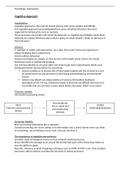
Information processing model
Processing Info
Input Info is coded and Output
From the environmental processed using Observable Behaviour
stimuli schemas
Computer Models:
Brain processing information like a computer
Central processing unit- brain coding- turn information into a useful format when you think
of something/ say something in your head, only you can hear it
The emergence of cognitive neuroscience:
Scientific study of biological structures that underpin mental processes
Broca identifies the damage to an area of the frontal lobe (part of the brain) that makes us
lose the ability to speak
Recently, advances in brain imagining techniques such as FMRI and PET scans, that scientists
have been able to observe and describe the basis of mental processes
Cognitive Approach
Assumptions:
Cognitive approach is the internal mental process that can be studies scientifically
The cognitive approach has investigated those areas of human behaviour that were
neglected by behaviourists such as memory.
These processes are private and cannot be observed, so cognitive psychologists study them
indirectly by making inferences about what is going on inside people’s minds on the basis of
their behaviour
Schema:
A ‘package’ of beliefs and expectations on a topic that comes from prior experiences. -
Always changing due to experiences
Schema affects behaviour
Schemas for babies are simpler as they are born with simple motor schema for innate
behaviours such as sucking and grasping.
Our schemas develop as we grow older and tends to get more sophisticated. Adults have
developed mental representation for everything.
Schema enables us to process lots of information quickly and this is useful as a sort
of mental short-cut that prevents us from being overwhelmed by environmental
stimuli
Schema may distort our interpretations of sensory information, leading to
perceptual errors. For e.g. schema for exams is that they are difficult and scary so it
is possible that you can have a panic attack before the exams which is not useful
Theoretic models:
Information processing model
Processing Info
Input Info is coded and Output
From the environmental processed using Observable Behaviour
stimuli schemas
Computer Models:
Brain processing information like a computer
Central processing unit- brain coding- turn information into a useful format when you think
of something/ say something in your head, only you can hear it
The emergence of cognitive neuroscience:
Scientific study of biological structures that underpin mental processes
Broca identifies the damage to an area of the frontal lobe (part of the brain) that makes us
lose the ability to speak
Recently, advances in brain imagining techniques such as FMRI and PET scans, that scientists
have been able to observe and describe the basis of mental processes