Psychology: Approaches
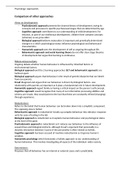
Comparison of other approaches
Views on development:
- Psychodynamic approach presents the clearest theory of development, trying its
concepts and processes to specific psychosexual stages that are determined by age.
- Cognitive approach contributes to our understanding of child development. For
instance, as part of our intellectual development, children form complex concepts
(schemas) as we grow older.
- Biological approach believes maturation is important and genetically determined
changes in a child’s psychological status influence psychological and behavioural
characteristics.
- Humanistic approach sees the development of self as ongoing throughout life.
- Behaviourist approach and social learning theory do not offer clear stage theories
of development but argue that learning is continuous.
Nature versus nurture:
Ongoing debate whether human behaviour is influenced by inherited factors or
environmental factors.
Biological approach and the 2 learning approaches (SLT and behaviourist approach) are
furthest apart.
Biological approach argues that behaviour is the result of genetic blueprint that we inherit
from our parents.
Freud disagreed and argues that our behaviour is driven by biological factors- saw
relationship with parents as important as it plays a fundamental role in future development.
Humanistic approach regard family as having a critical impact on the person’s self-concept.
Cognitive approach would recognise that many of our information processing abilities and
schema are innate, they would point to the fact that these are constantly refined (changing)
through experience.
Reductionism:
Refers to the belief that human behaviour can be broken down into a simplistic component.
The opposing view is holism
Behaviourist approach is reductionist- breaks up complex behaviour into stimulus- response
units for ease of testing in the lab
Biological approach is reductionist as it explains human behaviour and psychological states
at the level of the gene
Psychodynamic approach is reductionist as it reduces our behaviour to the influence of
sexual drives and biological instincts, although Freud’s argument that personality is a
dynamic interaction between 3 parts of the personality is often viewed as holistic.
Cognitive approach has been accused of machine reductionism as it ignores human’s
emotion.
Humanistic psychology which formulates a holistic approach to our understanding of
human behaviour. This involves investigating all aspects of the individual- wider society.
Determinism:
Proposes that all behaviour has an internal or external cause and is predictable.
Comparison of other approaches
Views on development:
- Psychodynamic approach presents the clearest theory of development, trying its
concepts and processes to specific psychosexual stages that are determined by age.
- Cognitive approach contributes to our understanding of child development. For
instance, as part of our intellectual development, children form complex concepts
(schemas) as we grow older.
- Biological approach believes maturation is important and genetically determined
changes in a child’s psychological status influence psychological and behavioural
characteristics.
- Humanistic approach sees the development of self as ongoing throughout life.
- Behaviourist approach and social learning theory do not offer clear stage theories
of development but argue that learning is continuous.
Nature versus nurture:
Ongoing debate whether human behaviour is influenced by inherited factors or
environmental factors.
Biological approach and the 2 learning approaches (SLT and behaviourist approach) are
furthest apart.
Biological approach argues that behaviour is the result of genetic blueprint that we inherit
from our parents.
Freud disagreed and argues that our behaviour is driven by biological factors- saw
relationship with parents as important as it plays a fundamental role in future development.
Humanistic approach regard family as having a critical impact on the person’s self-concept.
Cognitive approach would recognise that many of our information processing abilities and
schema are innate, they would point to the fact that these are constantly refined (changing)
through experience.
Reductionism:
Refers to the belief that human behaviour can be broken down into a simplistic component.
The opposing view is holism
Behaviourist approach is reductionist- breaks up complex behaviour into stimulus- response
units for ease of testing in the lab
Biological approach is reductionist as it explains human behaviour and psychological states
at the level of the gene
Psychodynamic approach is reductionist as it reduces our behaviour to the influence of
sexual drives and biological instincts, although Freud’s argument that personality is a
dynamic interaction between 3 parts of the personality is often viewed as holistic.
Cognitive approach has been accused of machine reductionism as it ignores human’s
emotion.
Humanistic psychology which formulates a holistic approach to our understanding of
human behaviour. This involves investigating all aspects of the individual- wider society.
Determinism:
Proposes that all behaviour has an internal or external cause and is predictable.