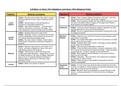
G.R.Elton on Henry VII’s Rebellions and Henry VIII’s Religious Policy
Rebellion Historian commentry Opposition Historian commentry
• G.Elton: “Question arose whether they ought to escape Foreign • G.Elton: “Fears of papal retaliation through the cloth trade…such fears
justice because the Church’s right of sanctuary had be delayed the first act of annates and the acts of appeals”
violated” • G.Elton: “Some burgesses showed that they preferred Catherine to Anne,
Lovell/ • G.Elton: “striking instance of the growing spirit of and some lords talked wildly to Chapuys of the support that Charles V
Stafford resistance to ecclesiastical pretensions” would receive if he invaded England”
• G.Elton: “Case deserves attention…Tudor principle of
relying on the decision of Common Law judge…and Parliament • G.Elton: “Commons proved themselves capable of opposition by freely
Tudor disregard for ancient franchises and immunities” resisting demands for money and financial assertion”
• G.Elton: “The act of appeals passed only because members did not like
• G.Elton: “Suddenly faced with a major threat” to displease Cromwell”
• G.Elton: “Subsidiary moves in Lancashire and Cornwall
could be disregarded, but the menace from across the Ministers/ • G.Elton: “Opposition was confined to those few whose objection rested
Lambert Bishops on principle or conscience”
Irish channel demanded immediate action”
Simnel • G.Elton: “The English Reformation under Henry VII produced, one might
• G.Elton: “his power rested on Kildare, Yorkist leaders…
2,000 German mercenaries contributed by Margaret of say, no victims and only martyrs”
Burgundy” • G.Elton: “Elizabeth Barton [Nun of Kent] 1525 began to attract attention
by her trances and prophecies”
• G.Elton: “Warbeck’s first protector was Charles VIII of • G.Elton: “Talk was not yet treasonable in statue law”
France…the treaty of Etaples put a stop to this and in • G.Elton: “Fisher and More were included…accused of misprision of the
1493 Warbeck passed into Burgundy Nun’s treason by having kept silent about her doings…Fisher had played
• G.Elton: “1493 he was in Vienna winning over the an equivocal part…he was in a position to deal with the Nun”
Warbeck unstable and foolish Maximilian…paying Henry VII out of • G.Elton: “More defended himself brilliantly in a trial scene as famous
his alleged treachery in the treaty of Etaples. Maximilian almost as that of Socrates”
went so far as to recognise Warbeck as Richard IV… • G.Elton: “Executions…More and Fisher, have always been considered
Warbeck signed a document in 1495 which made the worst blot on Henry’s record”
Maximilian his heir” • G.Elton: “Fisher had been in treasonable correspondence with the
emperor’s ambassador”
• G.Elton: “Killed a tax-collector at Taunton”
Cornish Dissolution • G.Elton: “in some ways it was almost the least revolutionary part of the
of the revolution, for attacks on clerical property and piecemeal dissolutions had
Monasteries taken place at intervals over the centuries”
• G.Elton: “Monastic charity and hospitality too, played little part in 16th
century…monks gave less that 5% of their net income to charitable
purposes”
Rebellion Historian commentry Opposition Historian commentry
• G.Elton: “Question arose whether they ought to escape Foreign • G.Elton: “Fears of papal retaliation through the cloth trade…such fears
justice because the Church’s right of sanctuary had be delayed the first act of annates and the acts of appeals”
violated” • G.Elton: “Some burgesses showed that they preferred Catherine to Anne,
Lovell/ • G.Elton: “striking instance of the growing spirit of and some lords talked wildly to Chapuys of the support that Charles V
Stafford resistance to ecclesiastical pretensions” would receive if he invaded England”
• G.Elton: “Case deserves attention…Tudor principle of
relying on the decision of Common Law judge…and Parliament • G.Elton: “Commons proved themselves capable of opposition by freely
Tudor disregard for ancient franchises and immunities” resisting demands for money and financial assertion”
• G.Elton: “The act of appeals passed only because members did not like
• G.Elton: “Suddenly faced with a major threat” to displease Cromwell”
• G.Elton: “Subsidiary moves in Lancashire and Cornwall
could be disregarded, but the menace from across the Ministers/ • G.Elton: “Opposition was confined to those few whose objection rested
Lambert Bishops on principle or conscience”
Irish channel demanded immediate action”
Simnel • G.Elton: “The English Reformation under Henry VII produced, one might
• G.Elton: “his power rested on Kildare, Yorkist leaders…
2,000 German mercenaries contributed by Margaret of say, no victims and only martyrs”
Burgundy” • G.Elton: “Elizabeth Barton [Nun of Kent] 1525 began to attract attention
by her trances and prophecies”
• G.Elton: “Warbeck’s first protector was Charles VIII of • G.Elton: “Talk was not yet treasonable in statue law”
France…the treaty of Etaples put a stop to this and in • G.Elton: “Fisher and More were included…accused of misprision of the
1493 Warbeck passed into Burgundy Nun’s treason by having kept silent about her doings…Fisher had played
• G.Elton: “1493 he was in Vienna winning over the an equivocal part…he was in a position to deal with the Nun”
Warbeck unstable and foolish Maximilian…paying Henry VII out of • G.Elton: “More defended himself brilliantly in a trial scene as famous
his alleged treachery in the treaty of Etaples. Maximilian almost as that of Socrates”
went so far as to recognise Warbeck as Richard IV… • G.Elton: “Executions…More and Fisher, have always been considered
Warbeck signed a document in 1495 which made the worst blot on Henry’s record”
Maximilian his heir” • G.Elton: “Fisher had been in treasonable correspondence with the
emperor’s ambassador”
• G.Elton: “Killed a tax-collector at Taunton”
Cornish Dissolution • G.Elton: “in some ways it was almost the least revolutionary part of the
of the revolution, for attacks on clerical property and piecemeal dissolutions had
Monasteries taken place at intervals over the centuries”
• G.Elton: “Monastic charity and hospitality too, played little part in 16th
century…monks gave less that 5% of their net income to charitable
purposes”