

GROSS NEGLIGENCE INVOL MAN
Intro:
D has the potential defence to murder of gross negligence
This arises when a death has occurred, but there is no malice aforethought (intention to kill or
cause GBH) to give rise to a murder conviction.
If successfully proven, beyond all reasonable doubt, D can be sentenced anything up to life, on
the judge’s discretion.
1. D OWES A DUTY OF CARE TO V:
The leading case on gross negligence is R v Adomako, where an anaesthetist failed to recognise
an oxygen tube had been dislodged, which led to the victim’s death.
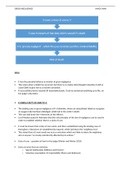
This case laid down the 4 elements of the offence.
Lord Mackay stated in Adomako that the civil principles of the law of negligence can be used in
order to establish whether there is a duty of care
It must be shown that a duty of care exists, and this is established using the leading case of
Donoghue v Stevenson (re-established by Caparo), which laid down the ‘neighbour test’
This stated that a D must avoid any acts or omissions which are likely to injure his neighbour,
who is anyone “so closely and directly affected by his actions.”
Duty of care – question of law for the judge (Winter and Winter 2010)
Duty can arise from an omission:
o Special relationship (Gibbons and Proctor)
o Voluntary assumption of responsibility (Stone and Dobinson)
Intro:
D has the potential defence to murder of gross negligence
This arises when a death has occurred, but there is no malice aforethought (intention to kill or
cause GBH) to give rise to a murder conviction.
If successfully proven, beyond all reasonable doubt, D can be sentenced anything up to life, on
the judge’s discretion.
1. D OWES A DUTY OF CARE TO V:
The leading case on gross negligence is R v Adomako, where an anaesthetist failed to recognise
an oxygen tube had been dislodged, which led to the victim’s death.
This case laid down the 4 elements of the offence.
Lord Mackay stated in Adomako that the civil principles of the law of negligence can be used in
order to establish whether there is a duty of care
It must be shown that a duty of care exists, and this is established using the leading case of
Donoghue v Stevenson (re-established by Caparo), which laid down the ‘neighbour test’
This stated that a D must avoid any acts or omissions which are likely to injure his neighbour,
who is anyone “so closely and directly affected by his actions.”
Duty of care – question of law for the judge (Winter and Winter 2010)
Duty can arise from an omission:
o Special relationship (Gibbons and Proctor)
o Voluntary assumption of responsibility (Stone and Dobinson)


