
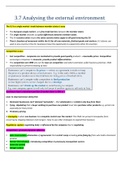
3.7 Analysing the external environment
The EU Is a single market- trade between member states is easy
§ The European single market- very few trade barriers between EU member states
§ The single market smooths out price differences between member states.
§ The EU customs union means the same customs duties apply to all good entering the EU
§ There’s freedom of movement within the EU for all raw materials, finished goods and workers. EU citizens can
work in any country in the EU, businesses have the opportunity to expand into other EU countries
Competition Laws:
§ Fair competition - companies are motivated to provide good quality products - reasonable prices. Competition
encourages companies to innovate, provide product differentiation
§ The competition Act 1998 sets out the laws on competition and what constitutes unfair business practices. CMA
responsibility to prevent breaking of laws
Businesses have a dominant position if market share is 50% or >
Laws to stop businesses doing this:
1. Dominant businesses can’t demand ‘exclusivity’ – that wholesalers or retailers only buy from them
2. Tying- stipulating that a buyer wishing to purchase one product must also purchase other products e.g. printer ink
especially for that printer
3. Predatory pricing
A monopoly is when one business has complete control over the market. The CMA can prevent monopolies from
occurring by stopping takeover and mergers- have to use other strategies to expand their business
Regulatory capture-regulating body is influenced by the company they’re regulating
Competition- promotes dynamic efficiency
§ Anti- trust cartels- elimination of agreements that restrict comp including price-fixing by firms who hold a dominant
position
§ Market liberalisation- introducing competition in previously monopolistic sectors
§ State aid control
§ Merger control
,Environmental policy - Businesses can turn these restrictions into USP- being the most environmentally friendly
§ Businesses have to ensure their production processes don’t cause pollution- pressure groups
§ Businesses must get authorisation before carrying out processes which create smoke or make noise. Environmental
health officers can force factories to stop making noise at night if its disturbing
§ The EU’s Emissions trading system gives greenhouse gas emissions allowances to businesses in the EU. Companies
can trade their allowances, they can sell some to a business that has run out
§ ‘green subsidy schemes’ pays businesses that use renewable energy to heat their buildings
§ The UK gov and EU fund organisation that encourage more efficient use of raw materials, such as the Waste and
Resources Action Programme (WRAP)- helps achieve a circular economy
Employment Law
An employee has a legal right to fair treatment while at work, and also while looking for employment
The equality act 2010 protects employees from discrimination based on age, gender, race, religion, disability ‘protected
characteristics’
§ Direct discrimination- treating someone less favourably as they have a protected characteristic
§ Indirect discrimination – when everyone is treated the same but it has a worse effect on one group of people than
another. E.g. a rule that employees mustn’t wear head coverings
Discrimination laws affect all aspects of businesses:
§ Recruitment, Pay, Promotions and redundancies
§ Avoiding discrimination when recruiting - businesses will recruit a more diverse workforce, wider range of
skills, talent and experience
§ Equal pay for both genders, same benefits too
§ Businesses can’t discriminate against young people for a promotion as they’re more likely to change jobs
Employment tribunals settle disputes
§ If employees feel they’ve been treated by their employers they can make a claim to a tribunal
§ Employer may have to pay compensation or give the employee their job back in an unfair dismissal case
Employers have to pay staff at least the minimum wage
§ Introduced in 1999 to prevent employees being paid unfairly low wages. In 2016 the NLW was introduced to replace
the minimum wages for over 25’s
§ NLW- increase motivation, reduce absenteeism, allows company to market themselves as an ethical employer
Employment contract sets out the conditions of employment- legally binding agreement between the employer and
employee about duties and rights. Employees are entitled to receive a written statement of employment within 2
month of starting work
, Business and the political environment
Government policies encourage enterprise
§ New businesses increase productivity- creates new jobs. Gov is keen to promote enterprise in areas that need
economic regeneration- provides opportunities
Strategies for this:
§ Government schemes allow enterprises to borrow money at low I/R and encourage private investment in businesses.
The enterprise investment scheme is a gov scheme that offers tax incentives to people who invest in small businesses
§ To make It easier for small businesses to succeed they don’t pay business rates and an employment allowance means
their national insurance contributions bill is reduced by £2000
Regulation
Privatisation- many state owned firms were sold into the private sector to improve efficiency and make a profit. E.g.
British gas, British telecom, British Steel and water companies
§ Some industries are natural monopolies. When privatising a natural monopoly the gov needs to build in regulation to
prevent the new owners from exploiting their position and raising prices
Infrastructure is made up of physical things, transport networks, pipes, wires that allow water, energy and information to
move about
Improvement in infrastructure - good for the economy – businesses more productive. This reduces costs of productions for
firms as transporting goods and services around the country and internationally becomes easier thus increasing efficiency
competitiveness which in the short and long run increases economic growth. Profitability for firms also increases as their
cost of productions reduce, this allows them to re-invest into their business and allow for their growth to persist over time.
Additionally, infrastructure improvements - allow for businesses to compete internationally, as they are more price and
quality competitive.
Policy changes can make international trade easier or harder:
§ Tariffs (import taxes) discourage international trade. removing or reducing tariffs between countries provide
opportunities for business by making international trade easier and cheaper
§ Quotas are trade restrictions set by governments that put limits on imports and exports, using import quotas allow
countries to protect their own economies and jobs- protectionist policy. Two or more countries sign a free trade
agreement which removes quotas between them to encourage international trade
§ Trade embargoes ban trade with a particular country. Less extreme are sanctions
The EU Is a single market- trade between member states is easy
§ The European single market- very few trade barriers between EU member states
§ The single market smooths out price differences between member states.
§ The EU customs union means the same customs duties apply to all good entering the EU
§ There’s freedom of movement within the EU for all raw materials, finished goods and workers. EU citizens can
work in any country in the EU, businesses have the opportunity to expand into other EU countries
Competition Laws:
§ Fair competition - companies are motivated to provide good quality products - reasonable prices. Competition
encourages companies to innovate, provide product differentiation
§ The competition Act 1998 sets out the laws on competition and what constitutes unfair business practices. CMA
responsibility to prevent breaking of laws
Businesses have a dominant position if market share is 50% or >
Laws to stop businesses doing this:
1. Dominant businesses can’t demand ‘exclusivity’ – that wholesalers or retailers only buy from them
2. Tying- stipulating that a buyer wishing to purchase one product must also purchase other products e.g. printer ink
especially for that printer
3. Predatory pricing
A monopoly is when one business has complete control over the market. The CMA can prevent monopolies from
occurring by stopping takeover and mergers- have to use other strategies to expand their business
Regulatory capture-regulating body is influenced by the company they’re regulating
Competition- promotes dynamic efficiency
§ Anti- trust cartels- elimination of agreements that restrict comp including price-fixing by firms who hold a dominant
position
§ Market liberalisation- introducing competition in previously monopolistic sectors
§ State aid control
§ Merger control
,Environmental policy - Businesses can turn these restrictions into USP- being the most environmentally friendly
§ Businesses have to ensure their production processes don’t cause pollution- pressure groups
§ Businesses must get authorisation before carrying out processes which create smoke or make noise. Environmental
health officers can force factories to stop making noise at night if its disturbing
§ The EU’s Emissions trading system gives greenhouse gas emissions allowances to businesses in the EU. Companies
can trade their allowances, they can sell some to a business that has run out
§ ‘green subsidy schemes’ pays businesses that use renewable energy to heat their buildings
§ The UK gov and EU fund organisation that encourage more efficient use of raw materials, such as the Waste and
Resources Action Programme (WRAP)- helps achieve a circular economy
Employment Law
An employee has a legal right to fair treatment while at work, and also while looking for employment
The equality act 2010 protects employees from discrimination based on age, gender, race, religion, disability ‘protected
characteristics’
§ Direct discrimination- treating someone less favourably as they have a protected characteristic
§ Indirect discrimination – when everyone is treated the same but it has a worse effect on one group of people than
another. E.g. a rule that employees mustn’t wear head coverings
Discrimination laws affect all aspects of businesses:
§ Recruitment, Pay, Promotions and redundancies
§ Avoiding discrimination when recruiting - businesses will recruit a more diverse workforce, wider range of
skills, talent and experience
§ Equal pay for both genders, same benefits too
§ Businesses can’t discriminate against young people for a promotion as they’re more likely to change jobs
Employment tribunals settle disputes
§ If employees feel they’ve been treated by their employers they can make a claim to a tribunal
§ Employer may have to pay compensation or give the employee their job back in an unfair dismissal case
Employers have to pay staff at least the minimum wage
§ Introduced in 1999 to prevent employees being paid unfairly low wages. In 2016 the NLW was introduced to replace
the minimum wages for over 25’s
§ NLW- increase motivation, reduce absenteeism, allows company to market themselves as an ethical employer
Employment contract sets out the conditions of employment- legally binding agreement between the employer and
employee about duties and rights. Employees are entitled to receive a written statement of employment within 2
month of starting work
, Business and the political environment
Government policies encourage enterprise
§ New businesses increase productivity- creates new jobs. Gov is keen to promote enterprise in areas that need
economic regeneration- provides opportunities
Strategies for this:
§ Government schemes allow enterprises to borrow money at low I/R and encourage private investment in businesses.
The enterprise investment scheme is a gov scheme that offers tax incentives to people who invest in small businesses
§ To make It easier for small businesses to succeed they don’t pay business rates and an employment allowance means
their national insurance contributions bill is reduced by £2000
Regulation
Privatisation- many state owned firms were sold into the private sector to improve efficiency and make a profit. E.g.
British gas, British telecom, British Steel and water companies
§ Some industries are natural monopolies. When privatising a natural monopoly the gov needs to build in regulation to
prevent the new owners from exploiting their position and raising prices
Infrastructure is made up of physical things, transport networks, pipes, wires that allow water, energy and information to
move about
Improvement in infrastructure - good for the economy – businesses more productive. This reduces costs of productions for
firms as transporting goods and services around the country and internationally becomes easier thus increasing efficiency
competitiveness which in the short and long run increases economic growth. Profitability for firms also increases as their
cost of productions reduce, this allows them to re-invest into their business and allow for their growth to persist over time.
Additionally, infrastructure improvements - allow for businesses to compete internationally, as they are more price and
quality competitive.
Policy changes can make international trade easier or harder:
§ Tariffs (import taxes) discourage international trade. removing or reducing tariffs between countries provide
opportunities for business by making international trade easier and cheaper
§ Quotas are trade restrictions set by governments that put limits on imports and exports, using import quotas allow
countries to protect their own economies and jobs- protectionist policy. Two or more countries sign a free trade
agreement which removes quotas between them to encourage international trade
§ Trade embargoes ban trade with a particular country. Less extreme are sanctions



