
Chapter 6 Investment notes:
Diversification is the process of allocating capital in a way that reduces the exposure to one
particular asset or risk.
Diversification reduces risk or volatility by investing in various assets
What are sources of risk affecting this portfolio?
Market/Systematic/non diversifiable risk: Risk factors to the WHOLE ECONOMY: INFLATION,
BUSINESS CYCLES, INTEREST RATES, and EXCHANGE RATES, cannot be predicted with
certainty.
Unique, Firm-specific/Nonsystematic/Diversifiable risk: Risk that can be eliminated by
diversification. Success in R&D, management style, and philosophy. Things that affect a
company without necessarily affecting other companies.
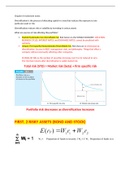
Portfolio SD falls as the number of securities increases, but it is not reduced to zero.
The risk that remains after diversification is called market risk.
Total risk (STD) = Market risk (beta) + firm specific risk
Portfolio risk decreases as diversification increases
FIRST, 2 RISKY ASSETS (BOND AND STOCK)
n
Wi = 1 W 1= Proportion of funds in security 1 W 2=1- W 1 Proportion of funds in security 2
i=1
, The sum of weights must always add to one.
ALWAYS USE TOTAL EXPECTED RETURN
bonds perform best in a mild recession,
returning 15% (since falling interest rates
create capital gains.
Notice that bonds outperform stocks in
both the mild and severe recession
scenarios. In both normal growth and
boom scenarios, stocks outperform
bonds.
(Ri – E(R))^2 is the squared deviation
When you use probabilities, you multiply
them by the ERs of each and then add to find
the total ER.
, If you are using weights like 40% and 60% with the Ers
of each (stock and bonds) in a certain state, then you
can’t add them.
The low risk of the portfolio is due to inverse rlt
between performances of stocks and bonds. In
recession, stocks don’t do well, however it is offset by
the large positive return of the bond.
Notice that the portfolio SD is actually lower than that
of either component fund
Covariance and correlation:
Diversification is the process of allocating capital in a way that reduces the exposure to one
particular asset or risk.
Diversification reduces risk or volatility by investing in various assets
What are sources of risk affecting this portfolio?
Market/Systematic/non diversifiable risk: Risk factors to the WHOLE ECONOMY: INFLATION,
BUSINESS CYCLES, INTEREST RATES, and EXCHANGE RATES, cannot be predicted with
certainty.
Unique, Firm-specific/Nonsystematic/Diversifiable risk: Risk that can be eliminated by
diversification. Success in R&D, management style, and philosophy. Things that affect a
company without necessarily affecting other companies.
Portfolio SD falls as the number of securities increases, but it is not reduced to zero.
The risk that remains after diversification is called market risk.
Total risk (STD) = Market risk (beta) + firm specific risk
Portfolio risk decreases as diversification increases
FIRST, 2 RISKY ASSETS (BOND AND STOCK)
n
Wi = 1 W 1= Proportion of funds in security 1 W 2=1- W 1 Proportion of funds in security 2
i=1
, The sum of weights must always add to one.
ALWAYS USE TOTAL EXPECTED RETURN
bonds perform best in a mild recession,
returning 15% (since falling interest rates
create capital gains.
Notice that bonds outperform stocks in
both the mild and severe recession
scenarios. In both normal growth and
boom scenarios, stocks outperform
bonds.
(Ri – E(R))^2 is the squared deviation
When you use probabilities, you multiply
them by the ERs of each and then add to find
the total ER.
, If you are using weights like 40% and 60% with the Ers
of each (stock and bonds) in a certain state, then you
can’t add them.
The low risk of the portfolio is due to inverse rlt
between performances of stocks and bonds. In
recession, stocks don’t do well, however it is offset by
the large positive return of the bond.
Notice that the portfolio SD is actually lower than that
of either component fund
Covariance and correlation:



