Unit 3: Business decisions and strategy
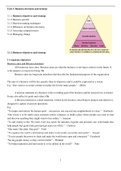
3.1.1 Business objectives and strategy
3.1.2 Business growth
3.1.3 Decision-making techniques
3.1.4 Influences on business decisions
3.1.5 Assessing competitiveness
3.1.6 Managing change
3.1.1 Business objectives and strategy
1 Corporate objectives
Business aims and Mission statement
All businesses have aims. Business aims are what the business is striving to achieve in the future. It
is the purpose or reason for being. Or
Business aims are long-term intentions that describe the fundamental purpose of the organisation.
The aim of a business will be less specific than its objectives and it could be expressed as a vision.
E.g. “Our vision is to create a better everyday life for the many people.” – IKEA
A mission statement of a business is the overriding goal of the business and the reason for its existence.
It may also reflect its goals and values. Or
A Mission statement is a brief statement, written by the business, describing its purpose and objectives,
designed to capture its present operations.
E.g.
“To inspire and nurture the human spirit – one person, one cup and one neighborhood at a time.” - Starbucks
“Our vision is to be earth's most customer-centric company; to build a place where people can come to find
and discover anything they might want to buy online.” - Amazon
“To add vitality to life. We meet every day needs for nutrition, hygiene and personal care with brands that
help people feel good, look good and get more out of life.” – Unilever
“One team. One plan. One goal.” - Ford
“To organize the world’s information and make it universally accessible and useful.” – Google
“To give people the power to share and make the world more open and connected.”– Facebook
“Saving people money so they can live better” – Walmart
“To bring inspiration and innovation to every athlete in the world” – Nike
1
, Mission statement describes in general terms what it considers to be the company’s core activities and
may also reference such information as the markets in which it operates, what its key commercial objectives
are, in what way it values its stakeholders, or what its ethics involve.
Features of a good mission statement:
It clarifies the direction a business should take by reminding the owners and directors of the reason why
business exists.
It brings business’s workforce together, inspire and increase employee motivation which can improve
efficiency, leading to a competitive advantage.
It guides the decision making process of the firm.
A good mission sta. differentiates the business from its competitors.
It guides the business to create a strong brand loyalty.
A good mission statement forms a promise to customers on what they can expect the business to strive for.
A good mission stat. is relevant to all major stakeholders - not just shareholders and managers.
Benefits of a mission statement:
A simple and clear mission statement can act as a motivational tool within the business. It can encourage
employees to work together towards one common goal that benefits both the organisation and themselves.
A good mission statement helps to engender job satisfaction and motivation, leading to increased
productivity.
It signifies clear intent and direction and acts as a signal to all stakeholders that the business knows what
it is doing and is on the right track. It is this sense of coherence and stability that is perhaps the mission
statement’s most important attribute.
Limitations of a mission statement:
A business may want its mission statement to sound good but its main purpose is to get people to do things.
An unrealistic mission statement can actually be de-motivating; employees may struggle to meet its
demands and it may lead the business to make unwise decisions.
Mission statements have also been criticised as a waste of time and money; those resources could be better
used in other areas of the business. In short, a mission statement may be no more than a PR exercise.
It is impossible to sum up what a business is all about in one or two sentences.
It may not always supported by actions of the business.
Development of corporate objectives from mission statement/corporate aims:
Corporate objectives:
Corporate objectives are those related to the business as a whole. They are set by managers and
directors of a company.
Corporate objectives should be specific to the company, its particular history and vision of the future,
and sit well with its mission statement. They should focus mainly on desired performance and results of the
business over time.
2
, Purposes of corporate objectives:
Provide strategic focus
Measure performance of the firm as a whole
Informed decision making
It acts as a guide to create more detailed functional objectives
Key areas for corporate objectives:
Market standing - Market share, customer satisfaction, product range
Innovation - New products, better processes, using technology
Productivity - Optimum use of resources, focus on core activities
Physical & financial resources - Factories, business locations, finance, supplies
Profitability - Level of profit, rates of return on investment
Management - Management structure; promotion & development
Employees - Organisational structure; employee relations
Public responsibility - Compliance with laws; social and ethical behaviour
The most effective objectives meet the following criteria:
S - Specific – objectives set out clearly what the business is aiming to achieve and should refer to a particular
aspect or function of the business.
E.g. a hotel might have an objective of filling 60% of its rooms a night during October, an objective specific
to that business.
M - Measurable – the business can put a value to the objective.
E.g. €10,000 in sales in the next half year of trading.
A - Agreed by all those concerned in trying to achieve the objective.
R - Realistic – the objective should be challenging, but it should also be able to be achieved by the resources
available and the prevailing market conditions.
T - Time specific – gives the stated time frame within which the objectives are to be achieved.
E.g. by the end of the year.
Departmental/ functional objectives:
Departmental and functional objectives are objectives of a department/ function within a business.
These are set for each major department or business function to ensure that the corporate objectives are
achieved.
3
3.1.1 Business objectives and strategy
3.1.2 Business growth
3.1.3 Decision-making techniques
3.1.4 Influences on business decisions
3.1.5 Assessing competitiveness
3.1.6 Managing change
3.1.1 Business objectives and strategy
1 Corporate objectives
Business aims and Mission statement
All businesses have aims. Business aims are what the business is striving to achieve in the future. It
is the purpose or reason for being. Or
Business aims are long-term intentions that describe the fundamental purpose of the organisation.
The aim of a business will be less specific than its objectives and it could be expressed as a vision.
E.g. “Our vision is to create a better everyday life for the many people.” – IKEA
A mission statement of a business is the overriding goal of the business and the reason for its existence.
It may also reflect its goals and values. Or
A Mission statement is a brief statement, written by the business, describing its purpose and objectives,
designed to capture its present operations.
E.g.
“To inspire and nurture the human spirit – one person, one cup and one neighborhood at a time.” - Starbucks
“Our vision is to be earth's most customer-centric company; to build a place where people can come to find
and discover anything they might want to buy online.” - Amazon
“To add vitality to life. We meet every day needs for nutrition, hygiene and personal care with brands that
help people feel good, look good and get more out of life.” – Unilever
“One team. One plan. One goal.” - Ford
“To organize the world’s information and make it universally accessible and useful.” – Google
“To give people the power to share and make the world more open and connected.”– Facebook
“Saving people money so they can live better” – Walmart
“To bring inspiration and innovation to every athlete in the world” – Nike
1
, Mission statement describes in general terms what it considers to be the company’s core activities and
may also reference such information as the markets in which it operates, what its key commercial objectives
are, in what way it values its stakeholders, or what its ethics involve.
Features of a good mission statement:
It clarifies the direction a business should take by reminding the owners and directors of the reason why
business exists.
It brings business’s workforce together, inspire and increase employee motivation which can improve
efficiency, leading to a competitive advantage.
It guides the decision making process of the firm.
A good mission sta. differentiates the business from its competitors.
It guides the business to create a strong brand loyalty.
A good mission statement forms a promise to customers on what they can expect the business to strive for.
A good mission stat. is relevant to all major stakeholders - not just shareholders and managers.
Benefits of a mission statement:
A simple and clear mission statement can act as a motivational tool within the business. It can encourage
employees to work together towards one common goal that benefits both the organisation and themselves.
A good mission statement helps to engender job satisfaction and motivation, leading to increased
productivity.
It signifies clear intent and direction and acts as a signal to all stakeholders that the business knows what
it is doing and is on the right track. It is this sense of coherence and stability that is perhaps the mission
statement’s most important attribute.
Limitations of a mission statement:
A business may want its mission statement to sound good but its main purpose is to get people to do things.
An unrealistic mission statement can actually be de-motivating; employees may struggle to meet its
demands and it may lead the business to make unwise decisions.
Mission statements have also been criticised as a waste of time and money; those resources could be better
used in other areas of the business. In short, a mission statement may be no more than a PR exercise.
It is impossible to sum up what a business is all about in one or two sentences.
It may not always supported by actions of the business.
Development of corporate objectives from mission statement/corporate aims:
Corporate objectives:
Corporate objectives are those related to the business as a whole. They are set by managers and
directors of a company.
Corporate objectives should be specific to the company, its particular history and vision of the future,
and sit well with its mission statement. They should focus mainly on desired performance and results of the
business over time.
2
, Purposes of corporate objectives:
Provide strategic focus
Measure performance of the firm as a whole
Informed decision making
It acts as a guide to create more detailed functional objectives
Key areas for corporate objectives:
Market standing - Market share, customer satisfaction, product range
Innovation - New products, better processes, using technology
Productivity - Optimum use of resources, focus on core activities
Physical & financial resources - Factories, business locations, finance, supplies
Profitability - Level of profit, rates of return on investment
Management - Management structure; promotion & development
Employees - Organisational structure; employee relations
Public responsibility - Compliance with laws; social and ethical behaviour
The most effective objectives meet the following criteria:
S - Specific – objectives set out clearly what the business is aiming to achieve and should refer to a particular
aspect or function of the business.
E.g. a hotel might have an objective of filling 60% of its rooms a night during October, an objective specific
to that business.
M - Measurable – the business can put a value to the objective.
E.g. €10,000 in sales in the next half year of trading.
A - Agreed by all those concerned in trying to achieve the objective.
R - Realistic – the objective should be challenging, but it should also be able to be achieved by the resources
available and the prevailing market conditions.
T - Time specific – gives the stated time frame within which the objectives are to be achieved.
E.g. by the end of the year.
Departmental/ functional objectives:
Departmental and functional objectives are objectives of a department/ function within a business.
These are set for each major department or business function to ensure that the corporate objectives are
achieved.
3