

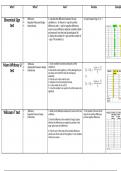
What? When? How? Formula Example
Binominal Sign
Difference
Repeated Measures Design
1. Calculate the difference between the two
conditions (a – b). Record a + sign for positive
S= least frequent sign (+ or -)
test Nominal data differences and a – sign for negative differences.
Leave any zero difference between conditions blank
and remove it from the total of participants (N)
2. Add up the number of + signs and the number of
– signs. The smallest is s.
Mann Whitney U
Difference
Independent Measures Design
1. If one condition has fewer participants call this
condition A.
test Ordinal data 2. Rank all the scores together, as if they belonged to just
one group, but record the ranks for each group
separately.
3. Find the sum of the ranks for each
4. Calculate U1 and U2 using the formula.
6. U is the smaller of U1 and U2
7. U must be smaller to or equal to the critical value to be
significant
Wilcoxon T test
Difference
Repeated Measures Design
1. Work out the difference between the scores in the two
conditions.
T= the smaller of the sum of the
ranks of the positive differences
Ordinal data and the negative differences
2. Rank the differences from smallest to largest. Ignore
whether the differences are negative or positive at this
stage. Ignore any zero differences.
3. Find the sum of the ranks of the positive differences
and the sum of the ranks of the negative. T is the smallest
of these two values
Binominal Sign
Difference
Repeated Measures Design
1. Calculate the difference between the two
conditions (a – b). Record a + sign for positive
S= least frequent sign (+ or -)
test Nominal data differences and a – sign for negative differences.
Leave any zero difference between conditions blank
and remove it from the total of participants (N)
2. Add up the number of + signs and the number of
– signs. The smallest is s.
Mann Whitney U
Difference
Independent Measures Design
1. If one condition has fewer participants call this
condition A.
test Ordinal data 2. Rank all the scores together, as if they belonged to just
one group, but record the ranks for each group
separately.
3. Find the sum of the ranks for each
4. Calculate U1 and U2 using the formula.
6. U is the smaller of U1 and U2
7. U must be smaller to or equal to the critical value to be
significant
Wilcoxon T test
Difference
Repeated Measures Design
1. Work out the difference between the scores in the two
conditions.
T= the smaller of the sum of the
ranks of the positive differences
Ordinal data and the negative differences
2. Rank the differences from smallest to largest. Ignore
whether the differences are negative or positive at this
stage. Ignore any zero differences.
3. Find the sum of the ranks of the positive differences
and the sum of the ranks of the negative. T is the smallest
of these two values


