Written by students who passed Immediately available after payment Read online or as PDF Wrong document? Swap it for free 4.6 TrustPilot
logo-home
Document preview thumbnail
Preview 2 out of 9 pages
Lecture notes

Co-ownership in land law

Document preview thumbnail
Preview 2 out of 9 pages

Land law lectures on co-ownership: Joint tenancy, tenants in common - features and definitions Severance of equitable joint tenancy into tenancy in common. Common intention constructive trust - cohabitation TOLATA Case law

Content preview

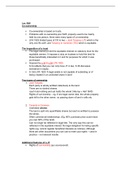
Lec 5&6
Co-ownership

 Co-ownership is based on trusts.
 Problems with co-ownership pre-1925: property used to be mainly
held by one person, there were many types of co-ownership.
 LPA 1925 limited types of CO to two – Joint Tenancy (JT) which is the
only one IN LAW, and Tenancy in Common (TIC) which is equitable.

The Imposition of a trust
 The legal owner(s) hold the equitable interest on statutory trust for the
equitable owners. It imposes a duty on trustees to hold the land for
those beneficially interested in it and for purposes for which it was
purchased.
 Imposed by s.34 & s.36 LPA 1925.
S 34 reflects that you can only have JT in law, S 36 discusses
severance in equity.
 S.1(6) LPA 1925 ‘A legal estate is not capable of subsisting or of
being created in an undivided share in land’

Two types of ownership
1. Joint Tenants
Each party is wholly entitled collectively to the land.
There are no distinct shares.
‘each hold nothing and yet holds the whole’ (Murray v Hall 1840)
Rights of survivorship – eg. if one legal owner dies, the whole property
gets left to the other owner, no passing down of land in wills etc.


2. Tenants in Common
Undivided shares.
The land is split into quantifiable shares but each is entitled to possess
the whole.
Often commercial relationships. (Eg. 60% purchase price could mean
you own 60% of the land).
Can no longer be reflected in legal title. The only way this can be
reflected in the equitable interest. No legal obligation for listing specific
rights (eg. cannot register beneficial interests as notices). Although
there are other documents you can use to mark your rights – used in
practice – not relevant insofar.


Additional features of a JT
 Rights of survivorship (jus accrescendi)

,  This means that if one JT dies their interest will accrue to the
remaining JT(s)
 This means that no JT can dispose of their interest in their will.
 If both/all legal owners die together or at the same time, the
youngest will have the right to the property (s 184 LPA 1925).

 Pre-1925, there could be an unlimited number of legal owners, now
the max number is 4.

 A JT can be severed in equity but not at law (s.36(2) LPA).
 The 4 unities must be present:
 Unity of possession (implies all own equal parts of property, all
are entitled to whole property).
 Unity of interest (relates to beneficial interest, both have same
interest)
 Unity of title (have to own the same title)
 Unity of time (ownership will have to happen at the same time).

If one or more of these unities are missing, will not fulfil a JT and a
TIC will occur.

Additional features of a TIC
 ‘Undivided shares’
 Right of survivorship does not apply
 The equitable interest can then be disposed of in any way
 Only the Unity of Possession needs be present.
 TIC is already considered severed from other interest.

Identifying JTs and TIC
 Look for the express declaration of interest in writing (Goodman v
Gallant (1986))
 If one of the 4 unities is missing it must be a TIC
 If words of severance are expressed it will TIC
 Equity follows the law – if JTs at law then JT in equity will be presu
med
 However, this can be displaced by counter-presumptions (Bull
v Bull (1958); Barton v Morris (1985))

Note also: s.1(6) The Legal estate cannot be held by a minor.
s.34(2) If there are more than 4 legal owners listed then the
first 4 names will be considered the legal owners.


Severance

Document information

Uploaded on
January 13, 2022
Number of pages
9
Written in
2019/2020
Type
Lecture notes
Professor(s)
Kagnas
Contains
All classes
£4.99

Wrong document? Swap it for free Within 14 days of purchase and before downloading, you can choose a different document. You can simply spend the amount again.
Written by students who passed
Immediately available after payment
Read online or as PDF

Sold
1
Followers
1
Items
6
Last sold
4 year ago


Why students choose Stuvia

Created by fellow students, verified by reviews

Quality you can trust: written by students who passed their exams and reviewed by others who've used these revision notes.

Didn't get what you expected? Choose another document

No problem! You can straightaway pick a different document that better suits what you're after.

Pay as you like, start learning straight away

No subscription, no commitments. Pay the way you're used to via credit card and download your PDF document instantly.

Student with book image

“Bought, downloaded, and smashed it. It really can be that simple.”

Alisha Student

Working on your references?

Create accurate citations in APA, MLA and Harvard with our free citation generator.

Working on your references?

Frequently asked questions