SECTION: Explanations for Obedience
TOPIC: Social Influence
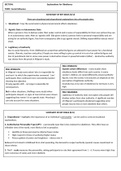
SUMMARY OF KEY IDEAS (K/U)
There are situational and dispositional explanations into why people obey.
1. Situational = how the social and/or physical environment effects obedience.
2. Agentic State vs Autonomous State
When a person is free to behave under their under control and in sense of responsibility for their own actions they are
in an autonomous state. After an ‘agentic shift’ (like given orders) a person feels no personal responsibility and are
acting for an authority figure, free from consequence able to go against morals. Shifting responsibility reduces moral
strain.
3. Legitimacy of Authority
Due to social hierarchy, from childhood we accept that authority figures are allowed to have power for a functional
society. (Parents, teachers and police.) People are more willing to give up control in trust of an authority figure and
fear of punishment. But in some cases power is destructive shown in powerful leaders (Hitler) – destructive authority
was shown from the prods in Milgram’s study.
PEEL STRENGTH
PEEL STRENGTH Explain culture differences – many studies show
In Milgram’s study some asked ‘who is responsible for obedience levels differ from each country. In some
any harm’ to which the experimenter answered ‘ I am’ society’s children are raised differently around authority
participants then continued more consistently/quicker figures, how the society is structured can depends on the
showing less objection. perception of legitimate authority.
Proving agentic shift – no longer responsible for Australia has a low rate of obedience by Germany is very
consequences. high.
But in other situations, (Hoflings nurse study) when PEEL WEAKNESS
participants obeyed, no signs of moral strain were shown Legitimacy of authority does not explain why people still
suggesting they weren’t in an agentic state. Meaning it disobey orders from clear authority. A significant number
can only account for some situations. of Milgram’s participants disobeyed suggesting some
people may be less or more obedient than others.
SUMMARY OF KEY IDEAS (K/U)
1. Dispositional = highlights the importance of an individual’s personality – can be used to contrast situational
explanations.
2. Authoritarian Personality Type (APT) – a personality type that is less resistant to obedience. They often have an
inflexible view of the world, more likely to link to prejudice.
Hostility to those perceived as inferior/lower status
High respect for those of authority/higher status
Preoccupation of power and toughness – obsess over it
Believed it is formed in childhood from strict parenting, the demand to respect authority (parent) causes resentment to
those inferior.
3. The F – scale measures the personality, asking participants to rate their agreement from 1 – 6. If scores were high, they
were conscious of status and more obedient.
TOPIC: Social Influence
SUMMARY OF KEY IDEAS (K/U)
There are situational and dispositional explanations into why people obey.
1. Situational = how the social and/or physical environment effects obedience.
2. Agentic State vs Autonomous State
When a person is free to behave under their under control and in sense of responsibility for their own actions they are
in an autonomous state. After an ‘agentic shift’ (like given orders) a person feels no personal responsibility and are
acting for an authority figure, free from consequence able to go against morals. Shifting responsibility reduces moral
strain.
3. Legitimacy of Authority
Due to social hierarchy, from childhood we accept that authority figures are allowed to have power for a functional
society. (Parents, teachers and police.) People are more willing to give up control in trust of an authority figure and
fear of punishment. But in some cases power is destructive shown in powerful leaders (Hitler) – destructive authority
was shown from the prods in Milgram’s study.
PEEL STRENGTH
PEEL STRENGTH Explain culture differences – many studies show
In Milgram’s study some asked ‘who is responsible for obedience levels differ from each country. In some
any harm’ to which the experimenter answered ‘ I am’ society’s children are raised differently around authority
participants then continued more consistently/quicker figures, how the society is structured can depends on the
showing less objection. perception of legitimate authority.
Proving agentic shift – no longer responsible for Australia has a low rate of obedience by Germany is very
consequences. high.
But in other situations, (Hoflings nurse study) when PEEL WEAKNESS
participants obeyed, no signs of moral strain were shown Legitimacy of authority does not explain why people still
suggesting they weren’t in an agentic state. Meaning it disobey orders from clear authority. A significant number
can only account for some situations. of Milgram’s participants disobeyed suggesting some
people may be less or more obedient than others.
SUMMARY OF KEY IDEAS (K/U)
1. Dispositional = highlights the importance of an individual’s personality – can be used to contrast situational
explanations.
2. Authoritarian Personality Type (APT) – a personality type that is less resistant to obedience. They often have an
inflexible view of the world, more likely to link to prejudice.
Hostility to those perceived as inferior/lower status
High respect for those of authority/higher status
Preoccupation of power and toughness – obsess over it
Believed it is formed in childhood from strict parenting, the demand to respect authority (parent) causes resentment to
those inferior.
3. The F – scale measures the personality, asking participants to rate their agreement from 1 – 6. If scores were high, they
were conscious of status and more obedient.