SECTION: Ways of Studying the Brain
TOPIC: Biopsychology
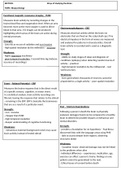
Functional magnetic resonance imaging – fMRI
Measures brain activity by recording changes in the
brains blood flow and oxygenation level. When an area
becomes more active more oxygen is used to direct
Electroencephalogram – EEG
blood to that area. 3-D images can be produced
highlighting which areas of the brain are active during Measures electrical activity within the brain via
mental processes. electrodes that are fixed on the scalp (skull cap.) Tiny
electrical impulses in the form of waves are measured
Strength:
and analysed for patterns in characteristics. Overall
- Low risk as no use of radiation and non-invasive
brain activity is recorded and is used as a diagnostic
- High spatial resolution by the millimetre – accuracy
tool.
Weakness:
Strength:
- highly expensive machinery
- Ability to study stages of sleep and diagnosis of
- poor temporal resolution, 5 second time lag (reduces
conditions (epilepsy) when detecting random bursts of
accuracy of recordings)
activity – practical
- high temporal resolution by the millisecond – real
world accuracy
Weakness:
- Over generalised, thousands of neurons cannot be
pinpointed to a single activity – poor spatial resolution
Event – Related Potential – ERP
Measures the brains response that is the direct result
of a specific sensory, cognitive, or motor event.
In a statistical analysis, brain activity recordings are
filtered, leaving the response that relates to the stimuli
- remaining is the ERP. ERP is basically the brainwaves
that are as a result of a particular event.
Post – Mortem Examinations
Strength:
- non - invasive Following a person’s death the brain is physically
- cheaper than fMRI analysed, damages found can be compared to a healthy
- high temporal resolution brain to determine possible impacts on behaviour and
- deeper understanding of cognitive functioning mental disorders.
Weakness: Strength:
- extraneous material (background noise) may cause - provides a foundation for ne hypothesis – Paul Broca
brain activity instead of tested stimuli discovered links with the language areas using PME
- able to access deeper brain regions, observing
structures better
Weakness:
- Causation issues- observed damage may not be linked
to the problems when alive
- Individual difference – experiences, medication, age,
exercise can affect a person’s brains, findings on one
patient cannot be generalised to the next.
- Ethical issues of consent before death
-
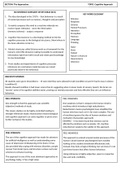
TOPIC: Biopsychology
Functional magnetic resonance imaging – fMRI
Measures brain activity by recording changes in the
brains blood flow and oxygenation level. When an area
becomes more active more oxygen is used to direct
Electroencephalogram – EEG
blood to that area. 3-D images can be produced
highlighting which areas of the brain are active during Measures electrical activity within the brain via
mental processes. electrodes that are fixed on the scalp (skull cap.) Tiny
electrical impulses in the form of waves are measured
Strength:
and analysed for patterns in characteristics. Overall
- Low risk as no use of radiation and non-invasive
brain activity is recorded and is used as a diagnostic
- High spatial resolution by the millimetre – accuracy
tool.
Weakness:
Strength:
- highly expensive machinery
- Ability to study stages of sleep and diagnosis of
- poor temporal resolution, 5 second time lag (reduces
conditions (epilepsy) when detecting random bursts of
accuracy of recordings)
activity – practical
- high temporal resolution by the millisecond – real
world accuracy
Weakness:
- Over generalised, thousands of neurons cannot be
pinpointed to a single activity – poor spatial resolution
Event – Related Potential – ERP
Measures the brains response that is the direct result
of a specific sensory, cognitive, or motor event.
In a statistical analysis, brain activity recordings are
filtered, leaving the response that relates to the stimuli
- remaining is the ERP. ERP is basically the brainwaves
that are as a result of a particular event.
Post – Mortem Examinations
Strength:
- non - invasive Following a person’s death the brain is physically
- cheaper than fMRI analysed, damages found can be compared to a healthy
- high temporal resolution brain to determine possible impacts on behaviour and
- deeper understanding of cognitive functioning mental disorders.
Weakness: Strength:
- extraneous material (background noise) may cause - provides a foundation for ne hypothesis – Paul Broca
brain activity instead of tested stimuli discovered links with the language areas using PME
- able to access deeper brain regions, observing
structures better
Weakness:
- Causation issues- observed damage may not be linked
to the problems when alive
- Individual difference – experiences, medication, age,
exercise can affect a person’s brains, findings on one
patient cannot be generalised to the next.
- Ethical issues of consent before death
-