CORPORATE COMMUNICATION
CEP’s and senior executives of many large organizations and multinationals nowadays consider
protecting their company’s reputation to be critical and as one of their most important strategic
objectives.
Input for reputation:
- Advertising
- Direct experiences
- (negative) news
Corporate communication is:
- A management function
- That offers a framework for the effective coordination of all internal and external
communication
- With an overall purpose of establishing and maintaining favourable reputations
- With stakeholder groups upon which the organization is dependent.
Two activities of Corporate communication professionals:
- Managerial activities:
Planning
Coordinating
Counselling CEOs and senior managers
- Tactical activities:
Producing messages
Disseminating messages
Factors that make CC more complex:
- Disciplines have different stakeholders, goals etc.
- Wide geographical range
- Wide range of products and or services
- Corporate headquarters and various divisions and business units
Range of disciplines:
- Corporate advertising
- Corporate design
- Employee communication
- Issue and crisis management
- Media relations
- Investor relations
- Change communication
- Public affairs
Mission: The overriding purpose in line with stakeholders’ values and expectations: Who we are,
what we value
Vision: The desired future state or aspiration of the organization: What we want to become
Objectives: The overall aims in line with the overall purpose: How we gauge our degree of success in
accomplishing our mission
,Strategy: The ways or means in which the corporate objectives are to be achieved and put into effect.
How we will achieve our vision/objectives
Corporate identity: The profile and values communicated by an organization
Corporate image: An individual’s immediate set of associations in response to signals or messages
from or about the organization at a single point in time
Corporate reputation: An individual’s collective representation of past images of an organization
established over time.
Stakeholder: Any group or individual who can affect or is affected by the achievement of the
organizations objectives.
Market: A defined group for whom a product or service is or may be in demand: Target group
Communication: The tactics and media that are used to communicate with the internal and external
groups.
Integration: The act of coordinating all communication so that the corporate identity is effectively
and consistently communicated to internal and external groups.
Trends and developments in CC:
- 1900/1970’s: Publicity, promotions, information dissemination
- 1980/2000’s: Positioning
- 2000’s/present: Stakeholder engagement:
Advocacy
Interactivity
Authenticity
Transparency
CHAPTER 2
1890-1930: Industrials revolution Increased competition, rise of marketing communications
- Consequence: Muckraking journalism Rise of public relations
1920-1930: Economic depression: PR and Marketing as separate external disciplines
1980: Integration of Marketing and PR Integration (Kotler & Mindak)
- Distinct disciplines
- Complementary disciplines, coordinated
- PR as a part of marketing
- Marketing as a part of PR
- M=PR Fully integrated disciplines
Drivers for integration:
, - Organizational drivers:
Efficiency
Accountability
Positioning: Strategic direction and purpose
Overlap between disciplines
- Communication-based drivers:
Enormous communication clutter
Message effectiveness: Through consistency and reinforcement
Complementarity & multiplication of media; cost inflation
- Market- and environment-based drivers
Transparency
Inseparability of internal & external communication
Overlap between stakeholder roles
Communication integration leads to:
- New corporate communication department
- Higher (vertical) position in organization
Vertical structures: Used by multi-divisional and multinational companies. Divide an organizations
primary tasks into smaller tasks and activities
Horizontal structures: Allow professionals to respond fast to emergent issues. Provide control and
ensure consistent messages. Allow for cross-functional team work and flexibility.
- Multi-functional teams:
Natural work team: Permanent team, ongoing basis
Taskforce team: Specific projects, ad hoc basis
Agile team: Flexible (re)grouping of professionals
- Standardized work processes: Tools to document work process
Flow charts
Process maps
Etc.
- Council meetings:
Representatives from different communication disciplines
Meet to discuss strategic issues and collaborate
Provide ideas for improves coordination between disciplines
- Communication guidelines:
Agreed work procedures
House style book: design regulations & core values
Global brand book multinationals
CHAPTER 3
Democratization:
- Access: Everyone with internet access can be a global publisher of content
- Technology: Camera phones lead to citizen journalists
Web 2.0: General ideological and technological shift in the use of online technologies blogs, wikis,
collaborative projects. Provides the platform for social media
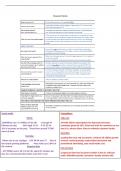
Traditional media environment New media environment
CEP’s and senior executives of many large organizations and multinationals nowadays consider
protecting their company’s reputation to be critical and as one of their most important strategic
objectives.
Input for reputation:
- Advertising
- Direct experiences
- (negative) news
Corporate communication is:
- A management function
- That offers a framework for the effective coordination of all internal and external
communication
- With an overall purpose of establishing and maintaining favourable reputations
- With stakeholder groups upon which the organization is dependent.
Two activities of Corporate communication professionals:
- Managerial activities:
Planning
Coordinating
Counselling CEOs and senior managers
- Tactical activities:
Producing messages
Disseminating messages
Factors that make CC more complex:
- Disciplines have different stakeholders, goals etc.
- Wide geographical range
- Wide range of products and or services
- Corporate headquarters and various divisions and business units
Range of disciplines:
- Corporate advertising
- Corporate design
- Employee communication
- Issue and crisis management
- Media relations
- Investor relations
- Change communication
- Public affairs
Mission: The overriding purpose in line with stakeholders’ values and expectations: Who we are,
what we value
Vision: The desired future state or aspiration of the organization: What we want to become
Objectives: The overall aims in line with the overall purpose: How we gauge our degree of success in
accomplishing our mission
,Strategy: The ways or means in which the corporate objectives are to be achieved and put into effect.
How we will achieve our vision/objectives
Corporate identity: The profile and values communicated by an organization
Corporate image: An individual’s immediate set of associations in response to signals or messages
from or about the organization at a single point in time
Corporate reputation: An individual’s collective representation of past images of an organization
established over time.
Stakeholder: Any group or individual who can affect or is affected by the achievement of the
organizations objectives.
Market: A defined group for whom a product or service is or may be in demand: Target group
Communication: The tactics and media that are used to communicate with the internal and external
groups.
Integration: The act of coordinating all communication so that the corporate identity is effectively
and consistently communicated to internal and external groups.
Trends and developments in CC:
- 1900/1970’s: Publicity, promotions, information dissemination
- 1980/2000’s: Positioning
- 2000’s/present: Stakeholder engagement:
Advocacy
Interactivity
Authenticity
Transparency
CHAPTER 2
1890-1930: Industrials revolution Increased competition, rise of marketing communications
- Consequence: Muckraking journalism Rise of public relations
1920-1930: Economic depression: PR and Marketing as separate external disciplines
1980: Integration of Marketing and PR Integration (Kotler & Mindak)
- Distinct disciplines
- Complementary disciplines, coordinated
- PR as a part of marketing
- Marketing as a part of PR
- M=PR Fully integrated disciplines
Drivers for integration:
, - Organizational drivers:
Efficiency
Accountability
Positioning: Strategic direction and purpose
Overlap between disciplines
- Communication-based drivers:
Enormous communication clutter
Message effectiveness: Through consistency and reinforcement
Complementarity & multiplication of media; cost inflation
- Market- and environment-based drivers
Transparency
Inseparability of internal & external communication
Overlap between stakeholder roles
Communication integration leads to:
- New corporate communication department
- Higher (vertical) position in organization
Vertical structures: Used by multi-divisional and multinational companies. Divide an organizations
primary tasks into smaller tasks and activities
Horizontal structures: Allow professionals to respond fast to emergent issues. Provide control and
ensure consistent messages. Allow for cross-functional team work and flexibility.
- Multi-functional teams:
Natural work team: Permanent team, ongoing basis
Taskforce team: Specific projects, ad hoc basis
Agile team: Flexible (re)grouping of professionals
- Standardized work processes: Tools to document work process
Flow charts
Process maps
Etc.
- Council meetings:
Representatives from different communication disciplines
Meet to discuss strategic issues and collaborate
Provide ideas for improves coordination between disciplines
- Communication guidelines:
Agreed work procedures
House style book: design regulations & core values
Global brand book multinationals
CHAPTER 3
Democratization:
- Access: Everyone with internet access can be a global publisher of content
- Technology: Camera phones lead to citizen journalists
Web 2.0: General ideological and technological shift in the use of online technologies blogs, wikis,
collaborative projects. Provides the platform for social media
Traditional media environment New media environment