Principles of Economics
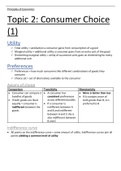
Topic 2: Consumer Choice
(1)
Utility
Total utility = satisfaction a consumer gains from consumption of a good
Marginal utility = additional utility a consumer gains from an extra unit of the good
Diminishing marginal utility = utility of successive units goes on diminishing for every
additional unit
Preferences
Preferences = how much consumers like different combinations of goods they
consume
Choice set = set of alternatives available to the consumer
Axioms of choice
Comparison Transitivity Monotonicity
• Consumer can compare 2 • A consumer has • More is better than less
bundles of goods consistent preferences • If A contains more of
• If both goods are liked across different bundles both goods than B, A is
equally = consumer is • If a consumer is preferred to B
indifferent between the indifferent between A
goods and B and indifferent
between A and C she is
also indifferent between
B and C
Indifference curve
• All points on the indifference curve = same amount of utility. Indifference curves join all
points yielding a common level of utility
,Principles of Economics
, Principles of Economics
Consumer Choice (2)
Marginal rate of substitution
• At any point, the slope tells us how much of one good we would be willing to give up to
get one more unit of the other good – concept of diminishing marginal utility
Marginal rate of substitution (MRS) = rate at which consumers are willing to
substitute one good for another
o MRS depends on the marginal utilities of the 2 goods
o MRS = MUX/MUY
The budget constraint
Budget constraint = the set of all bundles that one can afford
Price ratio = the slope of the budget constraint
Changes to the budget constraint
• Change in income = shift of budget curve
• Change in price
o Fall in price of X: maximum consumption of X rises but maximum consumption of
Y is unchanged → only one end of the budget constraint moves → slope changes
Topic 2: Consumer Choice
(1)
Utility
Total utility = satisfaction a consumer gains from consumption of a good
Marginal utility = additional utility a consumer gains from an extra unit of the good
Diminishing marginal utility = utility of successive units goes on diminishing for every
additional unit
Preferences
Preferences = how much consumers like different combinations of goods they
consume
Choice set = set of alternatives available to the consumer
Axioms of choice
Comparison Transitivity Monotonicity
• Consumer can compare 2 • A consumer has • More is better than less
bundles of goods consistent preferences • If A contains more of
• If both goods are liked across different bundles both goods than B, A is
equally = consumer is • If a consumer is preferred to B
indifferent between the indifferent between A
goods and B and indifferent
between A and C she is
also indifferent between
B and C
Indifference curve
• All points on the indifference curve = same amount of utility. Indifference curves join all
points yielding a common level of utility
,Principles of Economics
, Principles of Economics
Consumer Choice (2)
Marginal rate of substitution
• At any point, the slope tells us how much of one good we would be willing to give up to
get one more unit of the other good – concept of diminishing marginal utility
Marginal rate of substitution (MRS) = rate at which consumers are willing to
substitute one good for another
o MRS depends on the marginal utilities of the 2 goods
o MRS = MUX/MUY
The budget constraint
Budget constraint = the set of all bundles that one can afford
Price ratio = the slope of the budget constraint
Changes to the budget constraint
• Change in income = shift of budget curve
• Change in price
o Fall in price of X: maximum consumption of X rises but maximum consumption of
Y is unchanged → only one end of the budget constraint moves → slope changes