P2. Explain the structure of benzene using sigma and pi bonding, providing evidence for
the structure.
Benzene, C6H6, is a planar molecule which contains six carbon atoms arranged in a hexagonal
ring, each with a hydrogen atom attached. All of the carbon-carbon bonds in the ring have the
same lengths, intermediate between single and double bonds. Each carbon atom in the
hexagonal ring is bonded with another two carbon atoms and one hydrogen atom by single
covalent bonds. This leaves each carbon atom with one unused electron in the P orbital and
each P orbital overlaps with the neighbouring P orbital to form a PI bond. This leads to an
electron cloud (a ring of negative charge) forming above and below the plane of the ring.
The electrons within the PI bond do not belong to any carbon atoms and so they become
delocalised; free to move throughout the PI system. Due to the electrons being delocalised and
more spread out, there is less of a repulsion, making the benzene particularly stable. This is
why benzene generally undergoes electrophilic substitution reactions, which are initiated by
electrophiles and why benzene only undergoes addition reactions under more severe
conditions, as addition reactions involve breaking the delocalisation, thus causing the benzene
to lose its stability.
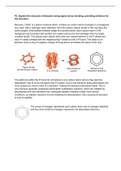
The corner of hexagon represents each carbon atom with a hydrogen attached
and the circle inside the hexagon represents the delocalised electrons.
the structure.
Benzene, C6H6, is a planar molecule which contains six carbon atoms arranged in a hexagonal
ring, each with a hydrogen atom attached. All of the carbon-carbon bonds in the ring have the
same lengths, intermediate between single and double bonds. Each carbon atom in the
hexagonal ring is bonded with another two carbon atoms and one hydrogen atom by single
covalent bonds. This leaves each carbon atom with one unused electron in the P orbital and
each P orbital overlaps with the neighbouring P orbital to form a PI bond. This leads to an
electron cloud (a ring of negative charge) forming above and below the plane of the ring.
The electrons within the PI bond do not belong to any carbon atoms and so they become
delocalised; free to move throughout the PI system. Due to the electrons being delocalised and
more spread out, there is less of a repulsion, making the benzene particularly stable. This is
why benzene generally undergoes electrophilic substitution reactions, which are initiated by
electrophiles and why benzene only undergoes addition reactions under more severe
conditions, as addition reactions involve breaking the delocalisation, thus causing the benzene
to lose its stability.
The corner of hexagon represents each carbon atom with a hydrogen attached
and the circle inside the hexagon represents the delocalised electrons.