Unit 4: Laboratory Techniques and their Application.
Unit 4c: Explore manufacturing techniques and testing methods for an organic solid.
In this assignment I will be preparing and testing the purity of an organic solid, draw
conclusions and describe the industrial manufacturing method. I will demonstrate skillful
application of techniques in preparing and testing the purity of an organic solid and compare
the laboratory, industrial manufacturing and testing of an organic solid. I will analyse the
factors affecting the yield and purity of an organic solid in the laboratory and their relevance
to its industrial manufacture.
Aspirin:
1
“Aspirin, which is also known as acetylsalicylic acid, is a pain reliever medication that has a
number of uses ranging from reducing the risk of serious problems such as: strokes and
heart attacks to reducing toothaches and headaches. It is given to cardiovascular patients as
it can stop blood clots and also has the ability to make the blood less sticky, this is due to its
antiplatelet qualities. In addition to this, it's also used for short term pain relief of symptoms
such as headaches, cold and toothaches. Biologists also use aspirin to interfere with white
blood cell action and molecular biologists use the drug to activate genes. Aspirins formula is
C9H8O4 , it has a melting point of 136℃ and a boiling point of 140℃.”
Part 1: Preparation of 2-hydroxybenzoic acid
Risk Assessment:
Hazards Risk Precaution
Oil of wintergreen is an Can cause irritation on skin Wear goggles and lab coat
irritant. and eyes.
2
2.0 mol dm-3 NaOH (aq) is Can cause irritation on skin Wear goggles and lab coat
an irritant and eyes.
2
2.00 mol dm-3 HCl (aq) is a Can cause irritation on skin Wear goggles and lab coat
low hazard and eyes.
Solution on Slips which can lead to Clean the spillage as quickly
floor broken bones. as possible.
1 01.02.21/Wikipedia
2 01.02.21/Princeton University
1
, 3
Trips and falls causing Make sure all obstacles are
Chairs and bags not tucked injuries. out of the way.
in
³
Glass ware Cuts on your hands and Store them safely. Be
may get infection if any careful of sharp edges.
4
chemical enters your blood. Sweep any glass quickly to
refrain from any accidents.
Heating Mantle Can burn your skin. Be wary of you surrounding,
make sure the wires are not
5
tangled.
Salicylic acid is corrosive It can irritate our skin and Wear goggles and lab coat
and an irritant eyes.
2
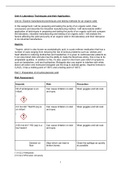
Figure 1: Risk assessment table
Apparatus:
- Goggles
- Balance
- Measuring cylinder 10cm3
- Measuring cylinder 50cm3
- Pear shaped flask 50cm3
- Liebig condenser
- Clamp
- Anti-bumping granules
- Water bath
- Beaker 100cm3
- Large beaker containing ice and water to cool the mixture
- Distilled water
- Dropping pipette
- Stirring rod
- Filtration under reduced pressure
- Watch glass
- Sample tube and lid
3 03.02.21/Label source
4 03.02.21/Elite signsandbanners.co.uk
5 06.02.21/Shutterstock
2
Unit 4c: Explore manufacturing techniques and testing methods for an organic solid.
In this assignment I will be preparing and testing the purity of an organic solid, draw
conclusions and describe the industrial manufacturing method. I will demonstrate skillful
application of techniques in preparing and testing the purity of an organic solid and compare
the laboratory, industrial manufacturing and testing of an organic solid. I will analyse the
factors affecting the yield and purity of an organic solid in the laboratory and their relevance
to its industrial manufacture.
Aspirin:
1
“Aspirin, which is also known as acetylsalicylic acid, is a pain reliever medication that has a
number of uses ranging from reducing the risk of serious problems such as: strokes and
heart attacks to reducing toothaches and headaches. It is given to cardiovascular patients as
it can stop blood clots and also has the ability to make the blood less sticky, this is due to its
antiplatelet qualities. In addition to this, it's also used for short term pain relief of symptoms
such as headaches, cold and toothaches. Biologists also use aspirin to interfere with white
blood cell action and molecular biologists use the drug to activate genes. Aspirins formula is
C9H8O4 , it has a melting point of 136℃ and a boiling point of 140℃.”
Part 1: Preparation of 2-hydroxybenzoic acid
Risk Assessment:
Hazards Risk Precaution
Oil of wintergreen is an Can cause irritation on skin Wear goggles and lab coat
irritant. and eyes.
2
2.0 mol dm-3 NaOH (aq) is Can cause irritation on skin Wear goggles and lab coat
an irritant and eyes.
2
2.00 mol dm-3 HCl (aq) is a Can cause irritation on skin Wear goggles and lab coat
low hazard and eyes.
Solution on Slips which can lead to Clean the spillage as quickly
floor broken bones. as possible.
1 01.02.21/Wikipedia
2 01.02.21/Princeton University
1
, 3
Trips and falls causing Make sure all obstacles are
Chairs and bags not tucked injuries. out of the way.
in
³
Glass ware Cuts on your hands and Store them safely. Be
may get infection if any careful of sharp edges.
4
chemical enters your blood. Sweep any glass quickly to
refrain from any accidents.
Heating Mantle Can burn your skin. Be wary of you surrounding,
make sure the wires are not
5
tangled.
Salicylic acid is corrosive It can irritate our skin and Wear goggles and lab coat
and an irritant eyes.
2
Figure 1: Risk assessment table
Apparatus:
- Goggles
- Balance
- Measuring cylinder 10cm3
- Measuring cylinder 50cm3
- Pear shaped flask 50cm3
- Liebig condenser
- Clamp
- Anti-bumping granules
- Water bath
- Beaker 100cm3
- Large beaker containing ice and water to cool the mixture
- Distilled water
- Dropping pipette
- Stirring rod
- Filtration under reduced pressure
- Watch glass
- Sample tube and lid
3 03.02.21/Label source
4 03.02.21/Elite signsandbanners.co.uk
5 06.02.21/Shutterstock
2