

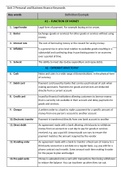
Unit 3 Personal and Business finance Keywords
Key words Definition/Example
A1 – FUNCTION OF MONEY
1. Legal tender Legal form of payment. For example buying an ice cream.
2. Barter Exchange (goods or services) for other goods or services without using
money.
3. Interest rate The cost of borrowing money or the reward for saving money.
4. Inflation Is a general rise in price level relative to available goods resulting in a
substantial and continuing drop in purchasing power in an economy
over a period of time.
5. Solvent The ability to meet day-to-day expenditure and repay debts.
A2 – DIFFERENT WAYS TO PAY
6. Cash Notes and coins in a wide range of denominations: in the physical form
of currency.
7. Debit card Payment card issued by banks that can be used instead of cash when
making purchases. Payments for goods and services are deducted
directly from a current account
8. Credit card Issued by financial institutions allowing customers to borrow money
that is currently not available in their account and delay payments for
goods and services.
9. Cheque A written order to a bank to make a payment for a specific amount of
money from one person’s account to another account
10. Electronic transfer Payment is transferred directly from one bank account to another
11. Direct debit An agreement made with a bank allowing a third party to withdraw
money from an account on a set day to pay for goods or services
received, e.g. pay a gas bill. Amount paid can vary to ensure the
payment matches the amount required by the vendor.
12. Standing order An agreement made with a bank to transfer a fixed sum of money to a
third party account on a set date on a regular basis, e.g. pay £30 for a
phone contract each month. Same amount each time making it easier
for the payee to plan and budget
13. Pre-paid cards Money is uploaded onto a card with transactions then being withdrawn
to reduce the balance. You can top them up when they run out.
Key words Definition/Example
A1 – FUNCTION OF MONEY
1. Legal tender Legal form of payment. For example buying an ice cream.
2. Barter Exchange (goods or services) for other goods or services without using
money.
3. Interest rate The cost of borrowing money or the reward for saving money.
4. Inflation Is a general rise in price level relative to available goods resulting in a
substantial and continuing drop in purchasing power in an economy
over a period of time.
5. Solvent The ability to meet day-to-day expenditure and repay debts.
A2 – DIFFERENT WAYS TO PAY
6. Cash Notes and coins in a wide range of denominations: in the physical form
of currency.
7. Debit card Payment card issued by banks that can be used instead of cash when
making purchases. Payments for goods and services are deducted
directly from a current account
8. Credit card Issued by financial institutions allowing customers to borrow money
that is currently not available in their account and delay payments for
goods and services.
9. Cheque A written order to a bank to make a payment for a specific amount of
money from one person’s account to another account
10. Electronic transfer Payment is transferred directly from one bank account to another
11. Direct debit An agreement made with a bank allowing a third party to withdraw
money from an account on a set day to pay for goods or services
received, e.g. pay a gas bill. Amount paid can vary to ensure the
payment matches the amount required by the vendor.
12. Standing order An agreement made with a bank to transfer a fixed sum of money to a
third party account on a set date on a regular basis, e.g. pay £30 for a
phone contract each month. Same amount each time making it easier
for the payee to plan and budget
13. Pre-paid cards Money is uploaded onto a card with transactions then being withdrawn
to reduce the balance. You can top them up when they run out.


