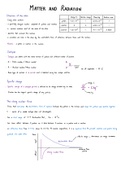
MATTER AND RADIATION
structure of the atom
charge C Relative
charge Mass
kg Relative mass
Every atom contains :
proton +1.60×10⁻¹⁹ I 1.67131×10⁻²⁷ I
a
positively charged nucleus composed of
protons and neutrons
•
neutron O O 1.67151×10⁻²⁷ I
↳ nucleus contains most of the mass of the atom 3'
1.60×10⁻¹⁹
.
electron
-
-
-
I 9.11 x 10 O .
0005
•
electrons that surround the nucleus
electrostatic force of attraction between them and nucleus
↳ electrons are held in the atom
by the the .
Nucleon : a
proton or neutron in the nucleus
Isotopes
Isotopes atoms with the number of protons but different number of neutrons
°
are same .
.
2 =
Proton number / Atomic number A
X chemical
-
A =
Nucleon number / Mass number 2 symbol
no .
of neutrons = A -
2
Each of nucleus nuclide and labelled notation
type is a is
using
the isotope
.
Specific charge charge ,
C
Q
Specific charge of
charged particle defined its
charge divided
by its mass
(
l
'
as
kg
a is
-
=
M
Electron has the
.
largest specific charge of
any particle mass
,
kg
The nuclear force
strong
Force that the electrostatic force of between the
repulsion protons the nucleus and keeps the
protons and neutrons
together
'
overcomes in .
does not
↳ nuclei of stable isotope disintegrate
'
. .
a .
has of femto meters ( fm ) Ism
-
short 3 4 Ifm 10
range
a
- -
=
,
has effect between 2 it does between 2 neutrons
-
same
protons as or a
proton and a neutron
.
an attractive force from 3 -
4 fm down to 0.5 fm .
At smaller
separations ,
it is a
repulsive force to
prevent neutrons and
protons being
into each other
pushed
I|
force
infinite decreases increases
; range
as
range
I
electrostatic force
§
distacneanerterom
I strong nuclear force
is
L,
, Radioactive
decay
Naturally occurring
radioactive
isotopes release 3
types of radiation
-
:
i ) Alpha radiation
consists of
alpha particles each and It
which
comprise
2
protons 2 neutrons
•
.
A A -4 4
X s Y + a
Z 2
z -
2
.
product nucleus
belongs to a different element Y .
2) Beta radiation
YB ( )
-
B beta
particle
:
consists of fast electrons or
moving
'
-
-
.
neutron
. beta particle created and emitted
instantly when a in the nucleus
changes into a
proton
↳
an
antiparticle with no
charge antineutrino ( t ) is emitted .
,
this ( neutron ) to nuclei that neutrons
.
change >
proton happens have too
many
.
Az X s
zany +
:B + i
3) Gamma radiation V
emitted unstable
-
electromagnetic radiation
by an nucleus
.
can
pass through thick metal
plates
.
no mass
,
no
charge
. emitted
by a nucleus with too much
energy , following an
alpha or beta emission
The existence of the neutrino was
hypothesised to account for conservation of
energy
in beta
decay .
↳ scientists found that beta particles were released with kinetic
energies up to a maximum that
depended on the
isotope although
,
each unstable nucleus lost certain amount of the
a
energy
in
process .
conserved ( & )
away by
not of it carried neutrinos
mystery particles antineutrinos
↳ either
energy
was in the
change or some were
Electromagnetic waves
l 108ms
speed of all
electromagnetic the
speed of
light 3.00 )
'
in vacuum is x
-
waves a
-
c
,
electric field
n
\
C
.
A =
f 9
field
magnetic
-
nm = 10 m
.
direction of wave
that
.
electromagnetic wave consists of an electric wave and a
magnetic wave travel
together
and vibrate : at
right angles to each other and to the direction of travel
;
with each other
in
phase .
structure of the atom
charge C Relative
charge Mass
kg Relative mass
Every atom contains :
proton +1.60×10⁻¹⁹ I 1.67131×10⁻²⁷ I
a
positively charged nucleus composed of
protons and neutrons
•
neutron O O 1.67151×10⁻²⁷ I
↳ nucleus contains most of the mass of the atom 3'
1.60×10⁻¹⁹
.
electron
-
-
-
I 9.11 x 10 O .
0005
•
electrons that surround the nucleus
electrostatic force of attraction between them and nucleus
↳ electrons are held in the atom
by the the .
Nucleon : a
proton or neutron in the nucleus
Isotopes
Isotopes atoms with the number of protons but different number of neutrons
°
are same .
.
2 =
Proton number / Atomic number A
X chemical
-
A =
Nucleon number / Mass number 2 symbol
no .
of neutrons = A -
2
Each of nucleus nuclide and labelled notation
type is a is
using
the isotope
.
Specific charge charge ,
C
Q
Specific charge of
charged particle defined its
charge divided
by its mass
(
l
'
as
kg
a is
-
=
M
Electron has the
.
largest specific charge of
any particle mass
,
kg
The nuclear force
strong
Force that the electrostatic force of between the
repulsion protons the nucleus and keeps the
protons and neutrons
together
'
overcomes in .
does not
↳ nuclei of stable isotope disintegrate
'
. .
a .
has of femto meters ( fm ) Ism
-
short 3 4 Ifm 10
range
a
- -
=
,
has effect between 2 it does between 2 neutrons
-
same
protons as or a
proton and a neutron
.
an attractive force from 3 -
4 fm down to 0.5 fm .
At smaller
separations ,
it is a
repulsive force to
prevent neutrons and
protons being
into each other
pushed
I|
force
infinite decreases increases
; range
as
range
I
electrostatic force
§
distacneanerterom
I strong nuclear force
is
L,
, Radioactive
decay
Naturally occurring
radioactive
isotopes release 3
types of radiation
-
:
i ) Alpha radiation
consists of
alpha particles each and It
which
comprise
2
protons 2 neutrons
•
.
A A -4 4
X s Y + a
Z 2
z -
2
.
product nucleus
belongs to a different element Y .
2) Beta radiation
YB ( )
-
B beta
particle
:
consists of fast electrons or
moving
'
-
-
.
neutron
. beta particle created and emitted
instantly when a in the nucleus
changes into a
proton
↳
an
antiparticle with no
charge antineutrino ( t ) is emitted .
,
this ( neutron ) to nuclei that neutrons
.
change >
proton happens have too
many
.
Az X s
zany +
:B + i
3) Gamma radiation V
emitted unstable
-
electromagnetic radiation
by an nucleus
.
can
pass through thick metal
plates
.
no mass
,
no
charge
. emitted
by a nucleus with too much
energy , following an
alpha or beta emission
The existence of the neutrino was
hypothesised to account for conservation of
energy
in beta
decay .
↳ scientists found that beta particles were released with kinetic
energies up to a maximum that
depended on the
isotope although
,
each unstable nucleus lost certain amount of the
a
energy
in
process .
conserved ( & )
away by
not of it carried neutrinos
mystery particles antineutrinos
↳ either
energy
was in the
change or some were
Electromagnetic waves
l 108ms
speed of all
electromagnetic the
speed of
light 3.00 )
'
in vacuum is x
-
waves a
-
c
,
electric field
n
\
C
.
A =
f 9
field
magnetic
-
nm = 10 m
.
direction of wave
that
.
electromagnetic wave consists of an electric wave and a
magnetic wave travel
together
and vibrate : at
right angles to each other and to the direction of travel
;
with each other
in
phase .