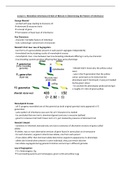
Lecture 1: Mendelian Inheritance & Role of Meiosis in Determining the Pattern of Inheritance
George Mendel
- worked with peas leading to discovery of:
dominant & recessive traits
concept of gene
formulation of basic laws of inheritance
Pea Characters
- character: heritable feature of individual
- trait / phenotype: variant form of character
Mendel’s First Law: Law of Segregation
- two forms of a gene (alleles) present in each parent segregate independently
- formulated law by studying results of monohybrid crosses
- monohybrid cross: cross between two true-breeding individuals differing in only one character
- true breeding: parents produce offspring that have same phenotype
- Mendel didn’t know why the yellow colour
went
- saw in the F2 generation that the yellow
colour came back so he knew that the
phenotype wasn’t destroyed, it was just masked
by the green colour
- he counted the phenotypes produced and got
a roughly 3:1 ratio of green:yellow
Monohybrid Crosses
- all F1 progeny resembled one of the parents but both original parental traits appeared in F2
generation
- same pattern of inheritance was seen for all 7 characters he studied
- he concluded that one trait is dominant (green) and one is recessive (yellow)
- gene for recessive trait hadn’t been lost in F1, just masked by presence of dominant trait
Mendel’s Model
- variations in inherited characteristics are due to existence of alternative versions of genes called
alleles
alleles: two or more alternative versions of gene found in same place on chromosome
- for each character, organism inherits two alleles, one from each parent
- if two alleles differ then dominant allele determines organisms appearance, its phenotype
- alleles don’t blend when present in same individual, they just remain discrete
- two alleles segregate during gamete formation and end up in different gametes
Law of Segregation
- F1 is heterozygous, Gg
true breeding parents are homozygous, green is GG and yellow is gg
,- each parent has two alleles but only one is passed to individual offspring via gamete
- each offspring receives one allele from one parent and another from the other giving them Gg
3:1 Ratio in F2 Generation
- if you have segregation during gamete formation where you have equal proportions of gametes
containing dominant allele & gametes containing recessive allele, due to random pairing after
fertilisation, you’ll have four possible combination in equal proportions
- this results in ratio phenotypes of 3:1 as there are 3 dominants (GG, Gg, Gg) and 1 recessive (gg)
- two different genotypes can produce same phenotype
GG and Gg both give green colour
Punnett Square
- diagrammatic device for predicting the outcomes of crosses between parents of known genotype
Test Cross
- method for determining genotype of individual with dominant phenotype of a trait
helps us see if it’ll be homozygous dominant or heterozygous dominant
- involves crossing it with homozygous recessive individual
- if it was homozygous dominant, they’d all be green
- if it was heterozygous dominant, half would be green,
and half would be yellow
,Mendel’s Law of Independent Assortment
- each pair of alleles assorts independently of each other pair of alleles during gamete formation
- relates to situation where inheritance of two or more different pairs of alleles is being studied
- formulated law by following inheritance of two characters at same time
- dihybrid cross: cross involving parents differing in two characters
Dihybrid Cross
- true breeding parents: yellow round (YYRR)
and green wrinkled (yyrr)
yellow is dominant over green and round is
dominant over wrinkled
- F1 is heterozygous for both genes
- F2 generation produced two new phenotypes
in addition to two parental phenotypes
called recombinants
- F2 generation produces 9:3:3:1
9 would be dominant for yellow & round (YYRR, YyRR, YyRR, YYRr, YYRr, YyRr, YyRr, YyRr, YyRr)
3 would be dominant for yellow, recessive for round (Yyrr, Yyrr, Yyrr)
3 would be recessive for yellow, dominant for round (yyRR, yyRr, yyRr)
1 would be recessive for yellow & round (yyrr)
If Independent Assortment Didn’t Occur
- Y & R alleles and y & r alleles would be inherited together
- gametes produced in F1 would only be of two types; YR and yr
- therefore, F2 would have no recombinant phenotypes and the only seeds formed would be yellow
round & green wrinkled
Complex Genetics Problems
- e.g. triple heterozygote with round, yellow seed in green pods
- R/r: round / wrinkled seed
- Y/y: yellow / green seed
- G/g: green / yellow pods
- RrYyGg x RrYyGg what proportion would have round, yellow seed in yellow pod
1) first draw punnnet square seed shape
- probability of round seeds = 3/4
2) then draw for seed colour
- probability of yellow seeds = 3/4
, 3) then draw for pod colour
- probability of yellow pod = 1/4
4) multiply probabilities to give overall probability
- ¾ x ¾ x ¼ = 9/64
- 9/64 of progeny would have round, yellow seeds in yellow pods
The Chromosome Theory of Inheritance
- association of paternal & maternal chromosomes in pairs and their subsequent separation during
reducing division may constitute the physical basis of Mendelian law of heredity
Mitosis vs Meiosis
Mitosis Meiosis
occurs in somatic cells occurs in germ line
one cell division two cell divisions
produces two identical produces four non-
diploid cells identical haploid cells
no synapsis synapsis
role is to drive growth & role is to produce
tissue repair haploid gametes &
introduce genetic
variability
Chromosome Terminology
- two chromosome of homologous pair: individual chromosomes that were inherited from different
parents
- homologues appear alike under microscope but have different alleles at some corresponding loci
- chromatid: one of two identical strands on new replicated chromosome
- sister chromatid: two indentical chromatids held together by common centromere
Stages of Meiosis I and II
George Mendel
- worked with peas leading to discovery of:
dominant & recessive traits
concept of gene
formulation of basic laws of inheritance
Pea Characters
- character: heritable feature of individual
- trait / phenotype: variant form of character
Mendel’s First Law: Law of Segregation
- two forms of a gene (alleles) present in each parent segregate independently
- formulated law by studying results of monohybrid crosses
- monohybrid cross: cross between two true-breeding individuals differing in only one character
- true breeding: parents produce offspring that have same phenotype
- Mendel didn’t know why the yellow colour
went
- saw in the F2 generation that the yellow
colour came back so he knew that the
phenotype wasn’t destroyed, it was just masked
by the green colour
- he counted the phenotypes produced and got
a roughly 3:1 ratio of green:yellow
Monohybrid Crosses
- all F1 progeny resembled one of the parents but both original parental traits appeared in F2
generation
- same pattern of inheritance was seen for all 7 characters he studied
- he concluded that one trait is dominant (green) and one is recessive (yellow)
- gene for recessive trait hadn’t been lost in F1, just masked by presence of dominant trait
Mendel’s Model
- variations in inherited characteristics are due to existence of alternative versions of genes called
alleles
alleles: two or more alternative versions of gene found in same place on chromosome
- for each character, organism inherits two alleles, one from each parent
- if two alleles differ then dominant allele determines organisms appearance, its phenotype
- alleles don’t blend when present in same individual, they just remain discrete
- two alleles segregate during gamete formation and end up in different gametes
Law of Segregation
- F1 is heterozygous, Gg
true breeding parents are homozygous, green is GG and yellow is gg
,- each parent has two alleles but only one is passed to individual offspring via gamete
- each offspring receives one allele from one parent and another from the other giving them Gg
3:1 Ratio in F2 Generation
- if you have segregation during gamete formation where you have equal proportions of gametes
containing dominant allele & gametes containing recessive allele, due to random pairing after
fertilisation, you’ll have four possible combination in equal proportions
- this results in ratio phenotypes of 3:1 as there are 3 dominants (GG, Gg, Gg) and 1 recessive (gg)
- two different genotypes can produce same phenotype
GG and Gg both give green colour
Punnett Square
- diagrammatic device for predicting the outcomes of crosses between parents of known genotype
Test Cross
- method for determining genotype of individual with dominant phenotype of a trait
helps us see if it’ll be homozygous dominant or heterozygous dominant
- involves crossing it with homozygous recessive individual
- if it was homozygous dominant, they’d all be green
- if it was heterozygous dominant, half would be green,
and half would be yellow
,Mendel’s Law of Independent Assortment
- each pair of alleles assorts independently of each other pair of alleles during gamete formation
- relates to situation where inheritance of two or more different pairs of alleles is being studied
- formulated law by following inheritance of two characters at same time
- dihybrid cross: cross involving parents differing in two characters
Dihybrid Cross
- true breeding parents: yellow round (YYRR)
and green wrinkled (yyrr)
yellow is dominant over green and round is
dominant over wrinkled
- F1 is heterozygous for both genes
- F2 generation produced two new phenotypes
in addition to two parental phenotypes
called recombinants
- F2 generation produces 9:3:3:1
9 would be dominant for yellow & round (YYRR, YyRR, YyRR, YYRr, YYRr, YyRr, YyRr, YyRr, YyRr)
3 would be dominant for yellow, recessive for round (Yyrr, Yyrr, Yyrr)
3 would be recessive for yellow, dominant for round (yyRR, yyRr, yyRr)
1 would be recessive for yellow & round (yyrr)
If Independent Assortment Didn’t Occur
- Y & R alleles and y & r alleles would be inherited together
- gametes produced in F1 would only be of two types; YR and yr
- therefore, F2 would have no recombinant phenotypes and the only seeds formed would be yellow
round & green wrinkled
Complex Genetics Problems
- e.g. triple heterozygote with round, yellow seed in green pods
- R/r: round / wrinkled seed
- Y/y: yellow / green seed
- G/g: green / yellow pods
- RrYyGg x RrYyGg what proportion would have round, yellow seed in yellow pod
1) first draw punnnet square seed shape
- probability of round seeds = 3/4
2) then draw for seed colour
- probability of yellow seeds = 3/4
, 3) then draw for pod colour
- probability of yellow pod = 1/4
4) multiply probabilities to give overall probability
- ¾ x ¾ x ¼ = 9/64
- 9/64 of progeny would have round, yellow seeds in yellow pods
The Chromosome Theory of Inheritance
- association of paternal & maternal chromosomes in pairs and their subsequent separation during
reducing division may constitute the physical basis of Mendelian law of heredity
Mitosis vs Meiosis
Mitosis Meiosis
occurs in somatic cells occurs in germ line
one cell division two cell divisions
produces two identical produces four non-
diploid cells identical haploid cells
no synapsis synapsis
role is to drive growth & role is to produce
tissue repair haploid gametes &
introduce genetic
variability
Chromosome Terminology
- two chromosome of homologous pair: individual chromosomes that were inherited from different
parents
- homologues appear alike under microscope but have different alleles at some corresponding loci
- chromatid: one of two identical strands on new replicated chromosome
- sister chromatid: two indentical chromatids held together by common centromere
Stages of Meiosis I and II