HAZARDS
THE CONCEPT OF HAZARDS
A natural hazard is a perceived event that threatens both life and property. Few hazards are entirely natural, human
actions intensify the impact of natural hazards. For example, exacerbating earthquake risk by building inappropriate
buildings.
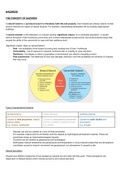
A natural disaster is the realisation of a hazard causing ‘significant impact’ on a vulnerable population. It causes
serious disruption of the functioning community and involves widespread socioeconomic and environmental losses that
exceed the ability of the community to cope and their resilience level.
‘Significant impact’ relies on several factors:
- Risk - the probability of the hazard occurring and creating loss of lives / livelihoods
- Vulnerability - risk of exposure to hazards combined with an inability to cope with them.
- Resilience - the degree to which a population or environment can absorb a hazardous event.
- Risk assessment - the likelihood of harm and damage, bearing in mind the probability and severity of a hazard
that may occur.
Types of geographical hazards
GEOPHYSICAL ATMOSPHERIC HYDROLOGICAL
Caused by land processes, majorly Caused by atmospheric processes Caused by water bodies and
tectonic plates. and the conditions created by these. movements.
E.g. volcano, earthquake. E.g. wildfire. E.g. drought.
- Hazards can also be classed as a mix of these processes.
- For example, tropical storms and floods could be classed as hydrological-atmospheric hazards. These are
sometimes known as hydrometeorological hazards.
- Tsunamis can be classed as geophysical and hydrological.
- Earthquake induced avalanches are geophysical and temperature or snow induced avalanches are atmospheric.
- Landslides caused by tectonic movement are geophysical, but atmospheric if caused by rain.
Hazard perception
People have different viewpoints of how dangerous hazards are and what risk they pose. These perceptions are
dependent on lifestyle factors which include economic and cultural elements.
, Wealth The financial situation of a person will affect how they perceive hazards. Wealthier people may
perceive a hazard to be smaller as they are less vulnerable (e.g. they have the ability to evacuate with
transport access, build stronger houses etc.) However, wealthier people may also view a risk as greater
as there is more risk of property damage and financial loss.
However, poorer people which rely on the primary sector will be affected worse than those relying on
the tertiary sector. They may also lack the means to evacuate and suitable infrastructure.
Normally, the number of dead decreases as GDP per capita grows - however GDP losses are
greater in wealthy countries, but the implication of losses and proportion of the compared to overall
GDP may be something to factor in.
Education A person who is more educated about hazards may understand their full effects on people and how
devastating they can be and have been in the past. They may also know better how to evacuate.
Religion Some may view hazards as put there by God for a reason, or being part of the natural cycle of life. In
and beliefs contrast, those who believe strongly in environmental conservation may perceive hazards to be a
huge risk to the natural environment, especially hazards that are becoming more frequent due to global
warming.
Mobility Those who have limited access to escape a hazard may perceive hazards as greater threats. This can
and age include when they are in a secluded location, or if they are impaired with a disability or illness.
Children and the elderly are included in this group - who also have less physical strength, are
susceptible to disease and less financially stable meaning dependent on their carers.
Gender Women are more likely to be vulnerable to hazards than men. This is partly because women are more
likely to be poor, less educated and politically marginalised, often due to sexism. They also face
more burdens as caretakers of the family.
Human responses
Hazards can be responded to in a passive way (making no effort to lessen a hazard) or in an active way. Fatalism is a
passive response to a hazard.
- Fatalism: The viewpoint that hazards are uncontrollable natural events, and any losses should be accepted as
there is nothing that can be done to stop them. More common in more religious and poorer communities.
Active responses to hazards are any strategy used to overall contribute to a lower hazard risk.
- Prediction: Using scientific research and past events in order to know when a hazard will take place, so that
warnings may be delivered and impacts of the hazard can be reduced. In some cases, hazards may also be
prevented when predicted early enough (e.g. predicting wildfires from climatic red flags).
- Adaptation: Attempting to live with hazards by adjusting lifestyle choices so that vulnerability is lessened. Can
include adjusting behaviour or infrastructure. (e.g. earthquake proofing houses).
- Mitigation: Strategies carried out to lessen the severity of a hazard (e.g. sandbags to offset impact of flooding).
- Management: Coordinated strategies to reduce a hazard’s effects. This includes prediction, adaptation,
mitigation.
, - Risk sharing: A form of community preparedness, whereby the community shares the risk posed by a natural
hazard and invests collectively to mitigate the impacts of future hazards.
Aspects of hazards
Incidence The frequency of a hazard and how often it occurs. Low incidence hazards may be harder to
predict and have less management strategies in place. They are also usually more intense.
Distribution The geographic location of hazards. Areas with high hazard distribution are likely to have a lot
of management strategies in place.
Intensity The power of a hazard.
Magnitude The size of the hazard, usually how intensity is measured. However, magnitude is usually
definable and can be a number and is not affected by management strategies, distance and
effects on society, unlike intensity.
Level of development A more developed area is likely to have more effective management strategies in place.
Park Model of Human Response
The Park Model is a graphical representation of human responses to hazards.
- The steepness of a curve shows how quickly an area recovers and deteriorates.
- The depth of the curve shows the scale of the disaster.
Relief: the immediate local and possibly global response, possibly in the form of medical attention and search and
rescue.
Rehabilitation: services restored, temporary restoration of infrastructure, (to allow the reconstruction phase to begin).
Can include temporary shelters and hospitals, peacekeeping efforts and providing food and water.
Reconstruction: Restoring the same or better QOL as before the event tool place. Infrastructure and property
reconstructed, crops regrown. Likely to include measures to mitigate against a similar level of destruction if the event
were to occur again in the future.
Hazard Management Cycle
The Hazard Management Cycle outlines the stages of responding to events, showing how the same stages take place
after every hazard.
- Preparedness: Being ready for an event to occur.
- Response: Immediate action taken after an event. Dependant on the emergency plan in place.
- Recovery: Long term responses, restoring the area to normality.
THE CONCEPT OF HAZARDS
A natural hazard is a perceived event that threatens both life and property. Few hazards are entirely natural, human
actions intensify the impact of natural hazards. For example, exacerbating earthquake risk by building inappropriate
buildings.
A natural disaster is the realisation of a hazard causing ‘significant impact’ on a vulnerable population. It causes
serious disruption of the functioning community and involves widespread socioeconomic and environmental losses that
exceed the ability of the community to cope and their resilience level.
‘Significant impact’ relies on several factors:
- Risk - the probability of the hazard occurring and creating loss of lives / livelihoods
- Vulnerability - risk of exposure to hazards combined with an inability to cope with them.
- Resilience - the degree to which a population or environment can absorb a hazardous event.
- Risk assessment - the likelihood of harm and damage, bearing in mind the probability and severity of a hazard
that may occur.
Types of geographical hazards
GEOPHYSICAL ATMOSPHERIC HYDROLOGICAL
Caused by land processes, majorly Caused by atmospheric processes Caused by water bodies and
tectonic plates. and the conditions created by these. movements.
E.g. volcano, earthquake. E.g. wildfire. E.g. drought.
- Hazards can also be classed as a mix of these processes.
- For example, tropical storms and floods could be classed as hydrological-atmospheric hazards. These are
sometimes known as hydrometeorological hazards.
- Tsunamis can be classed as geophysical and hydrological.
- Earthquake induced avalanches are geophysical and temperature or snow induced avalanches are atmospheric.
- Landslides caused by tectonic movement are geophysical, but atmospheric if caused by rain.
Hazard perception
People have different viewpoints of how dangerous hazards are and what risk they pose. These perceptions are
dependent on lifestyle factors which include economic and cultural elements.
, Wealth The financial situation of a person will affect how they perceive hazards. Wealthier people may
perceive a hazard to be smaller as they are less vulnerable (e.g. they have the ability to evacuate with
transport access, build stronger houses etc.) However, wealthier people may also view a risk as greater
as there is more risk of property damage and financial loss.
However, poorer people which rely on the primary sector will be affected worse than those relying on
the tertiary sector. They may also lack the means to evacuate and suitable infrastructure.
Normally, the number of dead decreases as GDP per capita grows - however GDP losses are
greater in wealthy countries, but the implication of losses and proportion of the compared to overall
GDP may be something to factor in.
Education A person who is more educated about hazards may understand their full effects on people and how
devastating they can be and have been in the past. They may also know better how to evacuate.
Religion Some may view hazards as put there by God for a reason, or being part of the natural cycle of life. In
and beliefs contrast, those who believe strongly in environmental conservation may perceive hazards to be a
huge risk to the natural environment, especially hazards that are becoming more frequent due to global
warming.
Mobility Those who have limited access to escape a hazard may perceive hazards as greater threats. This can
and age include when they are in a secluded location, or if they are impaired with a disability or illness.
Children and the elderly are included in this group - who also have less physical strength, are
susceptible to disease and less financially stable meaning dependent on their carers.
Gender Women are more likely to be vulnerable to hazards than men. This is partly because women are more
likely to be poor, less educated and politically marginalised, often due to sexism. They also face
more burdens as caretakers of the family.
Human responses
Hazards can be responded to in a passive way (making no effort to lessen a hazard) or in an active way. Fatalism is a
passive response to a hazard.
- Fatalism: The viewpoint that hazards are uncontrollable natural events, and any losses should be accepted as
there is nothing that can be done to stop them. More common in more religious and poorer communities.
Active responses to hazards are any strategy used to overall contribute to a lower hazard risk.
- Prediction: Using scientific research and past events in order to know when a hazard will take place, so that
warnings may be delivered and impacts of the hazard can be reduced. In some cases, hazards may also be
prevented when predicted early enough (e.g. predicting wildfires from climatic red flags).
- Adaptation: Attempting to live with hazards by adjusting lifestyle choices so that vulnerability is lessened. Can
include adjusting behaviour or infrastructure. (e.g. earthquake proofing houses).
- Mitigation: Strategies carried out to lessen the severity of a hazard (e.g. sandbags to offset impact of flooding).
- Management: Coordinated strategies to reduce a hazard’s effects. This includes prediction, adaptation,
mitigation.
, - Risk sharing: A form of community preparedness, whereby the community shares the risk posed by a natural
hazard and invests collectively to mitigate the impacts of future hazards.
Aspects of hazards
Incidence The frequency of a hazard and how often it occurs. Low incidence hazards may be harder to
predict and have less management strategies in place. They are also usually more intense.
Distribution The geographic location of hazards. Areas with high hazard distribution are likely to have a lot
of management strategies in place.
Intensity The power of a hazard.
Magnitude The size of the hazard, usually how intensity is measured. However, magnitude is usually
definable and can be a number and is not affected by management strategies, distance and
effects on society, unlike intensity.
Level of development A more developed area is likely to have more effective management strategies in place.
Park Model of Human Response
The Park Model is a graphical representation of human responses to hazards.
- The steepness of a curve shows how quickly an area recovers and deteriorates.
- The depth of the curve shows the scale of the disaster.
Relief: the immediate local and possibly global response, possibly in the form of medical attention and search and
rescue.
Rehabilitation: services restored, temporary restoration of infrastructure, (to allow the reconstruction phase to begin).
Can include temporary shelters and hospitals, peacekeeping efforts and providing food and water.
Reconstruction: Restoring the same or better QOL as before the event tool place. Infrastructure and property
reconstructed, crops regrown. Likely to include measures to mitigate against a similar level of destruction if the event
were to occur again in the future.
Hazard Management Cycle
The Hazard Management Cycle outlines the stages of responding to events, showing how the same stages take place
after every hazard.
- Preparedness: Being ready for an event to occur.
- Response: Immediate action taken after an event. Dependant on the emergency plan in place.
- Recovery: Long term responses, restoring the area to normality.