
PHYSICS NOTES 4U / DETAILED TOPIC SERIES
Gravitational fields and orbits
AQA 7408 | Detailed topic revision
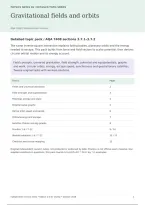
Detailed topic pack / AQA 7408 sections 3.7.1–3.7.2
The same inverse-square interaction explains falling bodies, planetary orbits and the energy
needed to escape. This pack builds from force and field vectors to scalar potential, then derives
circular orbital motion and its energy account.
Field concepts, universal gravitation, field strength, potential and equipotentials, graphs
and work, circular orbits, energy, escape speed, synchronous and geostationary satellites.
Twelve original tasks with worked solutions.
Find it Page
Fields and universal attraction 2
Field strength and superposition 3
Potential, energy and signs 4
Original radial graphs 5
Derive orbit speed and period 6
Orbital energy and escape 7
Satellite choices and log graphs 8
Practice 1––12
Worked solutions 1––12
Checklist and source mapping 13
Original independent revision notes, not produced or endorsed by AQA. Practice is not official exam material. Use
supplied constants in questions; this pack rounds G to 6.67×10⁻¹¹ N m² kg⁻² in examples.
Independent revision notes • Edition 1.0 for review • October 2026 1
, PHYSICS NOTES 4U / DETAILED TOPIC SERIES
Fields / universal attraction
AQA 7408 | Detailed topic revision
A force field is a region in which an object experiences a non-contact force. Field strength is a
vector: a direction as well as a magnitude. A field map describes what a suitable test object
would experience even when that test object is not actually present.
Newtonian gravitational force between point masses:
F=Gm1m2/r², directed along the joining line, always attractive.
G≈6.67×10⁻¹¹ N m² kg−2.
For spherically symmetric bodies outside their surfaces, treat each mass as concentrated at
its centre.
r is centre-to-centre distance. For an object at height h above a spherical planet of radius R, use
r=R+h, not h. The inverse-square formula is not an outside-field formula you can apply
unchanged inside a material planet.
Compare fields Common idea / distinction
Gravity and electrostatics Both have inverse-square point-source forces; both use field lines,
potential and equipotentials.
Source and test property Mass for gravity; charge for electrostatics. Gravity attracts mass;
electric forces can attract or repel.
Magnetism A further force-field interaction involving moving charge; do not assume
its force direction follows the same radial rule.
Worked small gravitational force
Two point-like masses 20 kg and 30 kg at r=0.50 m attract with
F=6.67×10−11×20×30/0.50²=1.60×10−7 N. Forces on the two masses have equal magnitudes
and opposite directions; their accelerations differ because their masses differ.
An orbiting body is not beyond gravity. Gravitational force provides the inward acceleration that curves its path.
Independent revision notes • Edition 1.0 for review • October 2026 2


