
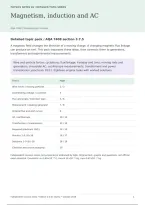
PHYSICS NOTES 4U / DETAILED TOPIC SERIES
Magnetism, induction and AC
AQA 7408 | Detailed topic revision
Detailed topic pack / AQA 7408 section 3.7.5
A magnetic field changes the direction of a moving charge. A changing magnetic flux linkage
can produce an emf. This pack separates these ideas, then connects them to generators,
transformers and experimental measurements.
Wire and particle forces; cyclotrons; flux/linkage; Faraday and Lenz; moving rods and
generators; sinusoidal AC; oscilloscope measurements; transformers and power
transmission; practicals 10/11. Eighteen original tasks with worked solutions.
Find it Page
Wire forces / moving particles 2/3
Accelerating voltage / cyclotron 4
Flux and angle / induction laws 5/6
Motional emf / rotating generator 7/8
Original flux and emf curves 9
AC / oscilloscope
Transformers / transmission
Required practicals 10/11
Practice 1–9 /10–18
Solutions 1–9 /10–18
Checklist and source mapping 20
Independent revision notes, not produced or endorsed by AQA. Original text, graphs and questions, not official
exam material. Constants: e=1.60×10⁻¹⁹ C, me=9.11×10⁻³¹ kg, mp=1.67×10⁻²⁷ kg.
Independent revision notes • Edition 1.0 for review • October 2026 1
,PHYSICS NOTES 4U / DETAILED TOPIC SERIES
Wire force / define the tesla
AQA 7408 | Detailed topic revision
For current perpendicular to a uniform magnetic field: F=BIl.
B is magnetic flux density, in tesla (T). One tesla produces 1 N on 1 m of wire carrying 1 A
perpendicular to B:1 T=1 N A⁻¹ m⁻¹.
The length l is the wire length inside the field, not the whole circuit length. More generally F=BIl
sinθ, where θ is between conventional current and B. Force is greatest at 90° and zero for a wire
parallel to B.
Fleming's left-hand rule
Hold thumb, first finger and second finger mutually perpendicular. First finger: field from N to S
outside a magnet. Second finger: conventional current. Thumb: force. Electron drift is opposite
to conventional current. Reversing either I or B reverses force; reversing both keeps the force
direction.
Direction notation Meaning
× Into page, like an arrow tail.
• Out of page, like an arrow tip.
I right, B into page Force upward; with B out of page it is downward.
Worked wire
A 0.040 m length carries 3.0 A perpendicular to 0.25 T. F=0.25×3.0×0.040=0.030 N. At 30° to
B, F=0.030sin 30°=0.015 N. These are model values, not safe apparatus current ratings.
Magnetic field lines form closed loops. B is a vector field: establish geometry before choosing a force direction.
Independent revision notes • Edition 1.0 for review • October 2026 2
, PHYSICS NOTES 4U / DETAILED TOPIC SERIES
Moving charges / magnetic bending
AQA 7408 | Detailed topic revision
Perpendicular motion: F=B|q|v.
General magnitude: F=B|q|v sinθ.
For positive charge use conventional-current direction along v. For negative charge reverse
that force direction.
Magnetic force is perpendicular to velocity, so it does no work on a freely moving charge. Speed
and kinetic energy stay constant in a magnetic field alone. Velocity changes direction. An
electric field can instead change kinetic energy.
Derive the circular radius
B|q|v=mv²/r → r=mv/(B|q|).
Momentum p=B|q|r.
T=2πr/v=2πm/(B|q|); f=B|q|/(2πm).
Higher momentum gives a larger radius at fixed B and charge. Opposite charges curve in
opposite senses. A parallel velocity component is unchanged while the perpendicular
component circles, giving a helix when both components are present.
Worked electron
At v=2.0×10⁶ m s⁻¹ perpendicular to B=0.010 T, F=3.20×10⁻¹⁵ N and
r=9.11×10⁻³¹×2.0×10⁶/(0.010×1.60×10⁻¹⁹)=1.14×10⁻³ m. If v is right and B into the page,
positive-charge force is upward but electron force is downward.
The period and kinetic-energy formulae here are nonrelativistic. Magnetic bending alone cannot increase speed.
Independent revision notes • Edition 1.0 for review • October 2026 3


