
PHYSICS NOTES 4U / DETAILED TOPIC SERIES
Electricity / circuits that make sense
AQA A-level Physics 7408 • Section 3.5 • Review edition
Detailed topic pack / AQA 7408 section 3.5
Start with charge conservation and energy per coulomb, then use circuit structure before
algebra. This pack builds from current and resistance to sensor dividers, internal resistance and
two required practicals.
18 pages with original I-V curves and divider schematic, worked circuit examples, 18
original practice tasks and full solutions. Covers required practicals 5 and 6. Capacitance,
fields and alternating current belong to later packs.
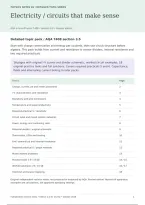
Find it Page
Charge, current, pd and meter placement 2
I-V characteristics and resistance 3
Resistivity and wire dimensions 4
Temperature and superconductivity 5
Required practical 5 / resistivity 6
Circuit rules and mixed resistor networks 7
Power, energy and combining cells 8
Potential divider / original schematic 9
Thermistors, LDRs and loading 10
Emf, terminal pd and internal resistance 11
Required practical 6 / graph methods 12
Mixed worked problems 13
Practice tasks 1--18
Worked solutions 1--18
Checklist and source mapping 18
Original independent revision notes, not produced or endorsed by AQA. Review edition. Numerical apparatus
examples are calculations, not approved operating settings.
Independent revision notes • Edition 1.0 for review • October 2026 1
,PHYSICS NOTES 4U / DETAILED TOPIC SERIES
Charge and energy / read the circuit
AQA A-level Physics 7408 • Section 3.5 • Review edition
Quantity Definition / unit
Charge Q Electric charge / coulomb (C)
Current I=ΔQ/Δt Rate of charge flow / ampere (A=C s⁻¹)
Potential difference V=W/Q Energy transferred per unit charge / volt (V=J C⁻¹)
Resistance R=V/I Ratio of pd to current at an operating point / ohm (Ω)
Conventional current follows positive-charge flow: from positive to negative through an external
load. In a metal the mobile electrons drift in the opposite direction. Current is not used up by a
resistor. Charge is conserved; energy is transferred from the electrical system to other stores.
Example: 0.40 A for 75 s transfers Q=It=30 C. Across 6.0 V, the energy transferred is
W=QV=180 J. Each coulomb transfers 6.0 J, not 6.0 C of energy.
Ammeter and voltmeter
An ammeter is inserted in series with the branch of interest. An ideal ammeter has zero
resistance and causes no pd drop. A voltmeter goes in parallel across two points. An ideal
voltmeter has infinite resistance and takes no current. Treat them as ideal unless the question
states otherwise.
Avoid a short circuit: placing a real ammeter directly across a supply can produce a large
damaging current. A voltmeter in series usually prevents useful circuit current. Check the
meter mode, socket, polarity and range before powering a real circuit.
Variable current
For constant current, Q=It. On a current-time graph, transferred charge is the signed area under
the graph. Average current over an interval is total charge divided by total time; do not assume
a final reading held throughout.
The circuit settles electrically much faster than electron drift along a wire. Do not describe the supply as sending
one electron around the whole circuit before a lamp can respond.
Independent revision notes • Edition 1.0 for review • October 2026 2
, PHYSICS NOTES 4U / DETAILED TOPIC SERIES
I-V curves / inspect the axes
AQA A-level Physics 7408 • Section 3.5 • Review edition
Qualitative I (vertical) against V (horizontal); scales illustrative, not measurement data.
I I I
V V V
Ohmic conductor Filament lamp Diode
Ohmic conductor: a straight line through the origin under constant physical conditions,
particularly temperature. I∝V. Resistance is constant. Ohm's law is a special behaviour, not a
synonym for the definition R=V/I.
Filament lamp: increasing current heats the filament. Resistance rises, so on an I-vertical graph
the curve becomes less steep at larger |V|. Negative polarity gives a similar opposite-sign
branch. The lamp is not ohmic across a range where temperature changes.
Semiconductor diode: large forward current after the forward region is reached; very small
reverse current in its normal operating range. The onset voltage depends on the diode and
conditions. Do not claim every diode has an exact universal threshold. Reverse breakdown is
outside this simple curve.
Gradient warning: on V against I, an ohmic line has slope R; on I against V it has slope
1/R. For a curved characteristic, R at a point is V/I, found from a line from the origin to that
point. The tangent gives a different small-change ratio and is not the ordinary resistance
unless the line is ohmic.
To measure a full characteristic use a suitable current-limiting element, series ammeter and voltmeter across the
component. Reverse polarity for the other branch. Do not allow a diode to carry an uncontrolled forward current.
Independent revision notes • Edition 1.0 for review • October 2026 3


