
PHYSICS NOTES 4U / DETAILED TOPIC SERIES
Particles and quantum phenomena
AQA A-level Physics 7408 • Section 3.2 • Review edition
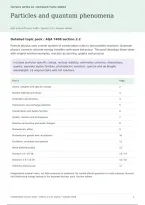
Detailed topic pack / AQA 7408 section 3.2
Particle physics uses a small number of conservation rules to test possible reactions. Quantum
physics connects discrete energy transfers with wave behaviour. This pack develops those ideas
with original worked examples, reaction accounting, graphs and practice.
Includes atom/ion specific charge, nuclear stability, antimatter, photons, interactions,
quarks, separate lepton families, photoelectric emission, spectra and de Broglie
wavelength. 18 original tasks with full solutions.
Find it Page
Atoms, isotopes and specific charge 2
Nuclear stability and decay 3
Antimatter and photons 4
Interactions and exchange particles 5
Classification and lepton families 6
Quarks, mesons and strangeness 7
Reaction accounting and weak changes 8
Photoelectric effect 9
Photoelectric graphs and calculations 10
Excitation, ionisation and spectra 11
Wave-particle duality 12
Practice 1--18
Solutions 1--18
Checklist and sources 17
Independent original notes, not AQA-produced or endorsed. No copied official questions or mark schemes. Nuclear
half-life/binding energy belong in the separate Nuclear pack. Review edition.
Independent revision notes • Edition 1.0 for review • October 2026 1
,PHYSICS NOTES 4U / DETAILED TOPIC SERIES
Atoms / charge and mass accounting
AQA A-level Physics 7408 • Section 3.2 • Review edition
Particle Charge / C Mass / kg Relative mass
Proton +1.60 × 10⁻¹⁹ 1.673 × 10⁻²⁷ 1
Neutron 0 1.675 × 10⁻²⁷ about 1
Electron −1.60 × 10⁻¹⁹ 9.11 × 10⁻³¹ about 1/1836
The small nucleus contains protons and neutrons. Electrons occupy the surrounding region.
Proton number Z fixes the element; nucleon number A counts protons plus neutrons. Neutron
count=A−Z. Write nuclides with A as upper-left and Z as lower-left indices.
Example: ²⁴₁₂Mg has 12 protons and 12 neutrons. A neutral atom has 12 electrons. Mg²⁺
has lost two electrons, so it has 10. Ion formation changes electron count, not nuclear Z or
A.
Isotopes
Isotopes have the same proton number but different neutron numbers. Their chemistry is similar
because neutral atoms have the same electron configuration, but their masses and nuclear
stability can differ. In isotope data, abundance-weighted averages describe a mixture, not a
fractional nucleon count for one nucleus.
Specific charge = charge / mass
Unit C kg−1. Keep charge sign unless a magnitude is requested. Proton: +e/mp≈+9.58 × 10⁷ C
kg−1. Electron: −e/me≈−1.76 × 10¹¹ C kg−1. Its much smaller mass gives much larger
magnitude.
Ion: approximate ²⁴Mg²⁺ mass as 24 × 1.67 × 10−27 kg. Charge=+2e. Specific
charge=(3.20 × 10⁻¹⁹)/(4.008 × 10−26)=+7.98 × 10⁶ C kg−1. For the bare nucleus, use
+12e instead: about +4.79 × 10⁷ C kg−1.
This mass approximation neglects electron masses and nuclear binding mass differences. Use provided isotope
masses when the question gives them.
Independent revision notes • Edition 1.0 for review • October 2026 2
, PHYSICS NOTES 4U / DETAILED TOPIC SERIES
Nuclear stability / two competing forces
AQA A-level Physics 7408 • Section 3.2 • Review edition
Protons repel electromagnetically. The strong nuclear force between nucleons can bind a
nucleus despite that repulsion. It is attractive over a short range up to about 3 fm and repulsive
at separations below about 0.5 fm. 1 fm=10−15 m. The repulsive core prevents collapse into one
point.
Alpha decay
An alpha particle is a helium-4 nucleus: two protons and two neutrons. Parent A falls by 4 and Z
by 2. It is not a neutral helium atom at emission.
General: (A,Z)X → (A−4,Z−2)Y + ⁴₂He.
Example: ²²⁶₈₈Ra → ²²²₈₆Rn + ⁴₂He.
Check nucleon total: 226=222+4. Charge: 88=86+2.
Beta-minus decay
A neutron changes to a proton, electron and electron antineutrino: n → p + e⁻ + anti-νe. In a
nucleus A stays constant and Z rises by 1. The emitted electron is created in the decay; it was
not an orbital electron ejected from the atom.
Example: ¹⁴₆C → ¹⁴₇N + e⁻ + anti-νe.
Charge: 6=7−1+0. Nucleon count: 14=14+0+0.
Electron-family lepton number: 0=0+1−1.
Beta electrons have a range of kinetic energies because the available energy is shared between
electron, antineutrino and recoiling nucleus. The neutrino hypothesis accounted for missing
energy; momentum conservation is also respected. Do not say beta decay violates energy
conservation.
These decay equations state particle changes. Decay-rate models, attenuation and binding energy are covered in
the Nuclear pack. Radiation demonstrations require approved supervision and source procedures, not improvised
sources.
Independent revision notes • Edition 1.0 for review • October 2026 3


