
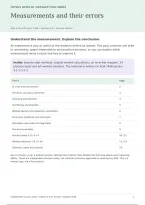
PHYSICS NOTES 4U / DETAILED TOPIC SERIES
Measurements and their errors
AQA A-level Physics 7408 • Section 3.1 • Review edition
Understand the measurement. Explain the conclusion.
An experiment is only as useful as the evidence behind its answer. This pack connects unit skills
to uncertainty, graph interpretation and practical decisions, so you can explain which
measurement limits a result and how to improve it.
Inside: step-by-step methods, original worked calculations, an error-bar diagram, 14
practice tasks and full worked solutions. The material is written for AQA 7408 section
3.1.1–3.1.3.
Find it Page
SI units and conversions 2
Precision, accuracy and errors 3
Choosing uncertainties 4
Combining uncertainties 5
Worked density and resistivity calculations 6
Error bars, gradients and intercepts 7
Estimation and orders of magnitude 8
Practical evaluation 9
Practice tasks 1––14
Worked solutions 1––14
Checklist, limits and sources 14
Use it actively: cover a worked solution, attempt the method, then identify the first step where your reasoning
differs. These are independent revision notes, not material produced, approved or endorsed by AQA. This is a
review copy, not a live product.
Independent revision notes • Edition 1.0 for review • October 2026 1
, PHYSICS NOTES 4U / DETAILED TOPIC SERIES
Units that keep physics honest
AQA A-level Physics 7408 • Section 3.1 • Review edition
Base and derived units
For this specification, use the six base quantities below. The candela is excluded from this
section. You do not need the formal definitions of SI base quantities or dimensional analysis as a
separate topic.
Quantity SI unit Symbol
Mass / length / time kilogram / metre / second kg / m / s
Current / temperature ampere / kelvin A/K
Amount of substance mole mol
Derived units follow from equations: velocity is m s−1; acceleration is m s−2; force is kg m s−2 =
N. Work = force × distance, so J = N m. Power = energy/time, so W = J s−1. Charge = current ×
time, so C = A s.
Prefix Factor Prefix Factor
tera T / giga G 10¹² / 10⁹ mega M / kilo k 10⁶ / 10³
centi c / milli m 10⁻² / 10⁻³ micro μ / nano n 10⁻⁶ / 10⁻⁹
pico p 10⁻¹² femto f 10⁻¹⁵
Worked conversion: 0.72 mm² = 0.72 × (10−3 m)² = 7.2 × 10⁻⁷ m². Square the
conversion factor too. Similarly, 1 cm³ = 10−6 m³.
Energy conversions
1 kW h = 1000 W × 3600 s = 3.6 × 10⁶ J. An electronvolt is energy, not voltage: 1 eV ≈ 1.60 ×
10−19 J. Thus 3.2 eV = 5.12 × 10⁻¹⁹ J. To convert J to eV, divide by 1.60 × 10⁻¹⁹.
Standard form has one non-zero digit before the decimal point: 0.000047 A = 4.7 × 10⁻⁵ A. Prefixes are
case-sensitive: m is milli; M is mega.
Independent revision notes • Edition 1.0 for review • October 2026 2


