
BRITISH COLUMBIA COOK CERTIFICATE OF QUALIFICATION
EXAMINATION PROFESSIONAL COOK LEVEL 2 COMPREHENSIVE
PRACTICE QUESTION BANK — 150 MULTIPLE-CHOICE PRACTICE
QUESTIONS, ANSWER KEY, AND DETAILED EXPLANATIONS.
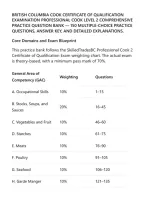
Core Domains and Exam Blueprint
This practice bank follows the SkilledTradesBC Professional Cook 2
Certificate of Qualification Exam weighting chart. The actual exam
is theory-based, with a minimum pass mark of 70%.
General Area of
Weighting Questions
Competency (GAC)
A. Occupational Skills 10% 1–15
B. Stocks, Soups, and
20% 16–45
Sauces
C. Vegetables and Fruit 10% 46–60
D. Starches 10% 61–75
E. Meats 10% 76–90
F. Poultry 10% 91–105
G. Seafood 10% 106–120
H. Garde Manger 10% 121–135
,General Area of
Weighting Questions
Competency (GAC)
J. Baked Goods and
10% 136–150
Desserts
Introduction
The British Columbia Professional Cook Level 2 Certificate of
Qualification Examination assesses the knowledge and applied
decision-making required for a cook who works under some
supervision, performing a variety of cooking and food preparation
tasks using multiple methods. It evaluates occupational skills,
stock and sauce production, vegetable and starch cookery, meat,
poultry, seafood, garde manger, and baked goods and desserts.
The exam emphasizes real-world application, food safety, cost
awareness, and professional standards. Candidates must
demonstrate the ability to select appropriate techniques, manage
food resources, and produce consistent, high-quality dishes
across the professional kitchen.
Instructions
Select the ONE best answer for each question. Each question
includes a hint to guide reasoning. The correct answer is marked
🟢, and a detailed rationale marked 🔴 follows each item. Answer
distribution is balanced across A, B, C, and D. This is an
independent practice resource; confirm important details against
current SkilledTradesBC program outlines and official examination
materials.
SECTION ONE: QUESTIONS 1–150
,Domain A: Occupational Skills (Questions 1–15)
1. A line cook is planning a table d’hôte menu for a busy dinner
service. Which principle is most important when balancing the
menu?
A. Using the most expensive ingredients to signal quality
B. Ensuring variety in cooking methods, textures, colours, and
nutritional balance
C. Repeating the same starch and vegetable with every entrée
D. Choosing only dishes that can be prepared in advance
Hint: A balanced menu avoids monotony and satisfies diverse
preferences.
🟢 B. Ensuring variety in cooking methods, textures, colours, and
nutritional balance
🔴 RATIONALE: Menu planning principles include variety in
cooking methods, textures, colours, flavours, and nutritional
content. Repetition and reliance on expensive ingredients do not
create balance.
2. Under the BC Employment Standards Act, which statement
about hours of work and overtime is most accurate for a cook?
A. Overtime is voluntary and may be refused without consequence
B. Employees must receive overtime pay after 8 hours per day or
40 hours per week, subject to variances
C. Cooks are exempt from all overtime provisions
D. Overtime is paid only after 12 hours in a single day
Hint: BC standards set daily and weekly thresholds.
, 🟢 B. Employees must receive overtime pay after 8 hours per day
or 40 hours per week, subject to variances
🔴 RATIONALE: The BC Employment Standards Act sets overtime
entitlements after 8 hours per day or 40 hours per week, subject
to approved variances. Cooks are not categorically exempt.
3. A cook is calculating the cost of a menu item. The raw
ingredient cost is $4.20, and the target food cost percentage is
30%. What should the selling price be, rounded to the nearest
$0.05?
A. $12.50
B. $14.00
C. $15.00
D. $16.80
Hint: Selling price = ingredient cost ÷ food cost percentage.
🟢 B. $14.00
🔴 RATIONALE: Selling price = $4.20 ÷ 0.30 = $14.00. Food cost
percentage pricing ensures that ingredient costs remain within the
target ratio of the selling price.
4. Which action best demonstrates effective cross-utilization in
a professional kitchen?
A. Using the same garnish for every plate
B. Using trim from one dish to produce stock or another menu
component
C. Ordering excessive quantities to avoid running out
D. Changing suppliers weekly
Hint: Cross-utilization reduces waste and increases efficiency.


