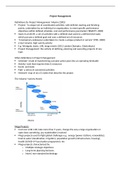
Project Management
Definitions for Project Management- Maylor (2005)
Project: "A unique set of coordinated activities, with definite starting and finishing
points, undertaken by an individual or organization, to meet specific performance
objectives within defined schedule, cost and performance parameters"(BS6079, 2000)
Slack et al (2019): a set of activities with a defined start point & a defined end state,
which pursues a defined goal and sues a defined set of resources
"A temporary endeavour undertaken to create a unique product or service" (PMI, 2000)
A low-volume, high variety activity
E.g. Westgate, dams, LHR, mega events (2012 London Olympics, Glastonbury)
Project Management: the activity of defining, planning and executing projects of any
type.
Other Definitions in Project Management
Schedule- result of transforming a project action plan into an operating timetable
Activity- task that requires time & resources
Event- end state
Path- a serios of connected activities
Network- map of arcs & nodes that describe the project
The Volume/ Variety Matrix
Mega Projects
Cost over $1B/ £1B, take more than 5 years, change the way a large organisation or
state does something, any stakeholders involved
Mega projects used to fight global challenges e.g. energy (power stations, renewables),
food & water (desalination, irrigation), population growth (infrastructure, housing),
health (COVID-19 Vaccination programme), etc
Mega-projects characterised by
o Multiple strategic objectives
o Long-term planning horizons
o Novel, non-standard technology
, o High uncertainty in cost, benefit and risk forecasting
o Complex governance, contract and decision-making structures
o Project lock-in or capture at early stage
o Scope and ambition change over life-cycle
o Dynamic political and economic environment
o Multiple stakeholders with changing agendas
Mega-project are complex due to:
o Technical elements: time dimensions, multiple stakeholders, complexity and
uncertainty, complex communication, projects are a technical network, not a
hierarchy
o Social elements: Conflicting, unclear or emergent goals, Organisational
leadership, Control or Commitment culture, Projects are a social network, not a
hierarchy, Experience periods of failure, Crises are normal
Historical development of PM
Stage 1: Pre 1950s- no generally accepted or defined methods
Stage 2: 1950s- one best way approach based on numerical methods established in the
US for large scale projects
Stage 3: 1990s- A contingent approach based on strategy
Stage 4: 2000s- projects as organisations
General Management Project Management
Responsible for managing the status quo Responsible for overseeing change
Authority defined by management Lines of authority are fuzzy
structure
Consistent set of tasks Ever changing set of tasks
Responsibility limited to own function Responsibility for cross-functional activities
Works in permanent organisational Operates within structures which exist for
structures the life of the project
Works in permanent organisational Predominantly concerned with innovation
structures
Tasks described as maintenance Main task is the resolution of conflict
Main task is optimisation Success determined by the achievement of
a stated goal
Success determined by achievement of Contains intrinsic uncertainties
interim targets
Limited set of variables
General Management vs Project Management
Project Management Structure Models
All projects need a project manager- manage human resources
o People need clear understanding of their own roles
o Allocate different tasks
o Respond to rapid exchange of info between stakeholders
Project Development- Maylor (2003)
, Understanding the environment
Define the project- setting objectives, scope & strategy
Conceptualisation, goal defintion, organisational strategy
Generate explicit statement of needs and identifity what has to be provided to meet
these needs and whether it is feasible.
Design the project process- deciding how to execute the project
Proposal, justification, agreement: show how needs met through project activites and
prepare and evaluate financial costs and benefits
How will it be done? When can it start and finish?
Planning process purposes:
o Determines the cost and duration of the project- Enables major
decisions to be made like whether to start project at all
o Determines level of resources needed
o Helps allocate work & monitor progress- who is responsible for what
o Helps assess impact of changes to project
5 steps in planning progress:
o Identify activities in project
o Estimate times & resources for activities
o Identify relationship between activities
o Identify time & resource schedule constraints
o Fix schedule for time & resources
o The third stage of planning is understanding the interactions between
different project activities: Activities need to be executed in a particular
order are dependent on a series of relationships (others are
independent)
Deliver the project- performing the technical aspects of the project
Start-up, execution, completion, handover: gather resources, assemble teams, carry out
defined tasks
Develop the process- reviewing
Review, feedback: identify outcomes for all stakeholders and put in place improvements
to procedures, fall knowledge gaps
The basic approach of all scheduling techniques is to form an actual or implied network of
activity and event relationships that graphically portrays the sequential relations between
the tasks of a project
Definitions for Project Management- Maylor (2005)
Project: "A unique set of coordinated activities, with definite starting and finishing
points, undertaken by an individual or organization, to meet specific performance
objectives within defined schedule, cost and performance parameters"(BS6079, 2000)
Slack et al (2019): a set of activities with a defined start point & a defined end state,
which pursues a defined goal and sues a defined set of resources
"A temporary endeavour undertaken to create a unique product or service" (PMI, 2000)
A low-volume, high variety activity
E.g. Westgate, dams, LHR, mega events (2012 London Olympics, Glastonbury)
Project Management: the activity of defining, planning and executing projects of any
type.
Other Definitions in Project Management
Schedule- result of transforming a project action plan into an operating timetable
Activity- task that requires time & resources
Event- end state
Path- a serios of connected activities
Network- map of arcs & nodes that describe the project
The Volume/ Variety Matrix
Mega Projects
Cost over $1B/ £1B, take more than 5 years, change the way a large organisation or
state does something, any stakeholders involved
Mega projects used to fight global challenges e.g. energy (power stations, renewables),
food & water (desalination, irrigation), population growth (infrastructure, housing),
health (COVID-19 Vaccination programme), etc
Mega-projects characterised by
o Multiple strategic objectives
o Long-term planning horizons
o Novel, non-standard technology
, o High uncertainty in cost, benefit and risk forecasting
o Complex governance, contract and decision-making structures
o Project lock-in or capture at early stage
o Scope and ambition change over life-cycle
o Dynamic political and economic environment
o Multiple stakeholders with changing agendas
Mega-project are complex due to:
o Technical elements: time dimensions, multiple stakeholders, complexity and
uncertainty, complex communication, projects are a technical network, not a
hierarchy
o Social elements: Conflicting, unclear or emergent goals, Organisational
leadership, Control or Commitment culture, Projects are a social network, not a
hierarchy, Experience periods of failure, Crises are normal
Historical development of PM
Stage 1: Pre 1950s- no generally accepted or defined methods
Stage 2: 1950s- one best way approach based on numerical methods established in the
US for large scale projects
Stage 3: 1990s- A contingent approach based on strategy
Stage 4: 2000s- projects as organisations
General Management Project Management
Responsible for managing the status quo Responsible for overseeing change
Authority defined by management Lines of authority are fuzzy
structure
Consistent set of tasks Ever changing set of tasks
Responsibility limited to own function Responsibility for cross-functional activities
Works in permanent organisational Operates within structures which exist for
structures the life of the project
Works in permanent organisational Predominantly concerned with innovation
structures
Tasks described as maintenance Main task is the resolution of conflict
Main task is optimisation Success determined by the achievement of
a stated goal
Success determined by achievement of Contains intrinsic uncertainties
interim targets
Limited set of variables
General Management vs Project Management
Project Management Structure Models
All projects need a project manager- manage human resources
o People need clear understanding of their own roles
o Allocate different tasks
o Respond to rapid exchange of info between stakeholders
Project Development- Maylor (2003)
, Understanding the environment
Define the project- setting objectives, scope & strategy
Conceptualisation, goal defintion, organisational strategy
Generate explicit statement of needs and identifity what has to be provided to meet
these needs and whether it is feasible.
Design the project process- deciding how to execute the project
Proposal, justification, agreement: show how needs met through project activites and
prepare and evaluate financial costs and benefits
How will it be done? When can it start and finish?
Planning process purposes:
o Determines the cost and duration of the project- Enables major
decisions to be made like whether to start project at all
o Determines level of resources needed
o Helps allocate work & monitor progress- who is responsible for what
o Helps assess impact of changes to project
5 steps in planning progress:
o Identify activities in project
o Estimate times & resources for activities
o Identify relationship between activities
o Identify time & resource schedule constraints
o Fix schedule for time & resources
o The third stage of planning is understanding the interactions between
different project activities: Activities need to be executed in a particular
order are dependent on a series of relationships (others are
independent)
Deliver the project- performing the technical aspects of the project
Start-up, execution, completion, handover: gather resources, assemble teams, carry out
defined tasks
Develop the process- reviewing
Review, feedback: identify outcomes for all stakeholders and put in place improvements
to procedures, fall knowledge gaps
The basic approach of all scheduling techniques is to form an actual or implied network of
activity and event relationships that graphically portrays the sequential relations between
the tasks of a project