

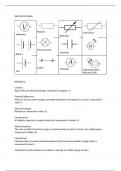
Electrical Symbols:
Resistor Thermistor
Voltmeter
Rheostat
Filament lamp
Capacitor
Battery
Switch Ammeter Light Dependent
Cell
Resistor (LDR)
Definitions:
Current:
Rate of flow of electrical charge, measured in ampere, A.
Potential difference:
Measure of how much energy is transferred between two points in a circuit, measured in
volts, V.
Electrical charge:
Resistance, measured in ohm,
Conductance:
An objects capacity to conduct electricity, measured in siemen, SI
Electrical power:
The rate at which electricity energy is transferred by an electric circuit, also called power.
Measured in Watts, W.
Capacitance:
Characteristic of a device/material medium that stores electrostatic charge which is
measured in farad, F.
Conductance and resistance in relation to density of mobile charge carriers:
, Conductance is the inverse of resistance; it measured how easily electric current flows
through something. Conductance, G, is equal to the reciprocal of resistance. G = 1/R
Current in terms of rate of flow of mobile charge carriers:
Rate of flow at which a charge carrier crosses pass a point on a circuit.
Electromotive force, EMF:
The energy per unit charge as a measure of the ratio of energy supplied.
Formulas:
Energy supplied:
W = VIt
Ohms law:
V = IR
Power:
P = IV
P = I2 R
Charge:
Q = It
Conductance:
1 1
G= =
R V
Resistivity:
pl
R= (m)
A
Capacitors:
Q = CV
Parallel capacitors: CT = C1 + C2
1 1 1
Series capacitors: = +
CT C1 C2
Kirchoffs First Law:
The junction rule is another name for the first law, which reads the sum of the currents
entering a junction and the sum of the currents exiting a junction are equal at every junction
in a circuit. A conserved charge is produced when the total current that entered the circuit
and the total current that exited the junction are equal. I1=I2 + I3 + I4 was produced.
Kirchoffs Second Law:
Resistor Thermistor
Voltmeter
Rheostat
Filament lamp
Capacitor
Battery
Switch Ammeter Light Dependent
Cell
Resistor (LDR)
Definitions:
Current:
Rate of flow of electrical charge, measured in ampere, A.
Potential difference:
Measure of how much energy is transferred between two points in a circuit, measured in
volts, V.
Electrical charge:
Resistance, measured in ohm,
Conductance:
An objects capacity to conduct electricity, measured in siemen, SI
Electrical power:
The rate at which electricity energy is transferred by an electric circuit, also called power.
Measured in Watts, W.
Capacitance:
Characteristic of a device/material medium that stores electrostatic charge which is
measured in farad, F.
Conductance and resistance in relation to density of mobile charge carriers:
, Conductance is the inverse of resistance; it measured how easily electric current flows
through something. Conductance, G, is equal to the reciprocal of resistance. G = 1/R
Current in terms of rate of flow of mobile charge carriers:
Rate of flow at which a charge carrier crosses pass a point on a circuit.
Electromotive force, EMF:
The energy per unit charge as a measure of the ratio of energy supplied.
Formulas:
Energy supplied:
W = VIt
Ohms law:
V = IR
Power:
P = IV
P = I2 R
Charge:
Q = It
Conductance:
1 1
G= =
R V
Resistivity:
pl
R= (m)
A
Capacitors:
Q = CV
Parallel capacitors: CT = C1 + C2
1 1 1
Series capacitors: = +
CT C1 C2
Kirchoffs First Law:
The junction rule is another name for the first law, which reads the sum of the currents
entering a junction and the sum of the currents exiting a junction are equal at every junction
in a circuit. A conserved charge is produced when the total current that entered the circuit
and the total current that exited the junction are equal. I1=I2 + I3 + I4 was produced.
Kirchoffs Second Law:


