
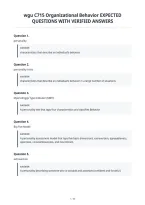
wgu C715 Organizational Behavior EXPECTED
QUESTIONS WITH VERIFIED ANSWERS
Question 1.
personality
ANSWER
characteristics that describe an individual's behavior.
Question 2.
personality traits
ANSWER
characteristics that describe an individual's behavior in a large number of situations
Question 3.
Myers-Briggs Type Indicator (MBTI)
ANSWER
A personality test that taps four characteristics and classifies Behavior
Question 4.
Big Five Model
ANSWER
A personality assessment model that taps five basic dimensions. extraversion, agreeableness,
openness, conscientiousness, and neuroticism.
Question 5.
extraversion
ANSWER
A personality describing someone who is sociable and assertive (confident and forceful )
,Question 6.
agreeableness
ANSWER
A personality that describes someone who is good natured, cooperative, and trusting.
Question 7.
conscientiousness
ANSWER
A personality that describes someone who is responsible, dependable, persistent, and
organized.
Question 8.
emotional stability
ANSWER
A personality that characterizes someone as calm, self-confident, and insecure.
Question 9.
openness to experience
ANSWER
A personality that characterizes someone in terms of imagination, sensitivity, and curiosity.
Question 10.
core self-evaluation
ANSWER
Bottom-line conclusions individuals have about their capabilities, competence, and worth as a
person.
Question 11.
Machiavellianism
ANSWER
The degree to which an individual is pragmatic, maintains emotional distance, and believes
that ends can justify means.
,Question 12.
narcissism
ANSWER
The tendency to be arrogant, self-importance, require excessive admiration, and have a sense
of entitlement.
Question 13.
self-monitoring
ANSWER
where an individual's has ability to adjust his or her behavior to external, situational factors.
Question 14.
proactive personality
ANSWER
People who identify opportunities, show initiative, take action, and persevere until meaningful
change occurs.
Question 15.
values
ANSWER
Basic convictions that a specific mode of conduct or end-state of existence is personally or
socially preferable to an opposite or converse mode of conduct or end-state of existence.
Question 16.
value system
ANSWER
A hierarchy based on a ranking of an individual's values in terms of their intensity.
Question 17.
terminal values
ANSWER
Values that we work towards (happiness, self-respect, family security, recognition)
, Question 18.
instrumental values
ANSWER
Core values that are permanent in nature (honesty, sincerity, ambition, independence)
Question 19.
personality Job-fit theory
ANSWER
A theory that identifies six personality types and proposes that the fit between personality type
and occupational environment determines satisfaction and turnover.
Question 20.
power distance
ANSWER
where society accepts that power in institutions and organizations is distributed unequally.
Question 21.
individualism
ANSWER
where people prefer to act as individuals rather than as members of groups.
Question 22.
collectivism
ANSWER
A national culture attribute that describes a tight social framework in which people expect
others in groups of which they are a part to look after them and protect them.
Question 23.
masculinity
ANSWER
where culture favors traditional masculine work roles of achievement, power, and control.


