
GLIAL CELLS
- They are support cells
- Include EPENDYMAL CELLS, ASTROCYTES, MICROGLIA in the CNS
- Schwann and satellite cells in the PNS.
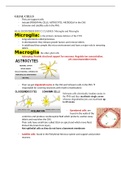
GLIA IS DIVIDED INTO 2 CLASSES: Microglia and Macroglia
Microglia: is the primary immune defence of the CNS
- Long extensions called processes.
- In development they release growth factors and remove debris
- In adulthood they sample the micro environment and have a major role in removing
debris
Macroglia: the other glial cells
- Astrocytes: Provide structural support for neurones. Regulate ion concentration,
pH, neurotransmitter levels.
- Then we get oligodendrocytes in the CNS and Schwann cells in the PNS
responsible for covering neurones with myelin (myelination)
Schwann cells electrically insulate axons in
the PNS and they myelinate single axons
whereas oligodendrocytes can myelinate up
to 60 axons.
- Ependymal cells: are
found in the walls of the
ventricles and produce cerebrospinal fluid which protects, washes away
debris and nourishes the CNS.
Their cells have small hairs called CILIA on apical end which move fluid.
Protect the brain from injury
Not epithelial cells as they do not have a basement membrane
- Satellite cells: found in the Peripheral Nervous system and support and protect
neurons.
- They are support cells
- Include EPENDYMAL CELLS, ASTROCYTES, MICROGLIA in the CNS
- Schwann and satellite cells in the PNS.
GLIA IS DIVIDED INTO 2 CLASSES: Microglia and Macroglia
Microglia: is the primary immune defence of the CNS
- Long extensions called processes.
- In development they release growth factors and remove debris
- In adulthood they sample the micro environment and have a major role in removing
debris
Macroglia: the other glial cells
- Astrocytes: Provide structural support for neurones. Regulate ion concentration,
pH, neurotransmitter levels.
- Then we get oligodendrocytes in the CNS and Schwann cells in the PNS
responsible for covering neurones with myelin (myelination)
Schwann cells electrically insulate axons in
the PNS and they myelinate single axons
whereas oligodendrocytes can myelinate up
to 60 axons.
- Ependymal cells: are
found in the walls of the
ventricles and produce cerebrospinal fluid which protects, washes away
debris and nourishes the CNS.
Their cells have small hairs called CILIA on apical end which move fluid.
Protect the brain from injury
Not epithelial cells as they do not have a basement membrane
- Satellite cells: found in the Peripheral Nervous system and support and protect
neurons.


