
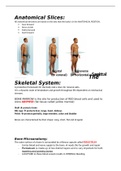
Anatomical Slices:
All anatomical directions are based on the idea that the body is in the ANATOMICAL POSITION.
Face forward
Arms at side
Palms forward
Feet forward
Frontal Transverse
(or coronal) (or horizontal orSagittal
axial)
The
Skeletal System:
A protective framework for the body and a store for mineral salts.
It is a dynamic state of breakdown and growth throughout life dependent on mechanical
stresses.
BONE MARROW is the site for production of RED blood cells and used to
store ADIPOSE (fat tissue called yellow marrow)
Skull protects brain
Rib cage protects liver, lungs, heart, kidneys
Pelvis protects genitalia, large intestine, colon and bladder
Bones are characterised by their shape: Long, short, flat and irregular
Bone Microanatomy:
The outer surface of a bone is surrounded by a fibrous capsule called PERIOSTEUM
- Carries blood and nerve supply to the bone needs this for growth and repair
- Periosteum is made up of two distinct layers and is very important for both
repairing and growing bones
- A RUPTURE to these blood vessels results in INTERNAL bleeding.
, Under periosteum is the dense calcified bone called COMPACT BONE
Ends of the bones are called EPIPHYSIS – where we find spongy bone
Middle area is DIAPHYSIS which separates the epiphysis from the diaphysis by a line of
BONE CELLS which grow and rebuild (epiphyseal line)
MIDDLE area (Diaphysis) is called the Medullary cavity. This can be:
1. Hollow
2. Spongy bone
3. Filled with bone marrow
Bone properties:
We have 270 bones at birth some which fuse together as it matures and
grows resulting in 206.
Some of these sutures may break due to trauma and tension leading to a
fracture.
Bones are made up 60% minerals and collagen, and 40% water.
- Mineral salts create the hardness of the bone
- Collagen fibres convey strength and resist force
Skeletal muscle is attached to bone via connective tissue and assist in exerting forces on
bone to help movement.
- Generates mechanical forces
Therefore, bone is adaptable as can become thickened due to extreme use such as tennis
player.
The Heart:
The heart works as a PULSATILE Generates pulse.
The four-chamber pump is composed of TWO ATRIA AND TWO
VENTRICLES
ROLE: transports substances such as oxygen, carbon dioxide, ions
(electrolytes), hormones and blood cells.
The heart is lined in its own sac called the PERICARDIAL CAVITY.
All anatomical directions are based on the idea that the body is in the ANATOMICAL POSITION.
Face forward
Arms at side
Palms forward
Feet forward
Frontal Transverse
(or coronal) (or horizontal orSagittal
axial)
The
Skeletal System:
A protective framework for the body and a store for mineral salts.
It is a dynamic state of breakdown and growth throughout life dependent on mechanical
stresses.
BONE MARROW is the site for production of RED blood cells and used to
store ADIPOSE (fat tissue called yellow marrow)
Skull protects brain
Rib cage protects liver, lungs, heart, kidneys
Pelvis protects genitalia, large intestine, colon and bladder
Bones are characterised by their shape: Long, short, flat and irregular
Bone Microanatomy:
The outer surface of a bone is surrounded by a fibrous capsule called PERIOSTEUM
- Carries blood and nerve supply to the bone needs this for growth and repair
- Periosteum is made up of two distinct layers and is very important for both
repairing and growing bones
- A RUPTURE to these blood vessels results in INTERNAL bleeding.
, Under periosteum is the dense calcified bone called COMPACT BONE
Ends of the bones are called EPIPHYSIS – where we find spongy bone
Middle area is DIAPHYSIS which separates the epiphysis from the diaphysis by a line of
BONE CELLS which grow and rebuild (epiphyseal line)
MIDDLE area (Diaphysis) is called the Medullary cavity. This can be:
1. Hollow
2. Spongy bone
3. Filled with bone marrow
Bone properties:
We have 270 bones at birth some which fuse together as it matures and
grows resulting in 206.
Some of these sutures may break due to trauma and tension leading to a
fracture.
Bones are made up 60% minerals and collagen, and 40% water.
- Mineral salts create the hardness of the bone
- Collagen fibres convey strength and resist force
Skeletal muscle is attached to bone via connective tissue and assist in exerting forces on
bone to help movement.
- Generates mechanical forces
Therefore, bone is adaptable as can become thickened due to extreme use such as tennis
player.
The Heart:
The heart works as a PULSATILE Generates pulse.
The four-chamber pump is composed of TWO ATRIA AND TWO
VENTRICLES
ROLE: transports substances such as oxygen, carbon dioxide, ions
(electrolytes), hormones and blood cells.
The heart is lined in its own sac called the PERICARDIAL CAVITY.


