
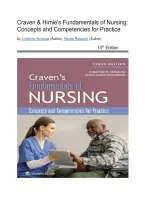
Craven & Hirnle's Fundamentals of Nursing:
Concepts and Competencies for Practice
by Christine Henshaw (Author), Renee Rassilyer (Author)
10th Edition
,TABLE OF CONTENTS
Unit 1 Professional Concepts
Chapter 1: The Profession of Nursing
Chapter 2: The Nurse’s Role in Healthcare Quality and Patient Safety
Chapter 3: Values, Ethics and Legal Issues
Chapter 4: Nursing Research and Evidence-Based Care
Unit 2 The Nursing Process and the Clinical Judgment Measurement Model
Chapter 5: Introduction to the Nursing Process, Critical Thinking, and Clinical Judgment
Chapter 6: Assessment: Recognizing Cues
Chapter 7: Diagnosis/Analysis: Analyzing Cues and Prioritizing Hypotheses
Chapter 8: Planning: Generating Solutions
Chapter 9: Implementation and Evaluation: Taking Action and Evaluating Outcomes
Chapter 10: Healthcare Team Communication: Documenting and Reporting
Unit 3 Healthcare Delivery Concepts
Chapter 11: Health, Wellness, and Integrative Healthcare
Chapter 12: Healthcare in the Community and Home
Chapter 13: Culture and Diversity
Chapter 14: Communication in the Nurse–Patient Relationship
Chapter 15: Patient Education and Health Promotion
Chapter 16: Caring for the Older Adult
Unit 4 Clinical Care Competencies
Chapter 17: Safety
Chapter 18: Health Assessment
Chapter 19: Vital Signs
Chapter 20: Asepsis
Chapter 21: Medication Administration
Chapter 22: Intravenous Therapy
Chapter 23: Perioperative Nursing
,Unit 5 Concepts Involving Protection and Movement
Chapter 24: Hygiene and Self Care
Chapter 25: Mobility
Chapter 26: Skin Integrity and Wound Healing
Chapter 27: Infection Prevention and Management
Chapter 28: Pain Management
Chapter 29: Sensory Perception
Unit 6 Concepts Involving Homeostasis and Regulation
Chapter 30: Respiratory Function
Chapter 31: Cardiac Function
Chapter 32: Fluids, Electrolytes, and Acid–Base Balance
Chapter 33: Nutrition
Chapter 34: Urinary Elimination
Chapter 35: Bowel Elimination
Chapter 36: Sleep
Unit 7 Psychosocial Concepts
Chapter 37: Self-Concept
Chapter 38: Families and their Relationships
Chapter 39: Cognitive Processes
Chapter 40: Sexuality
Chapter 41: Stress, Coping and Adaptation
Chapter 42: Loss and Grieving
Chapter 43: Spiritual Health
, TEST BANK: Craven & Hirnle's Fundamentals of Nursing, 10th Edition
(Henshaw, 2024)
UNIT 1: PROFESSIONAL CONCEPTS
Multiple Choice Questions
Chapter 1: The Profession of Nursing
1. Which historical figure is credited with establishing nursing as a formal profession based on
education and evidence?
A) Clara Barton
B) Florence Nightingale
C) Dorothea Dix
D) Mary Seacole
Answer: B
Rationale: Florence Nightingale is recognized as the founder of modern nursing. She established the first
formal nursing school at St. Thomas' Hospital in London in 1860 and emphasized the importance of
sanitation, observation, and evidence-based care. While Clara Barton founded the American Red Cross,
Dorothea Dix advocated for the mentally ill, and Mary Seacole provided care during the Crimean War,
Nightingale's contributions to nursing education and professionalization are unparalleled.
2. A nursing student asks the instructor, "What is the primary purpose of a professional nursing
organization such as the American Nurses Association (ANA)?" Which response is most accurate?
A) "To provide malpractice insurance to all registered nurses"
B) "To regulate nursing licensure in each state"
C) "To establish standards of practice and advocate for the profession"
D) "To accredit all nursing schools in the United States"
Answer: C
Rationale: The ANA's primary functions include establishing standards of nursing practice, developing
the Code of Ethics, and advocating for nurses and the public. Licensure is regulated by state boards of
nursing, accreditation is handled by bodies such as ACEN or CCNE, and malpractice insurance is provided
by private insurers.
3. Which document serves as the cornerstone for ethical nursing practice and outlines the profession's
fundamental values and commitments?
Concepts and Competencies for Practice
by Christine Henshaw (Author), Renee Rassilyer (Author)
10th Edition
,TABLE OF CONTENTS
Unit 1 Professional Concepts
Chapter 1: The Profession of Nursing
Chapter 2: The Nurse’s Role in Healthcare Quality and Patient Safety
Chapter 3: Values, Ethics and Legal Issues
Chapter 4: Nursing Research and Evidence-Based Care
Unit 2 The Nursing Process and the Clinical Judgment Measurement Model
Chapter 5: Introduction to the Nursing Process, Critical Thinking, and Clinical Judgment
Chapter 6: Assessment: Recognizing Cues
Chapter 7: Diagnosis/Analysis: Analyzing Cues and Prioritizing Hypotheses
Chapter 8: Planning: Generating Solutions
Chapter 9: Implementation and Evaluation: Taking Action and Evaluating Outcomes
Chapter 10: Healthcare Team Communication: Documenting and Reporting
Unit 3 Healthcare Delivery Concepts
Chapter 11: Health, Wellness, and Integrative Healthcare
Chapter 12: Healthcare in the Community and Home
Chapter 13: Culture and Diversity
Chapter 14: Communication in the Nurse–Patient Relationship
Chapter 15: Patient Education and Health Promotion
Chapter 16: Caring for the Older Adult
Unit 4 Clinical Care Competencies
Chapter 17: Safety
Chapter 18: Health Assessment
Chapter 19: Vital Signs
Chapter 20: Asepsis
Chapter 21: Medication Administration
Chapter 22: Intravenous Therapy
Chapter 23: Perioperative Nursing
,Unit 5 Concepts Involving Protection and Movement
Chapter 24: Hygiene and Self Care
Chapter 25: Mobility
Chapter 26: Skin Integrity and Wound Healing
Chapter 27: Infection Prevention and Management
Chapter 28: Pain Management
Chapter 29: Sensory Perception
Unit 6 Concepts Involving Homeostasis and Regulation
Chapter 30: Respiratory Function
Chapter 31: Cardiac Function
Chapter 32: Fluids, Electrolytes, and Acid–Base Balance
Chapter 33: Nutrition
Chapter 34: Urinary Elimination
Chapter 35: Bowel Elimination
Chapter 36: Sleep
Unit 7 Psychosocial Concepts
Chapter 37: Self-Concept
Chapter 38: Families and their Relationships
Chapter 39: Cognitive Processes
Chapter 40: Sexuality
Chapter 41: Stress, Coping and Adaptation
Chapter 42: Loss and Grieving
Chapter 43: Spiritual Health
, TEST BANK: Craven & Hirnle's Fundamentals of Nursing, 10th Edition
(Henshaw, 2024)
UNIT 1: PROFESSIONAL CONCEPTS
Multiple Choice Questions
Chapter 1: The Profession of Nursing
1. Which historical figure is credited with establishing nursing as a formal profession based on
education and evidence?
A) Clara Barton
B) Florence Nightingale
C) Dorothea Dix
D) Mary Seacole
Answer: B
Rationale: Florence Nightingale is recognized as the founder of modern nursing. She established the first
formal nursing school at St. Thomas' Hospital in London in 1860 and emphasized the importance of
sanitation, observation, and evidence-based care. While Clara Barton founded the American Red Cross,
Dorothea Dix advocated for the mentally ill, and Mary Seacole provided care during the Crimean War,
Nightingale's contributions to nursing education and professionalization are unparalleled.
2. A nursing student asks the instructor, "What is the primary purpose of a professional nursing
organization such as the American Nurses Association (ANA)?" Which response is most accurate?
A) "To provide malpractice insurance to all registered nurses"
B) "To regulate nursing licensure in each state"
C) "To establish standards of practice and advocate for the profession"
D) "To accredit all nursing schools in the United States"
Answer: C
Rationale: The ANA's primary functions include establishing standards of nursing practice, developing
the Code of Ethics, and advocating for nurses and the public. Licensure is regulated by state boards of
nursing, accreditation is handled by bodies such as ACEN or CCNE, and malpractice insurance is provided
by private insurers.
3. Which document serves as the cornerstone for ethical nursing practice and outlines the profession's
fundamental values and commitments?


