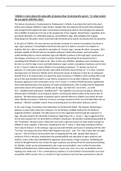
‘Othello is more about the absurdity of jealous than its destructive power.’ To what extent
do you agree with this view?
The theme of jealousy is fundamental to Shakespeare’s Othello. It provides the fuel for the play’s
action and catalyses Othello’s tragic demise. Despite this, the jealousy felt by both the protagonist
and antagonist throughout the play is presented as being quite absurd, thus bringing into question
the credibility of jealousy in its role as the perpetrator of the tragedy. Nevertheless, regardless of its
perceived absurdity, it is ultimately jealousy, personified by Iago, that instigates the tragedy,
illustrating how the play is more concerned with the destructive power of jealousy than its absurdity.
In the plot of Othello, the most devious and perfect example of a human incarnation of jealousy is
Iago. Iago’s jealousy is remarkably treacherous because he is able to conceal it to a degree so
faultless that he is able to uphold his reputation of “honest, Iago” among the other characters. He is
perhaps capable of this because he recognises jealousy’s destructive power. Such perceptive
understanding places a chasm between Iago and Othello’s jealousy as through Iago’s awareness of
the dangers of jealousy, he is able to protect himself from becoming all-encompassed by it-
something that Othello isn’t able to do. Thus, in this way, Othello’s spiralling sense of jealousy may
be seen as a foil for Iago’s more controlled jealousy. Iago’s astute conception of jealousy can be seen
in Act 3, Scene 3 when he warns Othello of succumbing to jealousy: “O, beware my lord, of
jealousy: /It is the green-eyed monster which doth mock/The meat it feeds on”. It is clear, however,
that Iago does not forewarn Othello of the destructive power of jealousy so that he can safeguard
himself from it; he instead does it to plant the seed of jealousy in Othello’s mind, trusting that it will
prey on him and manifest itself in a way that is conducive to his evil plot. Evidence of the latter
becomes apparent in the consecutive scene- Act 4, Scene 1- in which Othello becomes significantly
more distressed because of his jealousy of Cassio and Desdemona. This is evident by the disjointed
and frantic nature of his speech. Othello says to Iago, “Lie with her? Lie on her?...Lie with
her!...Handkerchief-confessions- handkerchief!”- the repetition and caesura serving to reflect the
deterioration of Othello’s once-eloquent speech, mirroring the deterioration of his psyche due to
jealousy. The destructive power of jealousy and its harmful effects on Othello can further be seen
when Othello proceeds to “[fall into a trance]” and Iago announces that “my lord hath fallen into an
epilepsy”. Othello’s epileptic seizure hence presenting just how destructive jealousy can be.
In the case of Iago, his jealousy and motivation are intrinsically linked. The impetus behind Iago’s
jealousy is never fully made clear, however, for he discloses multiple motives for his desire to
engender Othello’s downfall. The latter gives rise to the argument that through the character of
Iago, the play explores the absurdity of jealousy. Beginning in Act 1, Scene 1, Iago is aggrieved that
he has been passed over for promotion to Othello’s lieutenant, the position instead being granted to
the “Florentine” Michael Cassio. Whilst this may seem a genuine reason to want to get revenge on
Othello in some capacity, it becomes complicated in Act 2, Scene 1, when Iago introduces further,
more absurd motives. In his soliloquy, Iago accuses both Othello and Cassio of sleeping with his wife:
“For that I do suspect the lusty Moor/Hath leaped in my seat” , and, “For I fear Cassio with my night-
cap too”. The fact that he accuses both men of sleeping with his wife, despite their being no
evidence of this in the play, exacerbates the questionability and absurdity of Iago’s jealousy and
motives. Some critics have identified the apparent sexual nature of Iago’s jealousy, facilitating the
school of thought that the true reason for Iago’s jealousy was derived from his homosexual feelings
for Othello, which can be substantiated by the crude and animalistic way in which he describes
Othello and Desdemona’s heterosexual intimacy (“even now, now, very now, an old black ram/Is
tupping your white ewe”). For a contemporary audience, in a time before homosexuality was more
acceptable within society, this as a motive for Iago’s jealousy may have been perceived as absurd.
do you agree with this view?
The theme of jealousy is fundamental to Shakespeare’s Othello. It provides the fuel for the play’s
action and catalyses Othello’s tragic demise. Despite this, the jealousy felt by both the protagonist
and antagonist throughout the play is presented as being quite absurd, thus bringing into question
the credibility of jealousy in its role as the perpetrator of the tragedy. Nevertheless, regardless of its
perceived absurdity, it is ultimately jealousy, personified by Iago, that instigates the tragedy,
illustrating how the play is more concerned with the destructive power of jealousy than its absurdity.
In the plot of Othello, the most devious and perfect example of a human incarnation of jealousy is
Iago. Iago’s jealousy is remarkably treacherous because he is able to conceal it to a degree so
faultless that he is able to uphold his reputation of “honest, Iago” among the other characters. He is
perhaps capable of this because he recognises jealousy’s destructive power. Such perceptive
understanding places a chasm between Iago and Othello’s jealousy as through Iago’s awareness of
the dangers of jealousy, he is able to protect himself from becoming all-encompassed by it-
something that Othello isn’t able to do. Thus, in this way, Othello’s spiralling sense of jealousy may
be seen as a foil for Iago’s more controlled jealousy. Iago’s astute conception of jealousy can be seen
in Act 3, Scene 3 when he warns Othello of succumbing to jealousy: “O, beware my lord, of
jealousy: /It is the green-eyed monster which doth mock/The meat it feeds on”. It is clear, however,
that Iago does not forewarn Othello of the destructive power of jealousy so that he can safeguard
himself from it; he instead does it to plant the seed of jealousy in Othello’s mind, trusting that it will
prey on him and manifest itself in a way that is conducive to his evil plot. Evidence of the latter
becomes apparent in the consecutive scene- Act 4, Scene 1- in which Othello becomes significantly
more distressed because of his jealousy of Cassio and Desdemona. This is evident by the disjointed
and frantic nature of his speech. Othello says to Iago, “Lie with her? Lie on her?...Lie with
her!...Handkerchief-confessions- handkerchief!”- the repetition and caesura serving to reflect the
deterioration of Othello’s once-eloquent speech, mirroring the deterioration of his psyche due to
jealousy. The destructive power of jealousy and its harmful effects on Othello can further be seen
when Othello proceeds to “[fall into a trance]” and Iago announces that “my lord hath fallen into an
epilepsy”. Othello’s epileptic seizure hence presenting just how destructive jealousy can be.
In the case of Iago, his jealousy and motivation are intrinsically linked. The impetus behind Iago’s
jealousy is never fully made clear, however, for he discloses multiple motives for his desire to
engender Othello’s downfall. The latter gives rise to the argument that through the character of
Iago, the play explores the absurdity of jealousy. Beginning in Act 1, Scene 1, Iago is aggrieved that
he has been passed over for promotion to Othello’s lieutenant, the position instead being granted to
the “Florentine” Michael Cassio. Whilst this may seem a genuine reason to want to get revenge on
Othello in some capacity, it becomes complicated in Act 2, Scene 1, when Iago introduces further,
more absurd motives. In his soliloquy, Iago accuses both Othello and Cassio of sleeping with his wife:
“For that I do suspect the lusty Moor/Hath leaped in my seat” , and, “For I fear Cassio with my night-
cap too”. The fact that he accuses both men of sleeping with his wife, despite their being no
evidence of this in the play, exacerbates the questionability and absurdity of Iago’s jealousy and
motives. Some critics have identified the apparent sexual nature of Iago’s jealousy, facilitating the
school of thought that the true reason for Iago’s jealousy was derived from his homosexual feelings
for Othello, which can be substantiated by the crude and animalistic way in which he describes
Othello and Desdemona’s heterosexual intimacy (“even now, now, very now, an old black ram/Is
tupping your white ewe”). For a contemporary audience, in a time before homosexuality was more
acceptable within society, this as a motive for Iago’s jealousy may have been perceived as absurd.